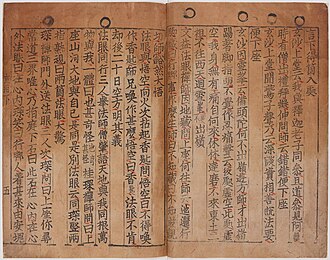
“In the art of printing, Korea stood at the frontier of human ingenuity — and Jikji is the proof that endures.”
In the long history of human communication, few inventions have shaped civilization as profoundly as the printed book. Most Westerners credit Johannes Gutenberg with revolutionizing printing through his movable metal type press in the 1450s. Yet deep in the archives of the Bibliothèque nationale de France in Paris rests a modest volume that silently overturns that assumption. The Jikji — formally known as Jikji Simche Yojeol — was printed in Korea in 1377 using movable metal type, making it the world’s oldest surviving book printed with that technology, predating Gutenberg’s Bible by a full 78 years.
For much of modern history, this extraordinary achievement was overlooked, its pages scattered and its story untold outside Korea. Today, Jikji is recognized by UNESCO as part of the Memory of the World Register, a testament to Goryeo Korea’s astonishing contribution to the history of printing and global intellectual heritage.
Quick Facts: Jikji at a Glance
| Full Title | Jikji Simche Yojeol (직지심체요절) |
|---|---|
| Date Printed | 1377 CE |
| Printing Method | Movable metal type |
| Dynasty | Goryeo (918–1392) |
| Location Printed | Heungdeok Temple, Cheongju, Korea |
| Subject | Buddhist teachings and Zen (Seon) doctrine |
| Current Location | Bibliothèque nationale de France, Paris |
| UNESCO Status | Memory of the World Register (2001) |
What Is Jikji, and Why Does It Matter?
The full title of the work translates roughly as Anthology of Great Buddhist Priests’ Zen Teachings. It is a compilation of the essential teachings of Buddhism, drawn from the recorded words and wisdom of revered Buddhist masters across centuries. The text was compiled by the Buddhist monk Baegun Hwasang (also known as Gyeonghan), who gathered the spiritual insights of eminent Seon (Zen) masters to create a guide for meditation and enlightened practice.
The work was originally printed in two volumes, though only the second volume survives today. This surviving volume consists of 38 pages — each one a fragile bridge across more than six centuries of history. Despite its modest appearance, the Jikji represents one of the most consequential technological achievements in the history of human knowledge.
What makes it extraordinary is not merely the content — though the Buddhist text itself is significant — but the method by which it was reproduced. The monks and craftsmen at Heungdeok Temple in Cheongju used individually cast metal characters arranged into pages, inked, and pressed onto paper. This is precisely the same fundamental principle that Gutenberg would employ in Europe nearly eight decades later, and it is the technology that would eventually transform literacy, science, religion, and politics across the entire world.
3 Reasons Why Jikji Changed History
1. It Predates Gutenberg’s Bible by 78 Years
Johannes Gutenberg completed his famous Latin Bible in approximately 1455. The Jikji was printed in 1377 — a full 78 years earlier. While Gutenberg’s achievement was independently conceived and had an enormous impact on European and world history, the existence of Jikji firmly establishes that movable metal type printing was first perfected on the Korean peninsula. Indeed, Korean records suggest that metal movable type was in use in Korea as early as the 13th century, during the reign of King Gojong of Goryeo, though Jikji is the oldest surviving printed example.
2. It Demonstrates the Sophistication of Goryeo Civilization
The Goryeo dynasty (918–1392) was a period of remarkable cultural and technological flourishing in Korea. Goryeo celadon ceramics — famous for their distinctive jade-green glaze — were among the most refined pottery in the world. Buddhist scholarship thrived, and the state invested in the reproduction and preservation of sacred texts. The development of metal movable type emerged from this environment of intellectual ambition and institutional support for learning. Printing an anthology of Buddhist wisdom was not merely a religious act; it was a statement of Goryeo’s civilizational confidence.
3. It Survived Against Extraordinary Odds
The fact that even a single volume of Jikji exists today is remarkable. The Goryeo dynasty fell in 1392, replaced by the Joseon dynasty, which shifted its official ideology from Buddhism to Confucianism. Countless Buddhist texts and artifacts were lost or destroyed during this transition and in the chaos of subsequent centuries. The Jikji’s survival — and its eventual journey to France — is a story of historical accident, colonial-era antiquarianism, and the long reach of cultural displacement.
“The Jikji is not simply Korea’s oldest printed book — it is humanity’s oldest surviving record of movable metal type printing, and a reminder that the story of knowledge belongs to the whole world.”
How Did Jikji End Up in Paris?
The journey of Jikji from a temple in Cheongju to a library in Paris is one of the more curious episodes in Korean cultural history. The volume came into the possession of Victor Collin de Plancy, a French diplomat who served in Korea in the late 19th century. De Plancy was an avid collector of Korean books and artifacts during his time on the peninsula, and he acquired Jikji along with many other items during this period.
After de Plancy returned to Europe, the book was eventually sold and made its way into the collection of the Bibliothèque nationale de France, where it remains to this day. For decades it sat largely unrecognized in the library’s stacks, its significance understood by very few outside Korea.
It was not until 1972 that the book gained international attention, when Korean bibliographer Park Byeongseon, who was working at the Bibliothèque nationale de France, identified the volume and publicized its significance. She presented it at a UNESCO international book exhibition in Paris that year, drawing global attention to the fact that this quiet, overlooked volume was, in fact, the world’s oldest surviving example of metal movable type printing. Park Byeongseon’s discovery was a watershed moment in Korean cultural heritage and in the global history of printing.
Jikji and Gutenberg: A Comparison
| Feature | Jikji (Korea, 1377) | Gutenberg Bible (Germany, c.1455) |
|---|---|---|
| Printing Technology | Movable metal type | Movable metal type |
| Date | 1377 CE | c. 1455 CE |
| Subject | Buddhist Zen teachings | The Latin Bible (Vulgate) |
| Survival | One volume (of two) survives | 49 copies survive (partial and complete) |
| Current Location | Bibliothèque nationale de France, Paris | Various institutions worldwide |
| UNESCO Recognition | Memory of the World Register (2001) | Memory of the World Register (2001) |
| Cultural Impact | Established Korea’s printing legacy | Transformed European literacy and religion |
UNESCO Recognition and the Fight for Korea’s Heritage
In 2001, UNESCO inscribed Jikji on its Memory of the World Register, an international program that recognizes documentary heritage of outstanding universal value. This inscription was a landmark moment for Korea’s cultural heritage on the world stage, confirming what Korean scholars had long asserted: that the Jikji is a document of global historical importance, not merely a national curiosity.
The recognition also reignited a long-standing diplomatic conversation between South Korea and France over the possible return of the volume. The Korean government and various cultural organizations have periodically requested that the Bibliothèque nationale de France return the Jikji to Korea, arguing that it is a foundational piece of Korean cultural identity that belongs on Korean soil. France has consistently declined to return it, citing French law regarding national museum collections. The debate mirrors similar international conversations about the repatriation of cultural artifacts — from the Elgin Marbles to Egyptian antiquities — and shows no sign of resolution in the near term.
In the meantime, Korea has worked to honor Jikji’s legacy at home. The city of Cheongju, where Heungdeok Temple once stood, has established the Cheongju Early Printing Museum, dedicated to the history of Korean printing and the legacy of Jikji. The city also hosts a biennial Cheongju International Craft Biennale that celebrates the artistic traditions of the region.
Why Jikji Still Resonates Today
In an age of digital information, it may seem strange to dwell on a 38-page fragment of a medieval Buddhist text. Yet Jikji resonates because it speaks to something fundamental about human civilization: the drive to record, preserve, and share knowledge. The craftsmen who cast the metal characters at Heungdeok Temple in 1377 were engaged in precisely the same project as the engineers who built the early internet — the democratization of information, the multiplication of ideas, the refusal to let wisdom die with any single person or institution.
Jikji also reminds us that the history of technology is rarely a single straight line running through one civilization. Innovation happens in many places, in response to many needs. The story of the printed book is not a European story, or a Korean story — it is a human story, and Jikji is one of its most important chapters.
Continue Exploring
- Jikji — Wikipedia: Full historical overview and references
- Encyclopedia of Korean Culture (AKS) — explore Goryeo-era printing traditions
- Jikji — Encyclopaedia Britannica
- UNESCO World Heritage — Korea’s recognized heritage sites and Memory of the World
- National Museum of Korea — collections related to Goryeo history and culture
- Visit Korea — Cheongju and the Early Printing Museum