“I still have twelve ships.” — Admiral Yi Sun-sin, reported before the Battle of Myeongnyang, 1597
On a narrow stretch of water off the southwest coast of Korea, one of the most remarkable naval battles in world history unfolded. On October 26, 1597 (by the lunar calendar), Admiral Yi Sun-sin led a force of just 13 Joseon warships against a Japanese fleet numbering in the hundreds. Against every conceivable odd, the Koreans won. The Battle of Myeongnyang did not merely save a dynasty — it altered the course of the Imjin War and secured Yi Sun-sin’s place among the greatest military commanders in history.
Quick Facts: The Battle of Myeongnyang
| Detail | Information |
|---|---|
| Date | October 26, 1597 (lunar calendar) |
| Location | Myeongnyang Strait, near Jindo Island, South Jeolla Province, Korea |
| Joseon commander | Admiral Yi Sun-sin |
| Joseon fleet size | 13 warships (panokseon) |
| Japanese fleet size | Estimated 133–330+ warships |
| Outcome | Decisive Joseon victory |
| Conflict | Imjin War (Japanese invasions of Korea, 1592–1598) |
| Significance | Halted Japanese naval advance; protected Joseon’s western sea lanes |
Background: The Imjin War and Yi Sun-sin’s Downfall
To understand why the Battle of Myeongnyang was so extraordinary, one must first understand the desperate circumstances that preceded it. Japan, then unified under the ambitions of Toyotomi Hideyoshi, launched a massive invasion of the Korean peninsula in 1592. The Joseon kingdom, caught largely unprepared on land, suffered devastating early defeats as Japanese forces swept northward toward Pyongyang.
At sea, however, the story was entirely different. Admiral Yi Sun-sin, commanding the Joseon Left Naval Command from his base in Yeosu, won a remarkable string of victories in the waters of the southern coast. Deploying innovative turtle ships (geobukseon) alongside conventional panokseon warships, he disrupted Japanese supply lines repeatedly, denying Hideyoshi’s armies the logistical support they needed to press deeper into the peninsula.
Then, in 1597, Yi Sun-sin became the victim of a Japanese deception operation. A false intelligence report, engineered by the Japanese, convinced the Joseon court that Yi was ignoring an opportunity to ambush an enemy fleet. Accused of insubordination and dereliction of duty, Yi was stripped of his command, arrested, tortured, and nearly executed. He was demoted to the rank of common infantry soldier — a catastrophic fall from grace.
His replacement, Admiral Won Gyun, led the Joseon fleet into a disastrous engagement at the Battle of Chilchonryang in August 1597. The fleet was virtually annihilated. Of the dozens of warships Yi had painstakingly built and trained, only 13 survived Won Gyun’s defeat. Won Gyun himself was killed. Faced with this catastrophe, the Joseon court had no choice but to reinstate Yi Sun-sin as commander of what remained of the navy. It was these 13 ships that Yi inherited — and with which he would fight the Battle of Myeongnyang.
Why Did Yi Sun-sin Choose the Myeongnyang Strait?
When Yi Sun-sin was restored to command in the late summer of 1597, advisors urged him to abandon the navy entirely and combine his forces with the army on land. Yi famously refused. His reply — that he still had ships, and that whoever controlled the sea would control the war — reflected a strategic clarity that proved correct.
Rather than flee or merge with land forces, Yi carefully selected the Myeongnyang Strait as his battlefield. The strait, located between the island of Jindo and the mainland near what is today Haenam in South Jeolla Province, was one of the most treacherous waterways on the Korean coast. Fierce tidal currents swept through the narrow channel, reversing direction roughly every six hours. The strait was so constrained that a large fleet could not deploy its numbers effectively — exactly the equalizer Yi needed.
By choosing this location, Yi transformed the Japanese numerical advantage from an overwhelming asset into a dangerous liability. In the confined waters of Myeongnyang, hundreds of Japanese ships could not maneuver freely. They would be forced to enter the channel in limited numbers, facing the full firepower of Yi’s smaller but disciplined force — while the tides themselves could become a weapon.
“He who seeks me out will find only death. He who does not seek battle will find that the sea itself is his enemy.” — Attributed to the strategic philosophy of Yi Sun-sin at Myeongnyang
The Battle: 13 Ships Against Hundreds
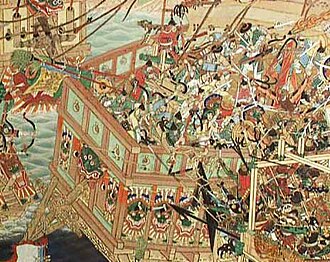
On the morning of October 26, 1597, the Japanese fleet appeared. Estimates of the Japanese force vary among historians and contemporary accounts, ranging from approximately 133 warships to over 300 vessels, with a large number of additional logistical and support craft. Against this armada, Yi positioned his 13 panokseon warships at the entrance to the Myeongnyang Strait.
The opening of the battle tested the resolve of Yi’s commanders and crews. Faced with the sight of hundreds of approaching enemy vessels, some of Yi’s subordinate ships reportedly held back, unwilling to advance. Yi himself is said to have moved his flagship forward alone, engaging the Japanese at close range to compel his captains to follow. Inspired — or perhaps shamed — by their admiral’s example, the other ships joined the fight.
The tidal current, which Yi had factored into his planning, became a decisive factor as the battle developed. Japanese ships crowding into the strait found themselves fighting both the Koreans and the powerful currents. As the tide reversed, ships that had been pressing forward were suddenly swept backward or thrown into disorder. Korean cannon fire raked the tightly packed Japanese vessels. A number of Japanese commanders were killed during the engagement, further disrupting their fleet’s coordination.
The battle ended as a stunning Joseon victory. Japanese sources and Korean accounts alike record significant Japanese losses, including warships sunk and commanders slain. The Joseon fleet, remarkably, lost no ships. Yi Sun-sin had achieved what seemed impossible — halting a vastly superior enemy fleet with a tiny force through a combination of superior tactical positioning, knowledge of local geography, and personal leadership.
3 Reasons the Battle of Myeongnyang Changed the War
- It severed Japan’s western supply lines. The Japanese strategy for the second invasion (the Chongyu War) depended on moving supplies and reinforcements up the western coast of Korea toward the Han River basin and the capital, Hanseong (Seoul). Yi’s victory at Myeongnyang denied them naval control of these crucial western sea lanes. Japanese armies operating inland would face persistent logistical difficulties as a result.
- It preserved the Joseon state’s capacity to resist. Had the Japanese fleet swept uncontested up the western coast following the destruction of the Joseon navy at Chilchonryang, Korea’s ability to organize resistance would have been severely compromised. The Battle of Myeongnyang bought time — time for Joseon and its Ming Chinese allies to stabilize their position.
- It cemented Yi Sun-sin’s legendary status. The victory at Myeongnyang with 13 ships transformed Yi Sun-sin from a brilliant but controversial admiral into a national hero of the first order. His reputation has endured for over four centuries; today he is widely regarded as one of Korea’s greatest historical figures and one of the most gifted naval tacticians in recorded history.
Yi Sun-sin: The Man Behind the Victory
Who was the man capable of achieving such a feat? Yi Sun-sin was born in 1545 in Hanseong (present-day Seoul) and pursued a military career after passing the military examination in 1576. His rise through the ranks was not without controversy — he was repeatedly passed over for promotion and twice court-martialed before the Imjin War began, the result of political enemies at court who resented his blunt refusal to compromise military decisions for political convenience.
When the Japanese invasion came in 1592, Yi’s organizational abilities and tactical genius became impossible to ignore. His series of naval victories in 1592 and 1593 — at Okpo, Sacheon, Dangpo, Hansando, and elsewhere — established a pattern: careful reconnaissance, disciplined gunnery, exploitation of terrain, and the avoidance of close-quarters combat in which Japanese boarding tactics were most dangerous.
Myeongnyang represented the fullest expression of this tactical philosophy under the most extreme conditions imaginable. Yi did not have enough ships to fight a conventional battle. He chose his ground instead, made the geography his ally, and demanded that his crews trust him absolutely. The result was a victory that has been studied by naval historians ever since.
Yi Sun-sin would not live to see the end of the war. He was killed in action at the Battle of Noryang in December 1598, the final major naval engagement of the Imjin War, reportedly saying as he lay dying that the battle was at its height and the news of his death should be suppressed until it was over.
The Myeongnyang Strait Today
The site of the battle remains accessible to visitors today. The Myeongnyang Strait, sometimes called Uldolmok, can be visited near Haenam and Jindo in South Jeolla Province. The powerful tidal currents that Yi exploited are still famously strong — the strait is one of the most dramatic tidal locations in Korea. A memorial and museum dedicated to Admiral Yi Sun-sin stand near the strait, honoring the memory of the battle and the admiral who won it.
A large statue of Yi Sun-sin stands in the center of Seoul at Gwanghwamun Square, facing south — toward the sea where he won his greatest victories. His image also appears on the Korean 100-won coin, a daily reminder of his enduring place in Korean national identity.