A day-by-day plan for the ancient capital of Silla: how to get there, what the tickets cost, where to stay, a walking route through the historic center, the temple and grotto on the mountain, and the thousand-year history under your feet.
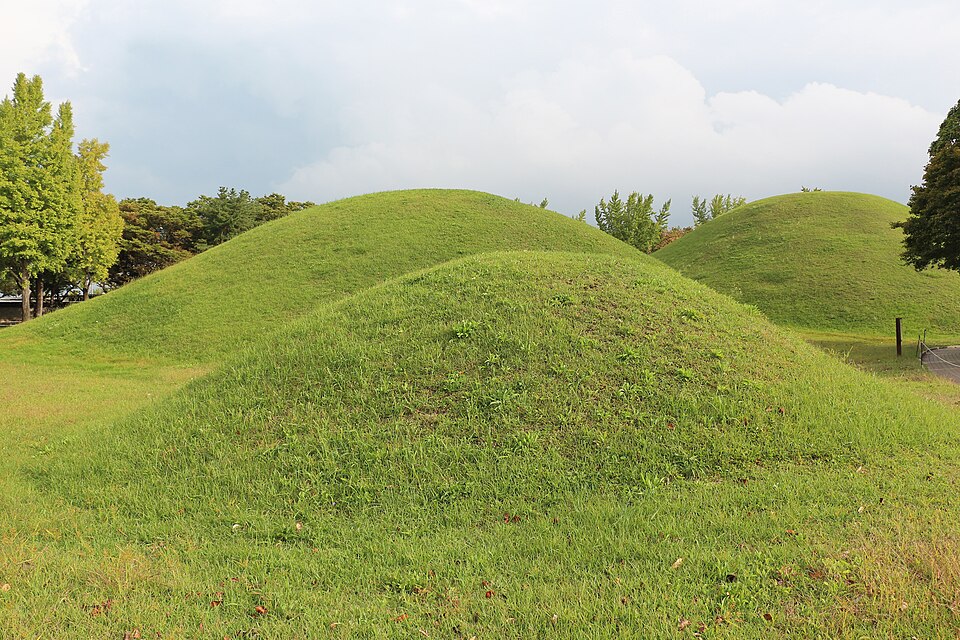
For almost a thousand years, from 57 BCE to 935 CE, one city was the capital of Silla, the kingdom that unified the Korean peninsula. Its palaces are gone, but its royal tombs rise as grassy hills in the middle of town, its stone observatory still stands in a field, its temples and carvings are scattered across the surrounding mountains, and a reconstructed royal garden is lit each night beside a pond that has held water since the seventh century. Gyeongju is often called a museum without walls, and the phrase is exact.
Two days is the right amount of time: enough to walk the historic center at a comfortable pace, see the museum, watch the pond light up at dusk, and give the following morning to Bulguksa and Seokguram on the mountain. This guide lays out that plan hour by hour, with the transport, tickets, and history that make it work.
Why Gyeongju Matters
Silla began as one of three rival kingdoms and ended by absorbing the others, and Gyeongju was its capital for the whole span. At its height in the eighth century the city held nearly a million people, its streets laid out on a grid, its roofs tiled rather than thatched, and its wealth expressed in gold crowns, stone pagodas, and the great bronze bell that still hangs in the National Museum. The kingdom’s adoption of Buddhism in the sixth century made the surrounding hills a landscape of temples, and Namsan, the mountain south of the city, is carved with more than a hundred Buddhist images.
Because no later dynasty made Gyeongju its capital, the ancient city was never built over. What remains is a rare thing: the fabric of a first-millennium royal capital, from tombs to observatory to garden, walkable in an afternoon. UNESCO recognized this in 2000 by inscribing the Gyeongju Historic Areas, five zones covering the city center, Namsan, and the tomb parks, in addition to the earlier listing of Bulguksa and Seokguram and the later one of Yangdong Village. Few cities in Asia offer as much history per kilometer.
Quick Facts
| Location | Gyeongju, Gyeongsangbuk-do, southeast Korea; about 2 hours from Seoul and 30 minutes from Busan by KTX |
|---|---|
| Getting There | KTX to Singyeongju Station, then bus or taxi 25–30 minutes to the center; express buses to Gyeongju Intercity Bus Terminal in the center |
| Admission | Cheomseongdae and the National Museum free; Daereungwon and Donggung & Wolji about 3,000 KRW each; Bulguksa and Seokguram free or reduced since 2023 |
| Getting Around | Historic center on foot or by bicycle; buses 10, 11, and 700-series to Bulguksa; taxis inexpensive; car useful for Yangdong and the coast |
| Best Time | Early April for cherry blossoms; late October–early November for foliage; evenings year-round for the illuminated pond |
| Website | https://www.gyeongju.go.kr |
Historical Background
Silla’s founding legend tells of a chief named Park Hyeokgeose hatched from an egg in 57 BCE, and its early centuries were spent as the weakest of Korea’s three kingdoms, squeezed between Goguryeo to the north and Baekje to the west. Its rise came in the sixth century under King Beopheung, who adopted Buddhism, and King Jinheung, who expanded the borders and organized the hwarang, the youth corps of aristocratic warriors whose ethos shaped the kingdom’s military culture. In alliance with Tang China, Silla defeated Baekje in 660 and Goguryeo in 668, then turned on its ally and expelled the Tang armies from the peninsula by 676, uniting most of Korea under one rule for the first time.
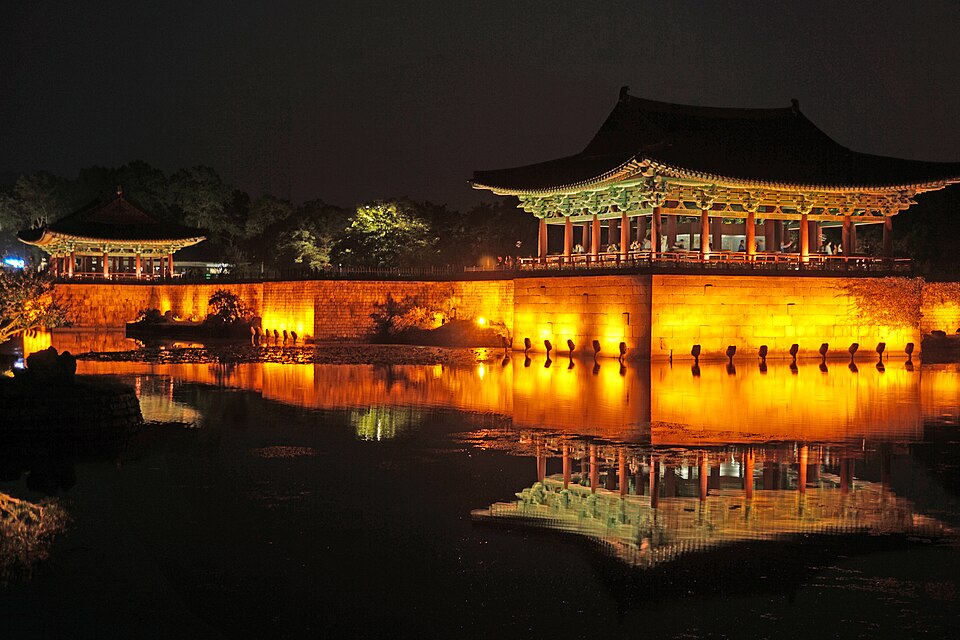
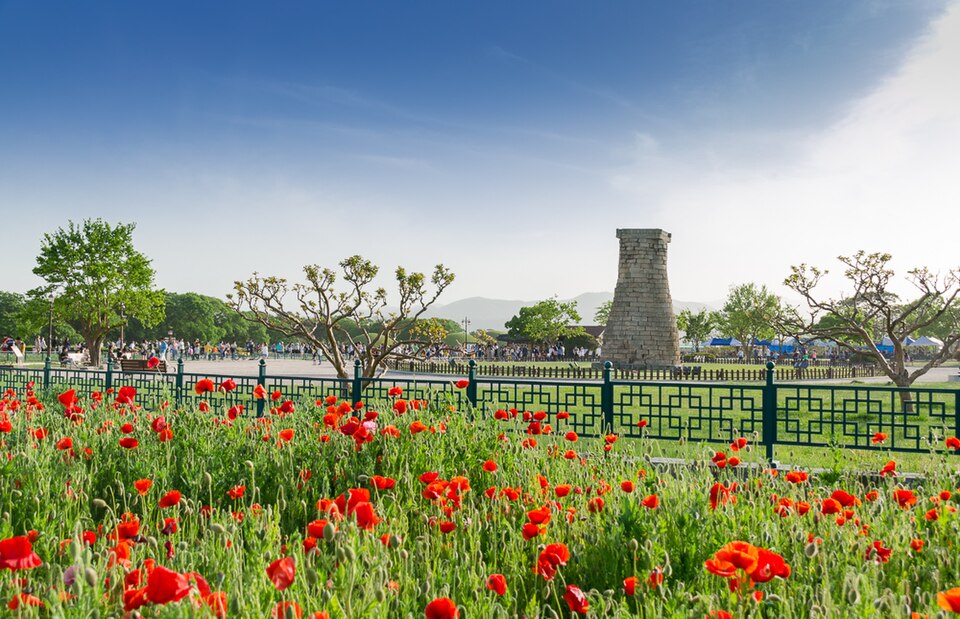
The next century was Gyeongju’s golden age. The tombs in the city center, huge earthen mounds over wooden chambers packed with gold crowns, belts, and jewelry, date mostly from the fifth and sixth centuries, before unification; the great Buddhist monuments, Bulguksa, Seokguram, and the bell of Bongdeoksa, belong to the eighth. Cheomseongdae, the bottle-shaped stone observatory, was built in the seventh century under Queen Seondeok, one of three women to rule Silla, and is the oldest surviving observatory in East Asia. Donggung, the crown prince’s palace, and its pond Wolji were built in 674 to celebrate unification.
Silla declined through the ninth century as aristocratic rivalries weakened the throne, and in 935 its last king surrendered to the rising Goryeo dynasty, which moved the capital north. Gyeongju became a provincial town, and its monuments slept in the fields until modern archaeology reawakened them. Coreaverse’s articles on Silla’s rise and on the Three Kingdoms tell the full story of the kingdom whose capital you are about to walk.
Silla: The Kingdom That United a Peninsula -> The Three Kingdoms of Korea ->
How to Visit
Getting There
The KTX from Seoul Station reaches Singyeongju Station in about two hours, with departures roughly hourly; from Busan the journey is about thirty minutes. Singyeongju lies west of the city, and buses 700, 50, 60, and 61 run to the historic center and the intercity terminal in twenty-five to thirty minutes, while a taxi takes about twenty. Express buses from Seoul’s terminals take around four hours and arrive at the Gyeongju terminal, within walking distance of the tomb parks; from Busan’s Nopo terminal buses take about an hour.
Getting Around
The historic center is compact and flat, ideal for walking or for the bicycles rented near the terminal and the tomb parks. Bulguksa is forty minutes east by bus 10 or 11, and Seokguram a further shuttle ride up the mountain. Yangdong Village, north of the city, is reached by bus 203 or 206 in about an hour, or thirty minutes by taxi. For the mountain sites and the coast, a rental car or a day tour is the efficient option, and several operators run English-language tours from Busan and Gyeongju that cover the highlights of this itinerary.
Where to Stay
Three areas suit different visitors. The historic center around Hwangnidan-gil and Gyochon has hanok guesthouses and small hotels within walking distance of everything on the first day; the Bomun Lake resort area east of town has large hotels, a lakeside path, and the cherry-blossom roads, but requires buses or taxis; and the area near the intercity terminal is convenient and inexpensive. Book well ahead for the cherry blossom season and autumn weekends.
Day 1: The Historic Center
09:30 – Daereungwon Tomb Park. Begin among the grassy mounds of the royal tomb park, where twenty-three tombs of Silla kings and nobles rise from a landscape of pines. Enter Cheonmachong, the Heavenly Horse Tomb, excavated in 1973 and now a walk-in display showing the wooden burial chamber, the gold crown, and the painted birch-bark saddle flap that gave the tomb its name. Allow an hour.
11:00 – Cheomseongdae and Gyerim. Walk south through the fields to the seventh-century observatory, nine meters of curved stone in an open meadow, and on into Gyerim, the “chicken forest” where legend places the birth of the Kim clan that ruled Silla. The ruined palace mound of Wolseong lies beyond, and the surrounding parkland is planted with flowers in season.
12:30 – Lunch in Gyochon Village. The hanok village beside Gyerim is the ancestral home of the Choi family, famous for twelve generations of wealth and charity, and the restaurants here serve Gyeongju’s specialties: ssambap, a spread of side dishes wrapped in leaves, and Gyeongju beopju, the family’s traditional liquor. Cross the reconstructed Woljeonggyo Bridge, a covered wooden bridge over the river, after eating.
14:30 – Gyeongju National Museum. A fifteen-minute walk east, and free, the museum holds the treasures of the tombs, the gold crowns above all, and, in its garden, the great bell of Bongdeoksa, cast in 771 and the largest surviving bell in Korea. Do not skip it; the objects here make sense of the mounds you walked through.
17:00 – Donggung and Wolji at dusk. Arrive at the royal garden as the light fades, walk the pond as the pavilions are illuminated, and watch their reflections settle on the water. This is Gyeongju’s signature sight, and it is best in the hour after sunset.
19:00 – Hwangnidan-gil. Finish in the street of renovated hanok that has become the city’s dining and café quarter, a few minutes from the tomb park.
Day 2: The Mountain and Beyond
07:30 – Bulguksa at opening. Take an early bus or taxi to the temple and walk its stone terraces, twin pagodas, and upper halls before the tour groups arrive. Coreaverse’s dedicated guide to Bulguksa and Seokguram covers the site in detail.
09:30 – Seokguram. Ride the shuttle up Tohamsan, walk the forest path, and view the granite Buddha through the glass screen; then walk the trail back down to Bulguksa if you have the legs for it.
12:00 – Lunch below the temple, then choose one of two afternoons.
Option A, 13:30 – Yangdong Village. Bus or taxi north to the UNESCO-listed clan village, where two aristocratic families have lived for five centuries among some 150 tiled and thatched houses set on wooded slopes. It is quieter and more authentic than any folk village, and needs two to three hours.
Option B, 13:30 – Namsan. Take a taxi to the Samneung tombs at the western foot of the mountain and walk the valley trail past a sequence of Buddhist carvings and headless statues to the ridge, about two to three hours round trip. Namsan is the open-air gallery of Silla Buddhism and rewards anyone willing to climb.
17:00 – Bomun Lake. End with a walk or bicycle ride along the lakeside path before dinner, or head straight to Singyeongju for an evening train.
Highlights Not to Miss
If you have only one day, keep Daereungwon, Cheomseongdae, the museum, and Donggung and Wolji from the first day, and Bulguksa from the second, leaving Seokguram for a return visit. If you have a third day, add the east coast: the Underwater Tomb of King Munmu, a rocky islet where the king who completed unification asked to be buried so he could become a dragon and guard the coast, and the Gameunsa temple site with its two towering stone pagodas.
Nearby Places & Experiences
Gyeongju combines naturally with Busan, thirty minutes away by KTX, for a southern circuit, and with Daegu and Haeinsa to the west. Within the city, the Bomun Lake area has the Gyeongju World amusement park, an expo park, and the cherry-blossom roads that draw crowds each April. Hanbok rental shops near Daereungwon let you walk the tomb park in costume, and evening tours of Donggung and Wolji with a guide are offered in season. The local sweet to take home is Gyeongju bread, a small pastry filled with red bean paste, sold at bakeries throughout the center.
Practical Tips
Wear walking shoes and expect to cover ten kilometers or more on the first day; a bicycle halves the effort. Summer is hot and humid, so start early and rest in the museum at midday. Most central sites accept cards, and the tourist information centers at Singyeongju Station and the terminal provide English maps and bus timetables. In cherry blossom season and on autumn weekends, book transport and rooms ahead and expect queues at Cheonmachong and the pond.
Frequently Asked Questions
How many days do you need?
Two: one for the historic center and the illuminated pond, one for Bulguksa, Seokguram, and Yangdong or Namsan. One long day covers the highlights at a rush.
How do I get there from Seoul?
KTX to Singyeongju in about two hours, then a twenty-five-minute bus or taxi to the center; express buses take around four hours.
Is Gyeongju walkable?
The historic center is; the mountain sites and Yangdong need buses, taxis, or a car.
What are the entrance fees?
Most central sites are free or about 3,000 KRW; Cheomseongdae and the museum are free.
When is the best time to visit?
Early April for cherry blossoms and late October to early November for foliage; weekdays are far calmer than weekends.
Continue Exploring
Silla: The Kingdom That United a Peninsula -> The Three Kingdoms of Korea -> Korean Buddhism Explained ->
- 08-gyeongju-donggung-wolji.jpg — Heera7 / CC BY-SA 4.0 / Wikimedia Commons source
- 08-gyeongju-daereungwon.jpg — Bernard Gagnon / CC0 / Wikimedia Commons source
- 08-gyeongju-cheomseongdae.jpg — Md Reyazul Islam / CC BY-SA 3.0 / Wikimedia Commons source
Disclosure: This article may contain affiliate links. Booking through them supports Coreaverse at no extra cost to you.