A practical guide to Jeju for travelers interested in history and culture: how to get around, what the UNESCO sites cost, where to watch the women divers, which folk village to choose, and the story of the island kingdom that ruled here before Korea did.
Eighty kilometers off the southern coast, Jeju is a volcano that rose from the sea two million years ago and a culture that developed apart from the mainland for most of recorded history. It had its own kingdom, Tamna, with its own founding myth; its own language, still spoken by the old; its own gods, several hundred of them; and its own economy, built on the women who dived for shellfish in the cold water while the men fished and farmed. The stone grandfathers who guard every gate, the black lava walls around every field, and the low thatched houses tied down against the wind are all answers to the same volcanic island.
Most visitors come for beaches and cafés. This guide is for those who come for the island itself: its UNESCO-listed volcanic landscapes, the haenyeo divers whose culture UNESCO also recognized, the folk villages where the old house forms survive, and the sites in Jeju City where Tamna’s story begins. It covers transport, tickets, and a three-day route.
Why Jeju’s Heritage Matters
Jeju is the only place in Korea where nature and culture carry parallel UNESCO listings. The volcanic island and its lava tubes were inscribed as a World Heritage site in 2007 for the quality and accessibility of their geology: a shield volcano rising to nearly two thousand meters, a tuff cone standing in the sea, and a system of lava caves whose colored formations are among the finest in the world. Nine years later the culture of the haenyeo, the island’s women divers, was added to the list of Intangible Cultural Heritage for the community, the knowledge, and the songs that surround a practice in which women in their seventies still free-dive to ten meters without breathing equipment.
Between those two listings lies everything that makes Jeju distinct. The island’s isolation preserved a shamanic religion, a language, and a material culture that the mainland lost, and its people’s relationship to a hard landscape, stone, wind, and sea, produced the walls, houses, and guardians that visitors photograph without knowing what they are. Seeing the island through that lens turns a beach holiday into something closer to a journey to a different country inside Korea.
Quick Facts
| Getting There | Flights from Gimpo (about 1 hour) and other mainland airports; ferries from Wando and Mokpo (2–5 hours) |
|---|---|
| Getting Around | Rental car strongly recommended; buses 101/201 circle the coast from Jeju City to Seongsan and Seogwipo; day tours cover the main sites |
| Key Sites & Fees | Seongsan Ilchulbong about 5,000 KRW; Manjanggul about 4,000 KRW; Seongeup Folk Village free; Samseonghyeol and Mokgwana small fees; Hallasan free with trail reservation |
| Haenyeo Demonstration | Cove below Seongsan Ilchulbong, most afternoons, weather permitting |
| Best Time | April–June and September–November; avoid the summer monsoon and typhoon season for the coast; February for the Seongsan sunrise festival |
| Website | https://www.visitjeju.net |
Historical Background
Jeju’s own account of its origin is told at Samseonghyeol, three holes in the ground in the middle of Jeju City. From them, the story goes, three demigods emerged, hunted the island’s game, and married three princesses who arrived by boat from a distant kingdom with seeds and livestock. Their descendants founded Tamna, the “island country,” and the three clans they established, the Go, Yang, and Bu, remain the island’s oldest families. Tamna appears in Korean and Chinese records from the fifth century as an independent kingdom trading with Baekje, Silla, and Japan, and it kept its own rulers, as a tributary, until the Goryeo dynasty absorbed it in 1105 and finally abolished its royal line in the fifteenth century under Joseon.
Under Joseon, Jeju became a place of exile for disgraced officials, some of whom, like the calligrapher Kim Jeong-hui in the 1840s, produced their finest work here, and a source of horses, tangerines, and abalone for the court. The Jeju Mokgwana, the reconstructed government office in Jeju City, was the seat of the magistrates who ruled the island for five hundred years. The islanders, meanwhile, held to their own ways: a pantheon of village gods served by shamans, a dialect that mainlanders could not follow, and an economy in which the women’s diving provided much of the household income, giving Jeju women an independence unusual in Confucian Korea.
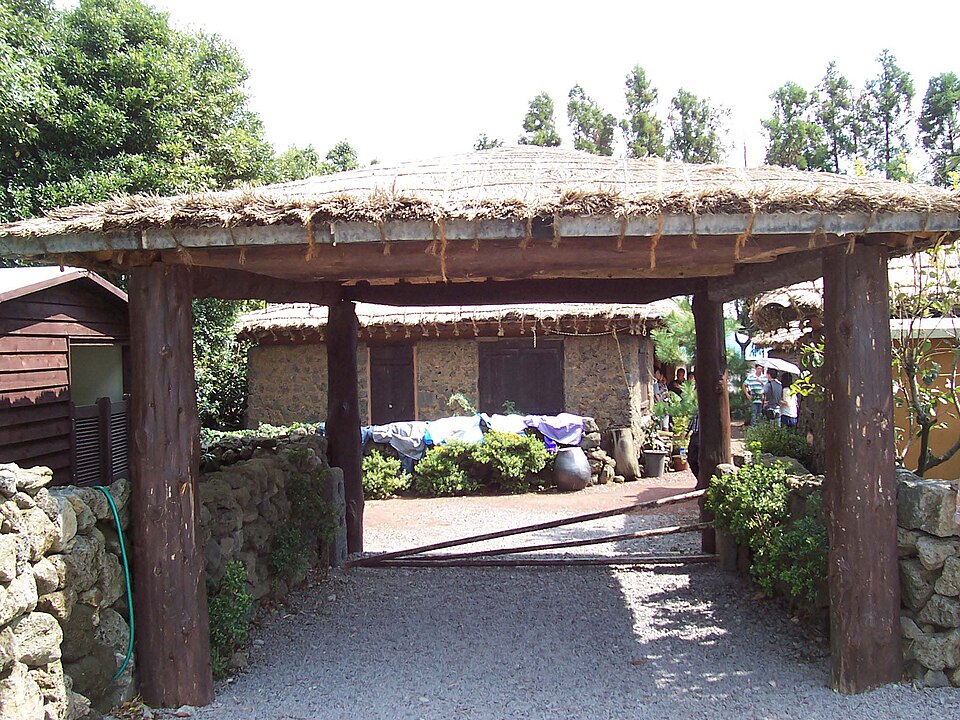
The island’s material culture answered its geology. Volcanic rock, everywhere and impossible to farm around, was stacked into the black walls that divide the fields, the walls around the houses, and the tombs on the hillsides; the dol hareubang, the “stone grandfathers” with their bulging eyes and folded hands, were carved from it to guard the gates of the three Joseon-era towns. Houses were built low, walled with stone, and roofed with thatch lashed down by a net of ropes against the wind. Coreaverse’s article on Korea’s historic heritage places Jeju’s within the wider national story.
Korea’s Historic Heritage: A Place Through Time -> Korea’s Heritage Sites: A Cultural Journey ->
How to Visit
Getting There and Around
Jeju is an hour’s flight from Seoul’s Gimpo Airport on one of the busiest air routes in the world, with departures every few minutes; flights also run from most mainland cities, and ferries sail from Wando, Mokpo, and other southern ports for those bringing a car. On the island, a rental car is the practical choice for a heritage itinerary, since the sites ring the coast and dot the interior; international visitors need an international driving permit. Without a car, the 101 and 201 buses run from Jeju City around the east coast to Seongsan and on to Seogwipo, and other routes cover the interior, but connections are slow. Hop-on tour buses and day tours from Jeju City bundle the main sites, and taxis can be hired by the day.
Tickets and Reservations
The volcanic sites charge modest fees: a few thousand won each for Seongsan Ilchulbong and Manjanggul, with children discounted. Seongeup Folk Village is free, as is walking the coast. Hallasan is free but its two summit trails, Seongpanak and Gwaneumsa, require an online reservation with a QR code, made through the national park’s system, and the daily quotas fill up in autumn. The haenyeo demonstration at Seongsan is free to watch from the shore. Sites open from early morning; Seongsan Ilchulbong opens before dawn for the sunrise, and Manjanggul closes in the late afternoon.
The Heritage Sites
The Haenyeo
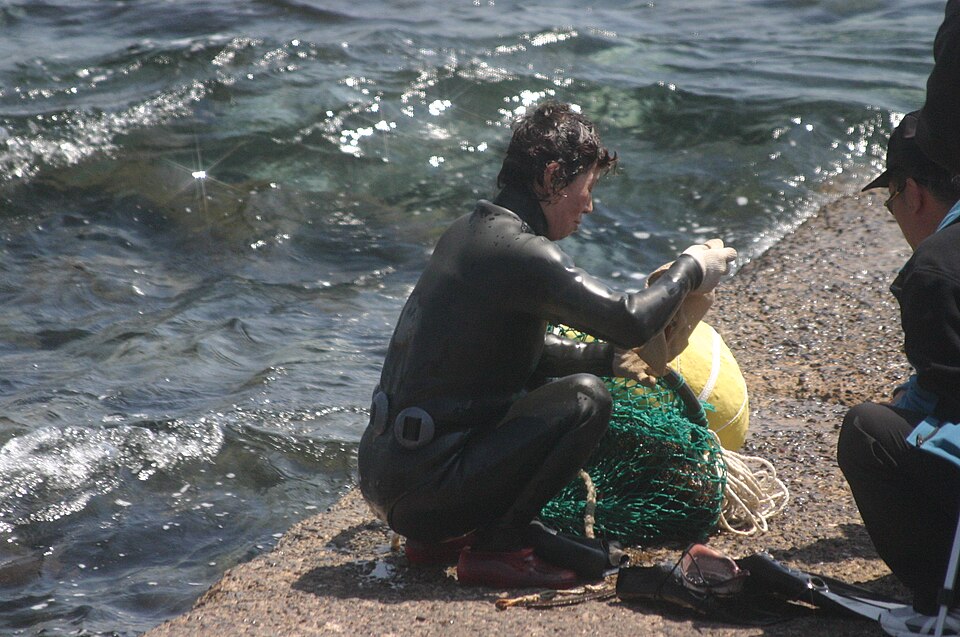
The women divers of Jeju free-dive for abalone, sea urchin, conch, and seaweed, holding their breath for a minute or more, and their whistling exhalation as they surface, the sumbisori, is one of the island’s sounds. Their numbers have fallen from tens of thousands to a few thousand, most now elderly, and the tradition is passing. To see them, go to the cove below Seongsan Ilchulbong, where a group gives a demonstration most afternoons and sells the catch, or walk the northeast coast between Gimnyeong and Hado in the morning, where working divers are often in the water. The Haenyeo Museum at Hado, with its displays, film, and reconstructed diver’s house, explains the culture, the gear, and the songs, and a haenyeo school nearby occasionally opens to visitors. Restaurants run by haenyeo cooperatives along the coast serve the catch raw or in soup.
Seongsan Ilchulbong
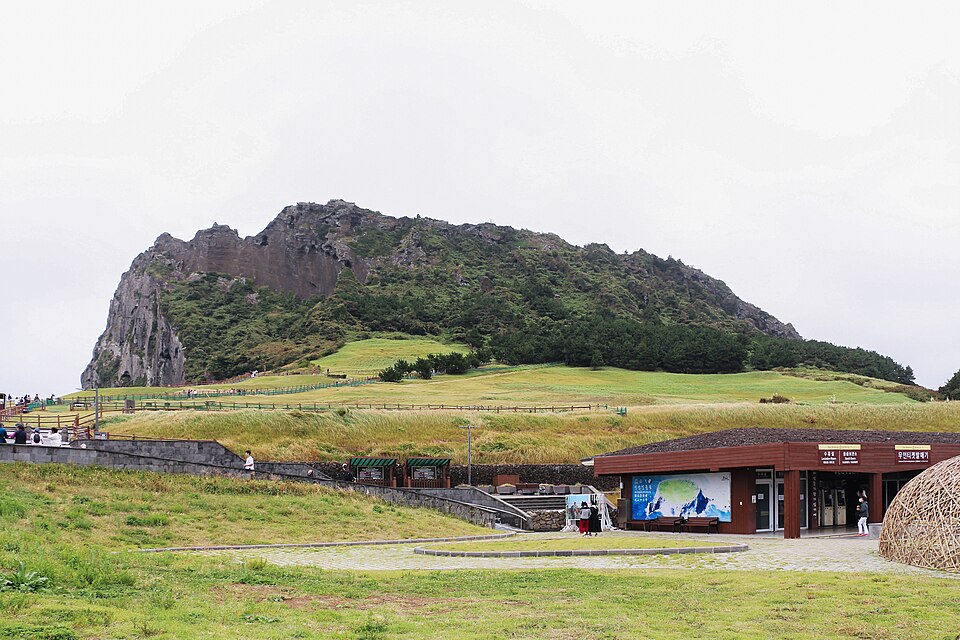
The “sunrise peak” is a tuff cone that rose from the sea in a shallow eruption some five thousand years ago, a crater ringed by jagged rock walls standing on the island’s eastern tip. A stepped path climbs to the rim in about twenty-five minutes for a view into the grassy crater and along the coast; the sunrise from the top is Jeju’s classic experience and draws crowds on New Year’s Day. Allow an hour, and combine it with the haenyeo cove below.
Manjanggul Lava Tube
Part of the Geomunoreum system, Manjanggul is a lava tunnel more than seven kilometers long, of which a one-kilometer section is open to walkers: a cool, dark passage with lava stalactites, flow lines on the walls, a “lava turtle” resembling the island, and, at the end, a lava column nearly eight meters high. Bring a layer; it is cold year-round. The Jeju World Natural Heritage Center nearby explains the volcanic system.
Seongeup Folk Village
Of Jeju’s several folk villages, Seongeup is the genuine one: a former county seat in the eastern interior where people still live among the stone walls, thatched houses, and shrines, with the old magistrate’s office, Confucian school, and thousand-year-old zelkova and hackberry trees at its center. Villagers lead informal tours explaining the houses, the pig-sty latrines, and the dol hareubang, and it is free. The Jeju Folk Village near Pyoseon, by contrast, is a reconstructed museum village used as a drama set, well done and ticketed.
Stone Culture
Jeju Stone Park, in the interior northeast of the city, is a landscape museum devoted to the island’s volcanic stone and the myth of the giant goddess Seolmundae who created it, with galleries, a lake, and hundreds of stone figures set in the woods; allow two hours. The original dol hareubang, forty-five surviving from the eighteenth century, stand at the Jeju Mokgwana, the university museum, and other sites in the city. Around the island, look for the stone tombs in the fields, each ringed by its own low wall, and the batdam, the field walls that run for tens of thousands of kilometers across the island and are themselves a heritage landscape.
Jeju City’s Historic Center
Samseonghyeol, the three holes of the founding myth, sit in a grove of old trees with a shrine and a small museum. A short walk away, the reconstructed Jeju Mokgwana shows the Joseon government office and the gate Gwandeokjeong, the oldest building on the island, built in 1448. The Jeju National Museum covers Tamna and the island’s history, and Dongmun Market nearby is the place for tangerines, black pork, and the island’s distinctive food.
Recommended 3-Day Itinerary
- Day 1 – The East. Drive or bus from Jeju City to Manjanggul and the World Natural Heritage Center in the morning; lunch at a haenyeo restaurant on the Gujwa coast; the Haenyeo Museum at Hado; Seongsan Ilchulbong in the late afternoon with the diving demonstration below; stay at Seongsan for the sunrise climb next morning.
- Day 2 – The Interior. Sunrise on Ilchulbong, then inland to Seongeup Folk Village for a villager-led walk; Jeju Stone Park in the afternoon; return to Jeju City for Dongmun Market and black pork.
- Day 3 – The City and the Mountain. Samseonghyeol, the Mokgwana, and the National Museum in the morning; in the afternoon, either the easy Eorimok trail on Hallasan’s flank or, with a reservation and an early start, the full Seongpanak summit hike instead of the city sites.
With a fourth day, add the southern coast: the columnar basalt of Jusangjeolli, the Jeongbang waterfall that drops straight into the sea, and Seogwipo’s Olle trails through tangerine groves.
Nearby Places & Experiences
Hallasan, the volcano at the island’s center and Korea’s highest mountain, is a full-day hike to the crater lake at 1,947 meters, with easier trails on its lower slopes. Udo, the small island off Seongsan, is reached by a short ferry and circled by bicycle in an afternoon, with its own haenyeo and beaches. The Olle trails, a network of walking routes around the island’s coast, pass through fishing villages, tangerine orchards, and shrines, and any section makes a good half day. Jeju’s food is part of its heritage: black pork barbecue, abalone porridge, sea urchin soup, and the tangerines that were once a royal tribute.
Practical Tips
Jeju’s weather is changeable and windy; bring rain gear and a layer even in summer, and check conditions before Hallasan or the Ilchulbong sunrise. Book cars and Hallasan trail slots well ahead for spring and autumn. Most sites accept cards, but the haenyeo stalls and village vendors prefer cash. Respect the divers: photograph from a distance, do not enter their working areas, and buy from them if you want to support the tradition. Drive carefully on the coastal roads, which are shared with cyclists and Olle walkers.
Frequently Asked Questions
Where can I see the haenyeo?
The cove below Seongsan Ilchulbong hosts a demonstration most afternoons; working divers are common on the northeast coast; the Haenyeo Museum at Hado explains the culture.
Do I need a car?
It makes the island far easier. Otherwise, coastal buses 101 and 201, tour buses, and day tours cover the main sites.
What are Jeju’s UNESCO sites?
Jeju Volcanic Island and Lava Tubes (2007): Hallasan, Seongsan Ilchulbong, and the Geomunoreum lava tubes including Manjanggul; and the haenyeo culture (2016).
How much do the sites cost?
Seongsan Ilchulbong and Manjanggul a few thousand won each; Seongeup free; city sites small fees; Hallasan free with a trail reservation.
How many days do I need?
Three for the volcanic east, the interior villages and stone culture, and the city’s historic center; four with a Hallasan hike or the south coast.
Continue Exploring
Korea’s Historic Heritage: A Place Through Time -> Korea’s Heritage Sites: A Cultural Journey -> The Three Kingdoms of Korea ->
- 15-jeju-seongsan-ilchulbong.jpg — Bernard Gagnon / CC0 / Wikimedia Commons source
- 15-jeju-haenyeo.jpg — karendotcom127 / CC BY 2.0 / Wikimedia Commons source
- 15-jeju-seongeup-village.jpg — 螺钉 / CC BY-SA 3.0 / Wikimedia Commons source
Disclosure: This article may contain affiliate links. Booking through them supports Coreaverse at no extra cost to you.