Gyeongbokgung Palace Visit Guide: Tickets, Hours, Guard Ceremony & the History Behind Seoul’s Grandest Palace
Everything you need to plan a visit to the main royal palace of the Joseon dynasty, from the best time to arrive for the Royal Guard Changing Ceremony to why every gate and hall was named the way it was.
Stand at the foot of Gwanghwamun Gate on a clear morning and the view tells you almost everything about why this palace was built here. Straight ahead, a broad axis of stone courtyards runs north toward the throne hall. Behind it, the granite ridge of Bugaksan rises like a backdrop painted for the occasion. To the south, a modern avenue leads to the heart of downtown Seoul. For more than six centuries this spot has been the symbolic center of Korea, and it remains the single most-visited historic site in the country.
This guide is written for first-time visitors who want both the practical details and the story. You will find opening hours, ticket prices, the free hanbok rule, subway directions, a half-day itinerary, and a short history of the palace, with buttons linking to Coreaverse’s deeper articles wherever you want to read more.
Why Gyeongbokgung Matters
Gyeongbokgung is the largest and oldest of Seoul’s five royal palaces and the one the Joseon dynasty built first, completed in 1395 only three years after the dynasty was founded. Its name, chosen by the scholar-statesman Jeong Do-jeon from a verse in an ancient Chinese classic, means roughly “palace greatly blessed by heaven.” That choice was not decorative. The new rulers wanted a capital and a palace that announced, in stone and timber, that their kingdom was ordered by Confucian principle and favored by heaven itself.
For visitors, this means the palace is not a random collection of pretty buildings. It is a deliberate diagram of how a Joseon king was expected to rule: a public throne hall for ceremony, a smaller council hall for daily government, private residences for the king and queen, and a garden retreat at the back. Walk it from south to north and you move from the public face of the kingdom to its private heart. Add the two national museums inside the grounds and the guard ceremony at the gate, and Gyeongbokgung is the richest single-site introduction to Korean royal culture in the country.
Quick Facts
| Location | 161 Sajik-ro, Jongno-gu, Seoul (north end of Gwanghwamun Square) |
|---|---|
| Hours | Opens 09:00 daily except Tuesday; closes 17:00 (Nov–Feb), 18:00 (Mar–May, Sep–Oct), or 18:30 (Jun–Aug); last entry one hour before closing |
| Closed | Tuesdays (if Tuesday is a public holiday, the palace opens and closes the following non-holiday day instead) |
| Admission | Adults 3,000 KRW; groups of 10+ 2,400 KRW; free for hanbok wearers, children, seniors, and on Culture Day (last Wednesday of the month) |
| Combination Ticket | 10,000 KRW for one entry each to Gyeongbokgung, Changdeokgung (Secret Garden included), Changgyeonggung, Deoksugung, and Jongmyo Shrine within three months |
| Best Time | April–May (blossoms, mild weather) and October–early November (autumn foliage); weekday mornings are quietest |
| Website | https://royal.khs.go.kr/gbg |
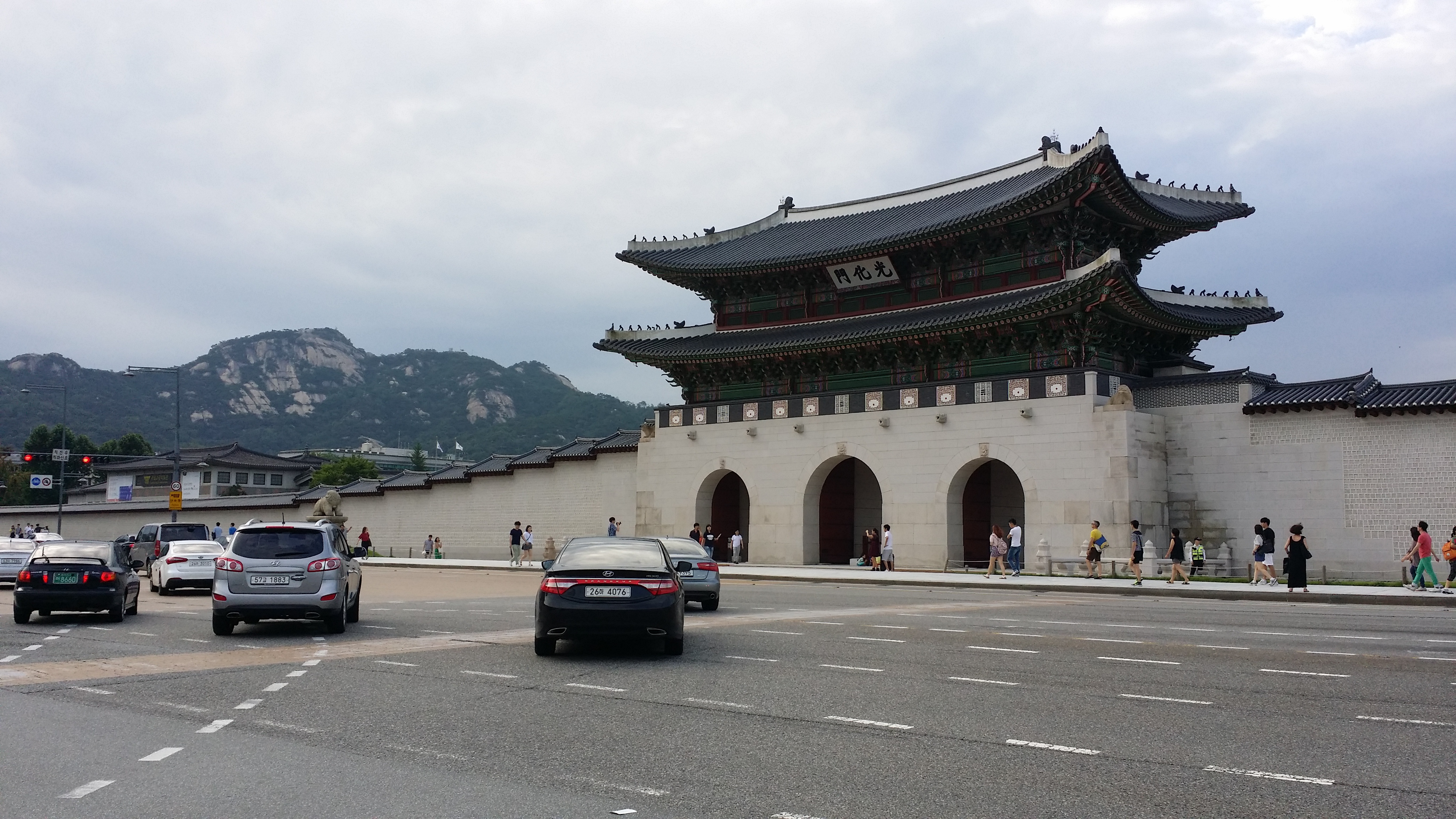
Gwanghwamun Gate with Bugaksan Mountain rising behind Gyeongbokgung Palace.
Historical Background
When General Yi Seong-gye overthrew the Goryeo dynasty in 1392 and took the throne as King Taejo, one of his first decisions was to leave the old capital behind. The site he chose, Hanyang, was selected according to pungsu, Korean geomancy: a basin ringed by four guardian mountains with a river to the south. Construction of a main palace began in 1394 and was finished, remarkably, the following year. Jeong Do-jeon laid out the complex on a north-south axis and named every major structure with a Confucian lesson built into the characters. Geunjeongjeon, the throne hall, means “the hall of diligent government.” Sajeongjeon, the council hall behind it, means “the hall of thinking about government.” The palace was, in effect, a moral instruction manual for the men who would rule from it.
For two hundred years Gyeongbokgung was the stage for royal coronations, state ceremonies, and daily administration. It was here that King Sejong gathered the scholars who created the Korean alphabet, Hangul, in the 1440s. Then, in 1592, the palace burned during a foreign invasion and was left in ruins for nearly three centuries while the court governed from Changdeokgung nearby. It was not until 1867, under the regent Heungseon Daewongun acting for the young King Gojong, that Gyeongbokgung was rebuilt on a grand scale with more than five hundred buildings.
The palace suffered heavy losses again in the early twentieth century, when most of those buildings were removed. A long restoration program launched in 1990 has been returning the complex to its late-Joseon form piece by piece, and the work is still ongoing. What you see today is therefore a mixture of original nineteenth-century structures, such as Geunjeongjeon and Gyeonghoeru, and careful modern reconstructions built with traditional techniques. You are walking through both a monument and an active restoration site.
How to Visit
Getting There
Gyeongbokgung sits at the top of Gwanghwamun Square, one of the most central points in Seoul, and it is easiest to reach by subway. Take Line 3 to Gyeongbokgung Station and follow the signs to Exit 5, which brings you up directly beside the palace’s west wall and the National Palace Museum. Alternatively, take Line 5 to Gwanghwamun Station, Exit 2, and walk north through the square for about ten minutes; this route is worth it for the approach view of Gwanghwamun Gate framed by the mountains. Anguk Station on Line 3 is also a short walk away and is convenient if you plan to combine the palace with Bukchon Hanok Village.
Admission & Hours
Tickets are sold at the booth just inside Gwanghwamun Gate, before the second gate, Heungnyemun. Standard adult admission is 3,000 KRW, with a discounted group rate and free entry for children, seniors, and anyone wearing hanbok. If you plan to see more than one palace during your trip, the combination ticket at 10,000 KRW covers Gyeongbokgung, Changdeokgung with its Secret Garden, Changgyeonggung, Deoksugung, and Jongmyo Shrine, and is valid for three months. The palace opens at 09:00 every day except Tuesday, and closing time shifts with the season, from 17:00 in winter to 18:30 in high summer. Last admission is one hour before closing.
Free guided tours in English start from the information center near Heungnyemun Gate several times a day and last about an hour; no reservation is needed. In spring and autumn the palace also runs a ticketed night-opening program with the main halls illuminated. Tickets for night tours are released online a few weeks in advance and sell out quickly, so check the official site if your dates fall in those seasons.
The Royal Guard Changing Ceremony
The single most popular moment of any visit is the Royal Guard Changing Ceremony at Gwanghwamun Gate. Reenacting the procedure used to rotate the palace guard during the Joseon period, it features guards in bright red, blue, and yellow uniforms, banners, drums, and traditional wind instruments. The ceremony is held twice a day, at 10:00 and 14:00, on every day the palace is open, and lasts around twenty minutes. It takes place outside the ticket gate, so you can watch it for free even without entering the palace, but arrive fifteen minutes early to secure a spot near the front, especially on weekends.
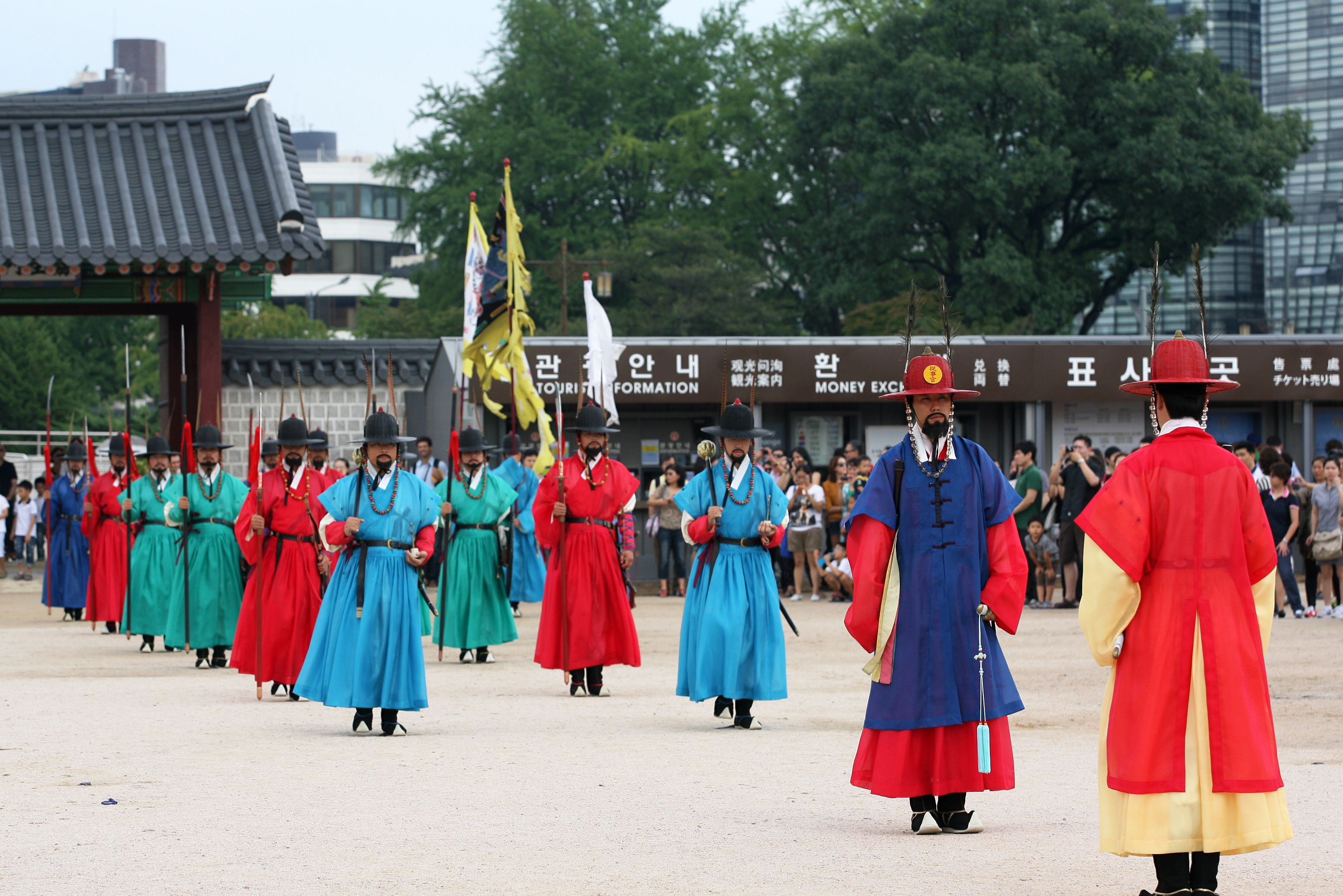
The Royal Guard Changing Ceremony at Gwanghwamun Gate.
Free Entry in Hanbok
One of the best-known perks of visiting Seoul’s palaces is that anyone wearing hanbok, the traditional Korean dress, is admitted free. This rule has turned the streets around Gyeongbokgung into a cluster of rental shops, most within a five-minute walk of Gyeongbokgung Station Exit 5 or Anguk Station. Rentals are priced by the hour, with two- to four-hour packages most common, and many shops include hair styling and accessories. Expect to leave a passport or ID as a deposit. Booking ahead saves time on busy days; walk-ins are normal outside peak season.
Beyond the free ticket, hanbok changes the experience of the palace itself. If you are curious about the garments, their colors, and what they once signified, Coreaverse has a dedicated article on the history of hanbok.
The Story of Hanbok →
What to See Inside: A Walking Route
Enter through Gwanghwamun and Heungnyemun, cross the small stone bridge Yeongjegyo, a ritual purification before entering the royal precinct, and pass Geunjeongmun to reach the great courtyard.
Geunjeongjeon Throne Hall. The granite courtyard is lined with rank markers that told officials where to stand, civil to the east and military to the west. The two-tiered hall is where kings were crowned and envoys received. Look for the zodiac animals carved on the balustrades, then step up to the doorway for the throne and the painted screen of sun, moon, and five peaks behind it.
Sajeongjeon Council Hall. Directly behind the throne hall is the smaller building where the king met his ministers for the daily business of government. The scale shift, from ceremonial vastness to a working office, is deliberate.
Gangnyeongjeon and Gyotaejeon. Continue north to the king’s and queen’s residences. Gyotaejeon, the queen’s quarters, backs onto Amisan, a small terraced garden with ornate brick chimneys that are among the most photographed details in the palace.
Gyeonghoeru Pavilion. West of the residences, a vast two-storey pavilion stands on 48 stone pillars in the middle of a rectangular pond. Built for state banquets, it is the palace’s most spectacular building and the classic photograph, especially in early morning light. Interior visits are offered on limited guided tours in warmer months.
Hyangwonjeong Pavilion. At the far north of the grounds, a small hexagonal pavilion sits on an island in a lotus pond, reached by a wooden bridge. Part of the royal family’s private nineteenth-century garden, it has the best mountain backdrop in the palace.
The two museums. The National Palace Museum of Korea, by the west entrance, displays royal seals, thrones, robes, and Sejong-era astronomical instruments; the National Folk Museum on the east side covers everyday life in traditional Korea. Both are free and ideal on a hot or rainy day.

Gyeonghoeru Pavilion reflected in its tranquil pond at Gyeongbokgung Palace.
Recommended Itinerary
Gyeongbokgung fills a morning on its own and sits in Seoul’s most walkable historic district. This half-day plan suits first-time visitors and stretches easily to a full day.
- 09:00 – Hanbok and arrival. Pick up your hanbok as shops open, walk to Gwanghwamun Gate, and watch the 10:00 guard ceremony from the front before entering.
- 10:30 – Palace core. Follow the south-to-north route above, detour west to Gyeonghoeru, and finish at Hyangwonjeong. Allow two hours.
- 12:30 – Lunch in Seochon or Samcheong-dong. Exit west for Seochon’s old alleys and small restaurants, or east for the cafés and galleries of Samcheong-dong.
- 14:00 – Museum or Bukchon. Return for the National Palace Museum, or walk fifteen minutes east to Bukchon Hanok Village for its hillside lanes of traditional houses.
- 16:00 – Gwanghwamun Square and Cheonggyecheon. Head south past the statues of King Sejong and Admiral Yi Sun-sin to the restored Cheonggyecheon stream for an easy evening walk.
If you are visiting during a night-opening season, consider reversing the plan: spend the afternoon in Bukchon and Insadong, then enter the palace after dark when the throne hall and Gyeonghoeru are lit.
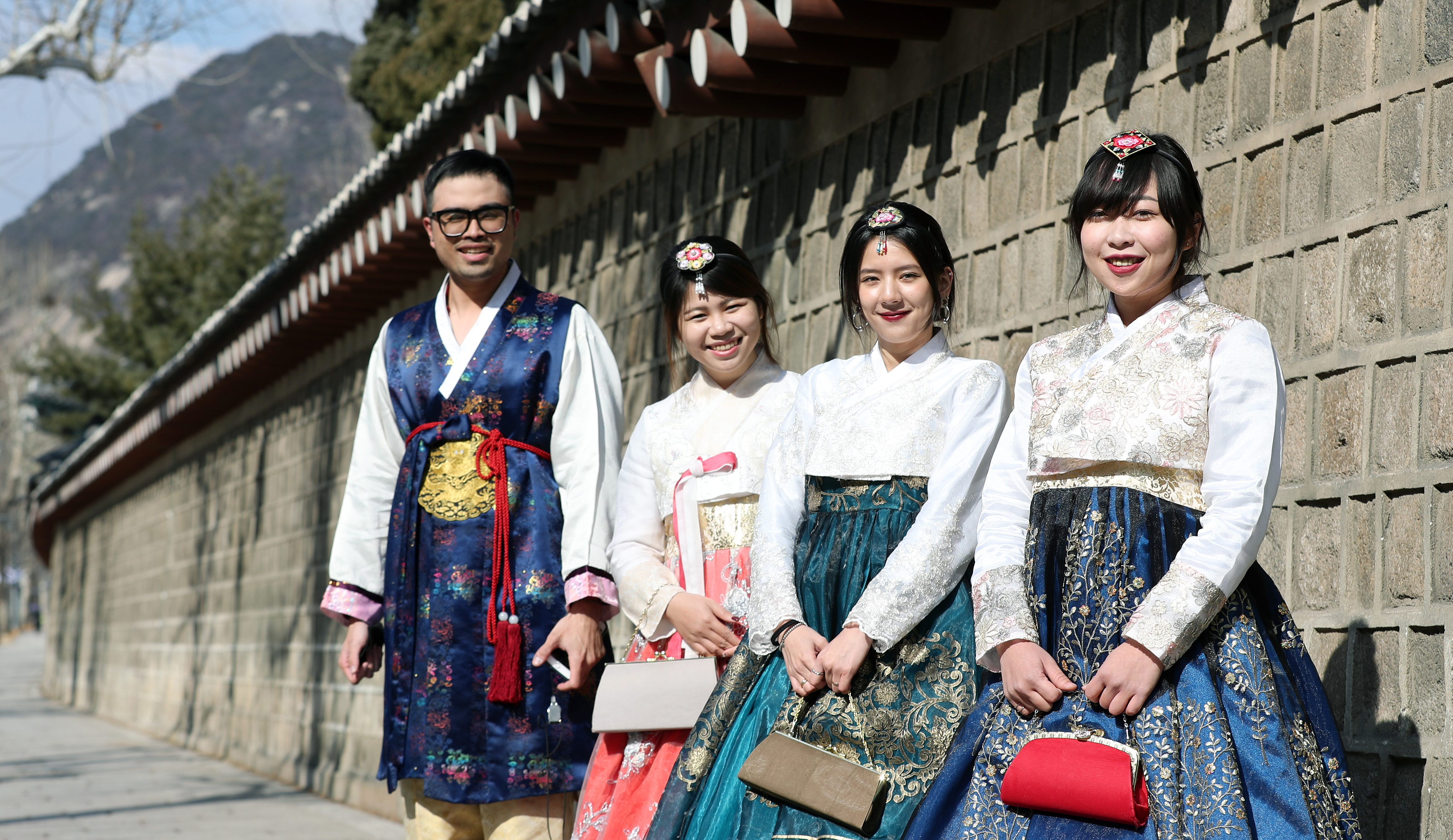
Visitors wearing traditional hanbok at Gyeongbokgung Palace.
Nearby Places & Experiences
The palace anchors a cluster of sights that can be combined without ever needing the subway. Changdeokgung Palace, a twenty-minute walk east, is the UNESCO-listed sister palace whose Secret Garden is one of Korea’s finest landscapes; its garden tours must be booked in advance. Bukchon Hanok Village lies between the two palaces and is the best place in Seoul to see traditional hanok houses still in residential use. Insadong, just south of Bukchon, is the traditional-crafts street for tea houses, calligraphy brushes, ceramics, and hanji paper. Gwanghwamun Square at the palace’s front door holds the monumental statues of King Sejong and Admiral Yi Sun-sin, with a small museum beneath the square. Jongmyo Shrine, the royal ancestral shrine of the Joseon kings and another UNESCO site, is a short bus ride or thirty-minute walk southeast and is included in the combination ticket.
Several operators run half-day walking tours combining Gyeongbokgung, Bukchon, and Insadong with an English-speaking guide; book ahead in spring and autumn.
Practical Tips
Wear comfortable shoes: the grounds are large, paved with uneven stone, and shadeless in places. Bring water in summer and a warm layer in winter. Restrooms and a small café are inside the grounds, signage includes English, and outdoor photography is allowed, though tripods and drones are restricted.
Frequently Asked Questions
How much does it cost to visit Gyeongbokgung Palace?
Adult admission is 3,000 KRW, with a group discount. Entry is free for hanbok wearers, young children, seniors, and everyone on Culture Day (last Wednesday of the month). A 10,000 KRW combination ticket covers the four main Seoul palaces and Jongmyo Shrine.
What day is Gyeongbokgung Palace closed?
Gyeongbokgung is normally closed on Tuesdays. When a public holiday falls on a Tuesday, the palace opens that day and closes on the following non-holiday weekday instead. Always check the official calendar for the exact date of your visit.
When is the Royal Guard Changing Ceremony?
The ceremony is held at Gwanghwamun Gate twice daily, at 10:00 and 14:00, on days the palace is open. It lasts about twenty minutes and can be watched free of charge from outside the ticket gate.
Is it true you can enter Gyeongbokgung for free in hanbok?
Yes. Visitors wearing hanbok are admitted free to Gyeongbokgung and the other Seoul royal palaces. Rental shops cluster around Gyeongbokgung and Anguk stations and typically charge by the hour, with two- to four-hour packages most common.
How long do you need at Gyeongbokgung Palace?
Allow two to three hours for the palace grounds. Adding the National Palace Museum, the National Folk Museum, and a hanbok rental makes a full half day, and combining the palace with Bukchon and Insadong fills a comfortable full day.
Continue Exploring
Gyeongbokgung: Heart of the Joseon Dynasty → The Architecture of Gyeongbokgung → Joseon Dynasty Explained →
Royal Guard Changing Ceremony — Jeon Han / Korea.net / Korean Culture and Information Service — CC BY-SA 2.0
Gyeonghoeru Pavilion — Hhk1201 / Wikimedia Commons — CC BY-SA 4.0
Hanbok at Gyeongbokgung Palace — Jeon Han / Korea.net / Korean Culture and Information Service / Wikimedia Commons — CC BY-SA 2.0
Disclosure: This article may contain affiliate links. Booking through them supports Coreaverse at no extra cost to you.