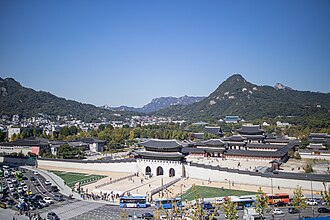
“Gyeongbokgung was not merely a palace — it was the living symbol of a dynasty’s legitimacy, its grandeur meant to reflect the moral order of the kingdom itself.”
Standing at the northern heart of Seoul, framed by the dramatic ridgeline of Bugaksan mountain, Gyeongbokgung Palace is Korea’s most iconic royal complex. Built in 1395, just three years after the founding of the Joseon dynasty, it served for over two centuries as the primary seat of royal power, state governance, and Confucian ceremony. Its story is one of construction, catastrophic destruction, ambitious reconstruction, colonial humiliation, and ultimately resilient restoration — a narrative that mirrors Korea’s own turbulent modern history.
Quick Facts: Gyeongbokgung at a Glance
| Detail | Information |
|---|---|
| Founded | 1395, during the reign of King Taejo |
| Location | Jongno District, Seoul, South Korea |
| Dynasty | Joseon (1392–1897) |
| Meaning of Name | "Greatly Blessed by Heaven" |
| Destroyed | 1592, during the Imjin War (Japanese invasions) |
| Reconstructed | 1867, under Heungseon Daewongun |
| Key Structures | Geunjeongjeon, Gyeonghoeru Pavilion, Hyangwonjeong |
| Status Today | Historic Site, open to public; ongoing restoration |
Origins: A Palace Born from a New Dynasty
When General Yi Seonggye overthrew the Goryeo dynasty and proclaimed the Joseon dynasty in 1392, he immediately set about constructing a new capital worthy of his regime’s Confucian ideals. The site chosen was Hanyang — today’s Seoul — positioned according to the principles of pungsu (Korean geomancy), nestled between the protective ridges of four guardian mountains.
Construction of Gyeongbokgung began in 1394 and was completed with remarkable speed in 1395. The palace’s name, coined by the scholar Jeong Do-jeon, was drawn from a verse in the Book of Odes, an ancient Chinese classic, and translates broadly as “Greatly Blessed by Heaven.” This was a deliberate ideological statement: the new dynasty was not merely seizing power but was ordained by heaven and rooted in the Confucian moral order.
Jeong Do-jeon, the brilliant and controversial architect of the early Joseon state, played a central role not only in naming the palace but in designing its layout. Each major structure was positioned and named with Confucian symbolism in mind, creating a physical map of the dynasty’s governing philosophy. The throne hall, Geunjeongjeon, sat at the palace’s ceremonial core — the place where kings received officials, conducted state examinations, and asserted the majesty of their rule.
Why Did Gyeongbokgung Sit Empty for Nearly Three Centuries?
One of the most dramatic chapters in Gyeongbokgung’s story is not its founding but its long abandonment. In 1592, Japanese forces under Toyotomi Hideyoshi invaded Korea in what Koreans call the Imjin Waeran. As Japanese troops advanced rapidly toward Hanyang, King Seonjo fled the capital. Enraged citizens, many of whom were enslaved workers from the palace, set fire to Gyeongbokgung before the Japanese even arrived. The palace burned to the ground.
What followed was a silence that lasted nearly 275 years. The Joseon court, once it reclaimed the capital, chose to rebuild and occupy other palaces — primarily Changdeokgung — rather than restore Gyeongbokgung. Reasons ranged from financial exhaustion after the devastating wars to superstition: some believed the original site was cursed. For generation after generation of Joseon kings, Gyeongbokgung remained a ruin, a ghostly reminder of the dynasty’s foundational glory.
“For nearly three centuries, the weeds grew where kings had once held court — Gyeongbokgung stood as a ruin, its silence louder than ceremony.”
It was not until the 1860s that reconstruction became a political project. Heungseon Daewongun, the regent who governed Korea on behalf of his young son King Gojong, undertook a massive rebuilding campaign beginning in 1865. For Heungseon Daewongun, the restoration of Gyeongbokgung was a powerful assertion of royal authority at a time when the Joseon court felt threatened by internal factionalism and external pressures. The rebuilt palace was completed in 1867 and contained some 330 buildings within its walls.
3 Reasons Gyeongbokgung Matters in Korean History
1. It Embodied Joseon’s Governing Philosophy
Every element of Gyeongbokgung’s design was intentional. The palace was laid out along a strict north-south axis, with the throne hall precisely positioned so that the king faced south — the direction of virtue in Confucian cosmology. Government offices, royal residences, and ceremonial spaces were arranged in a hierarchy that physically encoded the Joseon state’s beliefs about order, hierarchy, and moral governance. Walking through the palace’s successive gates was a ritual act, progressively separating the mundane world from the sacred space of royal authority.
2. It Became a Target of Japanese Colonial Policy
After Japan annexed Korea in 1910, colonial authorities systematically dismantled and degraded Gyeongbokgung. In 1915, a major industrial exposition was held within the palace grounds, requiring the demolition of hundreds of buildings to make space for exhibition halls. Most devastatingly, in 1926 the massive Government-General Building was constructed directly in front of Geunjeongjeon, the throne hall, deliberately blocking its view and symbolically supplanting Joseon royal authority with Japanese colonial administration. At its lowest point, only a handful of the original 330 structures remained standing.
3. Its Restoration Has Been a National Project of Recovery
The demolition of the Government-General Building in 1995 — timed to mark the 50th anniversary of Korea’s liberation from Japanese rule — was a nationally significant act of symbolic reclamation. Since the 1990s, the South Korean government has invested heavily in restoring Gyeongbokgung to something approaching its 19th-century grandeur. Dozens of structures have been rebuilt, and the work continues today, representing not just architectural restoration but a broader cultural project of recovering a national identity that colonialism sought to erase.
The Palace’s Most Celebrated Structures
Geunjeongjeon (근정전) — The throne hall is the grandest building in the palace complex, seated on a two-tiered stone platform and surrounded by ranked stone markers that indicated where officials of different ranks would stand during royal audiences. Its interior houses the royal throne beneath an elaborate painted ceiling and a fantastical painted ceiling panel of twin phoenixes.
Gyeonghoeru Pavilion (경회루) — Built on an artificial island in a large rectangular pond, Gyeonghoeru is one of the most beautiful wooden structures in Korea. It was used for state banquets and royal celebrations. The current structure dates from the 19th-century reconstruction and is designated as National Treasure No. 224.
Hyangwonjeong (향원정) — A smaller, hexagonal pavilion set on an island in a lotus pond in the northern section of the palace, Hyangwonjeong is one of the most photographed spots in Seoul. Its name means “pavilion of far-reaching fragrance.” The original bridge connecting it to the shore was reconstructed in 2021 based on historical records.
Heungnyemun Gate and Gwanghwamun Gate — The grand southern gates of the palace were the formal entry points that structured the ritual experience of approaching the royal court. Gwanghwamun, the outermost gate, was moved during the Japanese colonial period and later restored to its original position and alignment following extensive historical research completed in 2010.
Gyeongbokgung Under Japanese Colonialism: A Comparison
| Period | Number of Structures | Condition / Use |
|---|---|---|
| 1867 (Post-Reconstruction) | ~330 buildings | Active royal palace, seat of Joseon government |
| 1915 (Colonial Exhibition) | Hundreds demolished | Grounds used for Japanese colonial exposition |
| Mid-20th Century | ~10 structures | Dominated by Government-General Building |
| 1995–Present | Ongoing restoration | Public museum, active cultural site |
Visiting Gyeongbokgung Today
Gyeongbokgung is today one of Seoul’s most visited cultural sites, welcoming millions of domestic and international visitors each year. The palace complex houses the National Palace Museum of Korea and the National Folk Museum of Korea within its grounds. Visitors can witness the daily changing of the guard ceremony at Heungnyemun Gate, a colorful and historically informed performance that reconstructs Joseon-era royal guard rituals.
The site is designated as Historic Site No. 117 by the Cultural Heritage Administration of Korea, reflecting its status as one of the nation’s most protected landmarks. Restoration work continues across the complex, with new structures periodically unveiled as researchers complete their historical and architectural analysis.
For those visiting during the early morning or late afternoon, the palace offers a particularly atmospheric experience — the ancient stone courtyards and curved rooflines framed against the forested mountain behind create a view largely unchanged in its essential character from the height of Joseon power.