Korean Kings in Order: A Complete Guide to the Dynasties, Their Rulers, and How Succession Worked
From the legendary founder of Gojoseon to the last emperor of Joseon, this guide lays out the kings of Korea dynasty by dynasty, explains how the throne passed from one ruler to the next, and points to the monarchs who changed the course of Korean history.
Korean history can look bewildering at first, a long list of kingdoms with unfamiliar names and kings whose titles all seem to end in the same few syllables. But there is a clear order underneath it. Korea was ruled by a sequence of dynasties, each with its own royal line, and once you see how they follow one another, and how the kings within each were named and chose their heirs, the whole sweep of three thousand years falls into place. This guide is a map of that sequence: who ruled, in what order, and which kings matter most.
Rather than listing every monarch, which would run to hundreds of names, it moves dynasty by dynasty, giving the shape of each royal line, the way succession worked, and the handful of rulers in each whose reigns are essential to understanding Korea. Links lead to the fuller stories of each kingdom for those who want to go deeper.
Understanding Korean Royal Names
Before the list, one key unlocks it. Most Korean kings are known today not by their personal names but by their temple names, the titles given after death for use in the ancestral rites. These usually end in one of two syllables. A king honoured with -jo, such as Taejo, was typically a founder of a dynasty or a ruler credited with a great achievement or restoration. A king given -jong, such as Sejong or Sejong’s descendants, was honoured as a worthy successor who maintained the line. There is a third ending, -gun, meaning “prince,” which was given to the rare rulers who were deposed and stripped of full royal honours, marking them as kings the later court chose not to dignify.
This system means that when you read “King Sejong” or “King Jeongjo,” you are reading a posthumous title, not the name the man used in life. It also means the endings themselves tell you something about how later generations judged each ruler. Keep this in mind and the long lists of names become far easier to read. [VERIFY: nuances of -jo / -jong / -gun conventions]
The Dynasties in Order
| Dynasty / Kingdom | Period | Note |
|---|---|---|
| Gojoseon | legendary to 108 BCE | Korea’s first kingdom, founded by Dangun in myth |
| Three Kingdoms (Goguryeo, Baekje, Silla) | c. 57 BCE – 668 CE | Three rival kingdoms with separate royal lines |
| Unified Silla | 668 – 935 | Silla rules most of the peninsula |
| Balhae | 698 – 926 | Northern kingdom, successor to Goguryeo |
| Goryeo | 918 – 1392 | Reunifies the peninsula; origin of the name “Korea” |
| Joseon | 1392 – 1897 | 27 kings over five centuries |
| Korean Empire | 1897 – 1910 | Joseon reconstituted as an empire; two emperors |
[VERIFY: all dates in the dynasty table]
Gojoseon: The Legendary First Kingdom
Korean history begins, by tradition, with Dangun, the mythical founder of Gojoseon, said to have established the first Korean state in 2333 BCE. Gojoseon was a real Bronze Age polity in the north of the peninsula and Manchuria, though its early rulers are known more through legend than records, and it ended with conflict against the Han empire of China. It stands at the head of the Korean royal story as the origin to which all later dynasties looked back.
The Three Kingdoms and Their Lines
From around the first century BCE, three kingdoms emerged and competed for the peninsula, each with its own long line of kings. Goguryeo in the north was the largest and most powerful, famed for its warrior kings such as Gwanggaeto the Great, who vastly expanded its territory. Baekje in the southwest was a sophisticated maritime kingdom that spread culture to Japan. Silla in the southeast, at first the weakest, produced rulers and generals who would eventually outlast the others. Each kingdom’s kings ruled for roughly seven centuries in parallel, so the “order” here is three separate lines running side by side, not one.
Unified Silla and Balhae
In 668 Silla, allied for a time with the Tang empire of China, defeated its rivals and brought most of the peninsula under one rule, beginning the era of Unified Silla. Its kings presided over a golden age of Buddhist art and trade centred on the capital at Gyeongju. To the north, meanwhile, a separate kingdom, Balhae, rose as a successor to Goguryeo and ruled a vast territory with its own line of kings until the early tenth century. Historians often call this the North-South States period, with two Korean royal lines, Silla in the south and Balhae in the north, coexisting.
Goryeo: The Dynasty That Named Korea
As Unified Silla weakened, a new power reunified the peninsula: the Goryeo dynasty, founded by Wang Geon, known as King Taejo, in 918. Goryeo gave Korea its Western name and ruled for nearly five centuries, a period of flourishing Buddhism, celebrated celadon pottery, and the carving of the Tripitaka Koreana. Its line of kings weathered invasions and internal upheaval, including a long period when military rulers held real power behind the throne, before the dynasty gave way at the end of the fourteenth century.
Joseon: Twenty-Seven Kings Over Five Centuries
The last and longest dynasty, Joseon, was founded by Yi Seong-gye, King Taejo, in 1392, and ruled until 1897. Its twenty-seven kings govern the richest and best-documented stretch of Korean history, and several are essential:
- Taejo (r. 1392–1398), the founder, who moved the capital to Seoul and established the dynasty.
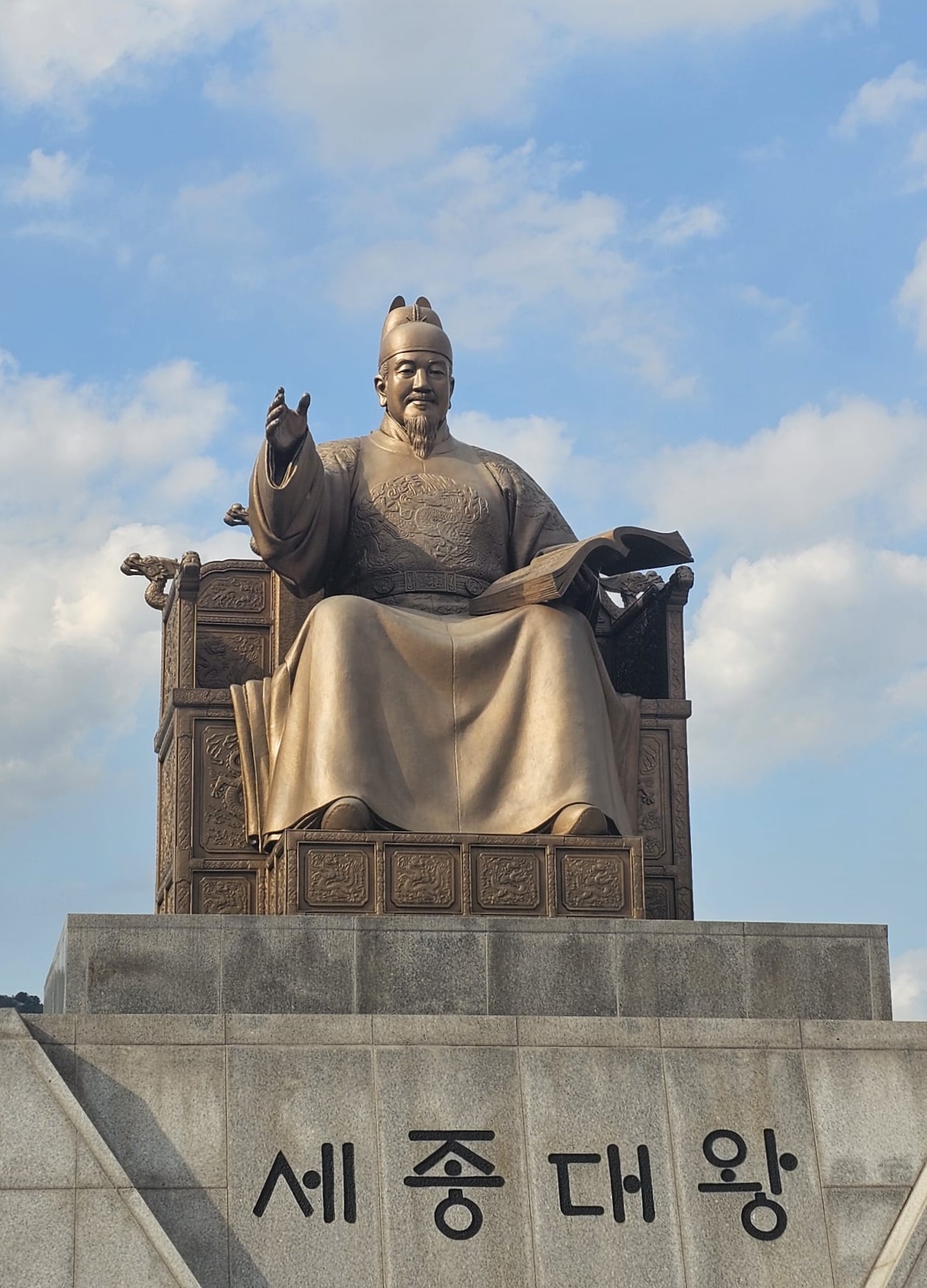
- Sejong the Great (r. 1418–1450), the fourth king, who created the Korean alphabet and oversaw advances in science, music, and administration, the most revered of all Korean monarchs.
- Seongjong (r. 1469–1494), who completed the dynasty’s great law code and cultural institutions.
- Yeongjo (r. 1724–1776) and Jeongjo (r. 1776–1800), the reforming eighteenth-century kings under whom Joseon flourished a second time; Jeongjo built the fortress city of Suwon.
- Gojong (r. 1863–1907), who declared the Korean Empire in 1897, and Sunjong (r. 1907–1910), the last to reign.
Two Joseon rulers were deposed and given the lesser “-gun” title rather than a temple name, marking them in the record as kings the later court judged harshly. The full order of the twenty-seven, with their temple names, is enshrined in the halls of Jongmyo in the sequence of their reigns. [VERIFY: reign dates for each named king]
The Korean Empire: The Final Chapter
In 1897 King Gojong proclaimed the Korean Empire, reconstituting Joseon as an empire and taking the title of emperor in a bid to assert Korea’s sovereignty and modernise the state. The empire had only two rulers, Gojong and his son Sunjong, and lasted until 1910, when Korea’s independent monarchy came to an end. With it the long line of Korean kings, stretching back through Joseon, Goryeo, Silla, and the Three Kingdoms to the legendary Dangun, reached its close.
How Succession Worked
In principle the throne passed to the eldest son of the king’s primary queen, in the Confucian ideal of primogeniture that Joseon especially upheld. In practice succession was often more complicated. Queens without sons, powerful in-law families, early deaths, and court factions all shaped who actually took the throne, and more than one king came to power as a younger son, a grandson, or a more distant relative chosen by the court. The tension between the ideal of orderly succession and the reality of court politics drives much of the drama of Korean dynastic history, and it is why the “order” of kings is a story of human struggle rather than a tidy family tree.
Frequently Asked Questions
How many dynasties ruled Korea?
A sequence: Gojoseon, the Three Kingdoms (Goguryeo, Baekje, Silla), Unified Silla and Balhae, Goryeo, and Joseon, which became the Korean Empire at the end. Each had its own line of kings.
Who was the first king of Korea?
By tradition Dangun, the legendary founder of Gojoseon. The Joseon dynasty was founded by Yi Seong-gye, King Taejo, in 1392.
How many kings did Joseon have?
Twenty-seven over five centuries, from Taejo in 1392 to Sunjong at the end. The best known is Sejong the Great. [VERIFY: count]
Why do kings’ names end in -jo and -jong?
They are temple names given after death: -jo often marked a founder or great ruler, -jong a worthy successor, and the lesser -gun was given to deposed kings.
Who was the most famous Korean king?
Sejong the Great, who created the Korean alphabet in the fifteenth century. His statue stands in central Seoul and his face is on Korean currency.
Continue Exploring
- 21-king-sejong-statue.jpg — Marsilar / CC BY-SA 4.0 / Wikimedia Commons source
Disclosure: This article may contain affiliate links. Booking through them supports Coreaverse at no extra cost to you.