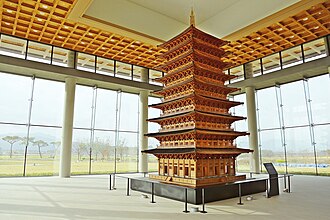
“In the land of Silla, there rose a temple so vast and magnificent that it stood as the spiritual heart of an entire kingdom — until fire and conquest erased it from the earth.”
Among the ruins that sleep beneath the ancient capital of Gyeongju, few sites carry as much historical and spiritual weight as Hwangnyongsa (황룡사), the Temple of the Imperial Dragon. Once the largest and most revered Buddhist temple complex in the Silla kingdom, Hwangnyongsa stood for nearly seven centuries as a symbol of royal power, religious devotion, and architectural ambition. Today, only its vast stone foundations remain — silent witnesses to a grandeur that vanished in the smoke of the Mongol invasion of the thirteenth century.
For historians, archaeologists, and travellers drawn to the ancient streets of Gyeongju, Hwangnyongsa represents one of Korea’s greatest lost treasures. Understanding its story means understanding the intimate relationship between Buddhism and kingship in early Korea, and the devastating cost of empire’s reach.
Quick Facts: Hwangnyongsa at a Glance
| Korean Name | 황룡사 (Hwangnyongsa) |
| Meaning | Temple of the Imperial Dragon |
| Location | Gyeongju, North Gyeongsang Province, South Korea |
| Kingdom | Silla |
| Construction Begun | 553 CE (reign of King Jinheung) |
| Nine-Story Pagoda Built | 645 CE (reign of Queen Seondeok) |
| Destroyed | 1238 CE (Mongol invasion) |
| UNESCO Status | Part of Gyeongju Historic Areas (World Heritage Site, 2000) |
| Site Designation | Historic Site (South Korea) |
Origins: How Did a Palace Become a Temple?
The founding of Hwangnyongsa is inseparable from Silla royal legend. According to historical records, construction began in 553 CE during the reign of King Jinheung (r. 540–576 CE), one of Silla’s most celebrated monarchs and a fervent patron of Buddhism. The original intention was to build a new palace on the site. However, the story goes that a yellow dragon — a creature of imperial and divine significance in East Asian cosmology — appeared in the area. Taking this as a heavenly sign, King Jinheung changed course and ordered a Buddhist temple to be built instead.
This origin story is telling. In Silla, Buddhism was not merely a personal faith but a state ideology, used to legitimise royal authority and unify the kingdom’s people under a shared spiritual framework. The transformation of an intended palace into a sacred temple reflects the degree to which kingship and Buddhist devotion were intertwined in Silla political culture. Construction of the temple complex continued over several decades, with major buildings added across successive reigns.
By the time the initial construction phases were complete, Hwangnyongsa occupied an enormous footprint. Archaeological excavations conducted in the twentieth century revealed that the temple grounds covered approximately 2.5 hectares (around 6 acres), making it one of the largest temple complexes in the ancient Korean peninsula. The layout followed a formal axial plan common to grand East Asian Buddhist architecture, with principal halls and the monumental pagoda arranged along a central north-south axis.
The Nine-Story Pagoda: A Monument to National Ambition
If Hwangnyongsa was the spiritual heart of Silla, its nine-story wooden pagoda was the crown jewel — and among the most celebrated structures in all of Korean history. Built in 645 CE during the reign of Queen Seondeok (r. 632–647 CE), Silla’s first ruling queen, the pagoda represented an extraordinary feat of engineering and a profound act of political statecraft.
“The nine-story pagoda of Hwangnyongsa was not merely a religious monument — it was a declaration of Silla’s supremacy, each storey said to represent a rival nation brought under the kingdom’s spiritual protection.”
According to tradition recorded in the Samguk Yusa (Memorabilia of the Three Kingdoms), a monk named Jajang travelled to Tang China and received instruction from the Bodhisattva Manjushri, who urged him to return to Silla and build the pagoda as a means of protecting the kingdom from its nine neighbouring enemies. Each of the nine stories was said to symbolise one of these adversaries: Japan, China, Wu, Tamna, Eungyu, Malgal, Danguk, Yeokna, and Yemek. The pagoda thus served simultaneously as a religious structure and a statement of Silla’s divine mandate to prevail over surrounding powers.
The construction project was led by a master craftsman named Abiji, who came from the neighbouring kingdom of Baekje — a remarkable detail given that Silla and Baekje were often at war during this period. Abiji is said to have directed a workforce of some two hundred craftsmen and labourers. Based on later reconstructive studies and descriptions in surviving texts, the pagoda is estimated to have risen to approximately 80 metres in height — a staggering achievement in seventh-century wooden architecture, comparable to a modern twenty-storey building.
No image of the pagoda survives, and it was destroyed long before photography. Archaeologists excavating the site in the 1970s and 1980s uncovered the massive stone foundation platforms upon which it stood, allowing scholars to calculate its probable dimensions. Efforts to reconstruct the pagoda digitally and physically have continued into the twenty-first century, keeping its memory alive for new generations.
3 Reasons Hwangnyongsa Mattered to Silla Society
1. A Symbol of Royal Legitimacy
Hwangnyongsa was intimately connected to the Silla royal family across multiple generations. King Jinheung initiated its construction, Queen Seondeok commissioned its greatest monument, and successive monarchs sponsored rituals, restorations, and additions. The temple functioned as a site of state ceremonies, royal prayers, and national observances. To maintain Hwangnyongsa was to demonstrate that the king or queen enjoyed the blessing of the Buddha — and by extension, the mandate to rule.
2. A Centre of Buddhist Learning and Practice
The monk Jajang, who inspired the construction of the nine-story pagoda, was one of the most influential Buddhist figures in Silla history. He returned from his studies in Tang China bringing relics, scriptures, and a vision of Buddhism as a unifying national force. Hwangnyongsa became associated with this mission of establishing Silla as a Buddhist kingdom — a concept sometimes called Hoeguk Bulgyo, or state-protection Buddhism. The temple housed sacred relics, received eminent monks, and served as a hub for the dissemination of Buddhist teaching across the kingdom.
3. An Architectural Marvel That Defined an Era
The sheer scale of Hwangnyongsa set it apart from any other religious building on the peninsula at the time. Its principal hall, the Jangnyukjeon, housed a massive gilded bronze Buddha statue — itself an undertaking of enormous cost and technical skill. The combination of the great hall, the nine-story pagoda, and the surrounding monastic buildings created an ensemble that contemporary visitors would have found awe-inspiring. For the people of Silla, Hwangnyongsa was not merely a temple; it was proof of their civilisation’s greatness.
The Great Bronze Buddha of the Main Hall
Alongside the pagoda, another of Hwangnyongsa’s celebrated treasures was its enormous gilded bronze Buddha statue, housed in the principal worship hall. Historical records suggest the statue was cast during the reign of King Jinpyeong (r. 579–632 CE) and represented a colossal investment of material and labour. Accounts describe the statue as requiring vast quantities of copper and gold to complete.
The bronze Buddha, the nine-story pagoda, and a sacred belt said to have belonged to a royal figure were collectively referred to in Silla tradition as the “Three Treasures of Hwangnyongsa” — objects believed to protect the kingdom from harm. That all three were ultimately lost to the Mongol assault carries a particular poignancy: the very talismans of Silla’s national protection could not withstand the armies that swept across East Asia in the thirteenth century.
The Mongol Destruction of 1238
By the time of the Mongol invasions of Korea, Silla had long since given way to the Goryeo dynasty. But Hwangnyongsa endured in Gyeongju as a sacred site of pan-Korean Buddhist significance. The Mongol forces that ravaged the Korean peninsula in a series of invasions beginning in 1231 showed little mercy to religious sites, which were frequently burned along with the cities and towns that surrounded them.
In 1238, during the third Mongol invasion of Korea, Hwangnyongsa was burned to the ground. The nine-story wooden pagoda — centuries old and irreplaceable — was consumed by fire. The great bronze Buddha statue was looted or destroyed. Centuries of accumulated religious art, manuscripts, and devotional objects were lost. The temple was never rebuilt.
The destruction of Hwangnyongsa was recorded with grief by Korean chroniclers. It represented not merely the loss of beautiful buildings but the erasure of living memory — a place where generations of Koreans had prayed, celebrated, mourned, and sought the protection of the Buddha for their kingdom.
Archaeology and the Memory of What Was Lost
The site of Hwangnyongsa in Gyeongju was systematically excavated by Korean archaeologists between 1976 and 1983, yielding an extraordinary body of findings. Researchers uncovered the stone column bases that once supported the great wooden halls and pagoda, thousands of roof tiles, fragments of the bronze Buddha statue, and a range of ritual objects. These discoveries allowed scholars to reconstruct the temple’s layout with considerable confidence and to estimate the dimensions of its structures.
Today, the site is an open archaeological park where visitors can walk among the surviving stone foundations and visualise the temple’s original scale. Information boards and reconstructive diagrams help bring the vanished complex to life. The site forms part of the broader Gyeongju Historic Areas, inscribed as a UNESCO World Heritage Site in 2000, which encompasses the ancient capital’s remarkable concentration of Silla-era monuments, tombs, and ruins.
Discussions about the possibility of physically reconstructing the nine-story pagoda have continued in South Korea for decades. Proponents argue that reconstruction would restore a vital piece of national cultural heritage and draw visitors to Gyeongju. Critics raise questions about historical accuracy and the philosophical challenges of rebuilding what was lost. As of the time of writing, no full reconstruction has taken place, though detailed plans and digital models have been developed.
Continue Exploring
On Coreaverse
- Gyeongju: Walking Through the Capital of a Thousand Years
- Queen Seondeok: Silla’s Visionary Ruler
- How Buddhism Transformed the Three Kingdoms of Korea