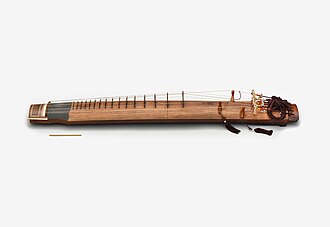
“Of all instruments, the geomungo holds the highest place” — a sentiment echoed by Korean scholars and musicians across centuries of recorded history.
Few instruments carry the weight of Korean cultural identity quite like the geomungo (거문고). A long, fretted zither with six strings and a deep, resonant voice, the geomungo has been central to Korean court music, scholarly life, and spiritual practice for well over a millennium. Its origins trace back to the ancient kingdom of Goguryeo, and its influence has never truly faded — even today it remains a living instrument, designated as a National Intangible Cultural Heritage of South Korea.
To understand the geomungo is to understand something essential about how Koreans have thought about music itself: not merely as entertainment, but as a moral and philosophical pursuit, a bridge between heaven and earth, between the cultivated self and the wider cosmos.
Quick Facts: The Geomungo at a Glance
| Feature | Detail |
|---|---|
| Instrument Type | Fretted zither (plucked string instrument) |
| Number of Strings | Six |
| Origin | Goguryeo Kingdom (ancient Korea) |
| Cultural Status | National Intangible Cultural Heritage of South Korea |
| Playing Method | Struck and plucked with a bamboo stick (suldae) |
| Associated Repertoire | Korean court music, chamber music (jeongganbo notation) |
What Are the Origins of the Geomungo?
The geomungo’s story begins in Goguryeo, one of the Three Kingdoms of ancient Korea, whose territory stretched across the northern Korean peninsula and into present-day Manchuria. According to traditional accounts preserved in Korean historical records, the instrument was developed after a Chinese instrument — believed to be related to the qin zither — arrived in Goguryeo. A court official and musician named Wang San-ak is credited with transforming this foreign instrument into something distinctly Korean, modifying its structure and composing original music for it.
The name geomungo itself is thought to derive from the Korean words for “black” (geomun) and “crane” (go, an older term), a reference to a legend in which a black crane descended from the sky and danced upon hearing Wang San-ak play. This poetic origin story reflects how deeply the instrument was associated with the divine and the transcendent from its very beginnings. The black color also links the instrument to the dark lacquered wood used in its construction, giving it a visual gravity that matches its sonic weight.
Evidence of the geomungo’s antiquity has been found in Goguryeo tomb murals, where musicians are depicted playing long zither-like instruments. These murals, discovered in tombs dating back more than fifteen centuries, place the geomungo firmly within the visual and cultural record of early Korean civilization.
How the Geomungo Is Built and Played
The geomungo is a long, flat instrument, typically constructed from paulownia wood for the soundboard and harder woods for the body. It features six strings, traditionally made from twisted silk, which are stretched across a series of moveable bridges and fixed frets. The frets, called gwae, are made from hard wood or bamboo and are positioned along the upper portion of the instrument. Sixteen of these frets are arranged on the left side of the instrument’s body, allowing the player to produce a wide range of pitches by pressing the strings down between or against them.
Unlike most zithers, which are played purely by plucking or strumming, the geomungo is played using a short, thick stick of bamboo called a suldae. The player holds the suldae in the right hand and strikes or plucks the strings in a controlled, deliberate manner, while the left hand presses and slides along the strings to vary pitch and create expressive ornaments. This dual technique — striking and fretting — gives the geomungo a distinctive, percussive yet melodic quality that is immediately recognizable.
The instrument is placed horizontally across the player’s lap or on a low stand, and the player typically sits on the floor in the traditional Korean manner. The physical demands of playing the geomungo are considerable: mastery of the left-hand technique alone requires years of disciplined practice, and the full expressive range of the instrument takes decades to command.
“The geomungo demands not just fingers and ears, but the full cultivation of the self — it was never merely music, but a form of moral discipline.”
The Geomungo in Korean Court and Scholarly Life
Through the Goryeo period and into the long centuries of the Joseon dynasty (1392–1897), the geomungo occupied a position of extraordinary prestige among Korea’s educated elite. It was considered one of the essential accomplishments of the seonbi — the Confucian scholar-gentleman — alongside poetry, calligraphy, and painting. To play the geomungo was not merely to make music; it was to demonstrate one’s moral cultivation, one’s connection to the classical tradition, and one’s capacity for quiet, disciplined refinement.
Korean literary and historical sources from the Joseon period are filled with references to scholars and officials who played the geomungo as a form of self-cultivation, composing music in private to order their thoughts and regulate their emotions. The instrument was regarded as possessing an inherently serious character — its deep, dark tone unsuited to frivolity, its demands too great for casual engagement. This philosophical framing elevated the geomungo above other instruments in the hierarchy of Korean music culture.
In the context of the royal court, the geomungo featured prominently in jeongak — the refined, slow-paced court music of Joseon. Ensembles performing in the royal banquet and ritual contexts routinely included geomungo players, and the instrument appears in numerous illustrations and records of court musical life. The sophisticated notation system known as jeongganbo, developed during the reign of King Sejong in the fifteenth century, was used to record geomungo repertoire and allowed the precise transmission of music across generations.
3 Reasons the Geomungo Remained Central to Korean Music
1. Its Association with Moral Philosophy
In Confucian thought, music was not decorative but functionally moral — properly ordered sound was believed to cultivate virtue in the listener and the performer alike. The geomungo, with its restrained tone and demanding technique, was seen as the instrument most aligned with these ideals. Its serious character made it the preferred instrument of scholars who wished to demonstrate their commitment to self-improvement.
2. Its Flexibility Across Musical Contexts
While associated primarily with court and scholarly music, the geomungo proved adaptable across different musical settings. It appeared in intimate chamber ensembles, solo performance contexts, and large court orchestras. This versatility ensured that as Korean musical life evolved across different dynasties and social contexts, the geomungo continued to find relevant roles.
3. Its Status as a Cultural Emblem
The geomungo came to function as something more than a musical instrument — it became a symbol of Korean cultural identity and historical continuity. Its documented origins in Goguryeo, its preservation through centuries of court patronage, and its survival into the modern era made it a potent emblem of the depth and resilience of Korean civilization. This symbolic weight has ensured continued institutional support, from the royal court of Joseon to the modern Korean government’s cultural heritage programs.
The Geomungo in the Modern Era
The twentieth century brought enormous disruption to traditional Korean musical culture. The Japanese colonial period (1910–1945) suppressed many aspects of Korean cultural expression, and the Korean War (1950–1953) destroyed institutions and scattered communities. Traditional instruments like the geomungo faced the real risk of falling out of living practice altogether.
Yet the geomungo survived. In the postwar decades, the South Korean government undertook systematic efforts to document, preserve, and revitalize traditional music. The designation of geomungo performance as a National Intangible Cultural Heritage was part of this broader project, recognizing that the living transmission of the instrument’s technique — from master to student — was as important to preserve as any physical artifact.
Today, the geomungo is taught at specialized music schools and universities across South Korea. The National Gugak Center in Seoul serves as a major institutional home for its continued practice and performance. Contemporary musicians have also explored ways of bringing the geomungo into new musical contexts, collaborating with jazz musicians, experimental composers, and world music ensembles — ensuring that this ancient instrument continues to speak to new audiences without losing its roots.
The Geomungo and Korea’s Intangible Heritage
The protection of the geomungo as an intangible cultural heritage reflects a broader Korean and global understanding that heritage is not only found in buildings and artifacts, but in living skills, performances, and knowledge systems. The technique of playing the geomungo — the specific gestures of the right hand wielding the suldae, the subtle pressure and slide of the left hand along the silk strings, the physical and mental discipline required — constitutes a form of embodied knowledge that cannot be preserved in a museum case.
Korea’s framework for protecting intangible cultural heritage, developed over decades and aligned with UNESCO conventions, has provided a structure through which master geomungo players are recognized, supported, and charged with transmitting their knowledge. This system has helped ensure that the instrument’s full expressive vocabulary, including the ornaments, the tonal nuances, and the interpretive traditions that give geomungo music its character, continues to be passed on.
| Feature | Geomungo (Korea) | Guqin (China) | Koto (Japan) |
|---|---|---|---|
| Strings | 6 | 7 | 13 (traditional) |
| Playing Method | Bamboo stick + left hand fretting | Finger plucking | Finger picks |
| Frets / Bridges | Fixed frets + moveable bridges | No frets (harmonics) | Moveable bridges only |
| Cultural Role | Scholar instrument, court music | Scholar instrument, ritual music | Court music, popular tradition |
| Heritage Status | National Intangible Heritage (Korea) | UNESCO Intangible Heritage | Important Intangible Cultural Property (Japan) |
Continue Exploring
On This Site
- The World of Joseon Court Music: Jeongak and Its Instruments
- Goguryeo: The Kingdom That Shaped the Korean North
- Korea’s Living Traditions: Understanding Intangible Cultural Heritage