“The Baekje Historic Areas bear exceptional testimony to the unique and brilliant culture of the Baekje Kingdom during its later period.”
Few chapters in Korean history carry the elegance and quiet tragedy of the Baekje Kingdom. One of the Three Kingdoms of ancient Korea, Baekje endured for nearly seven centuries before falling to a Silla–Tang alliance in 660 CE. Yet even in its final capital cities, Baekje left behind a legacy of artistic refinement, urban planning, and spiritual devotion that continues to speak to us today. In 2015, that legacy received global recognition when the Baekje Historic Areas were inscribed as a UNESCO World Heritage Site — a collection of archaeological sites, Buddhist temples, ancient tombs, and palace ruins spread across the modern South Korean cities of Gongju, Buyeo, and익산 (Iksan).
This article explores what the Baekje Historic Areas are, why they matter, and what they reveal about one of East Asia’s most culturally influential kingdoms.
Quick Facts: The Baekje Historic Areas at a Glance
| Detail | Information |
|---|---|
| UNESCO Inscription Year | 2015 |
| Number of Component Sites | 8 archaeological sites across 3 cities |
| Cities Covered | Gongju (Kongju), Buyeo, and Iksan, South Korea |
| Kingdom Period Represented | Later Baekje period (475–660 CE) |
| UNESCO Criterion Met | Outstanding Universal Value for cultural exchange |
| Modern Province | South Chungcheong Province and North Jeolla Province |
| Baekje Kingdom Founded | Traditionally 18 BCE |
| Fall of Baekje | 660 CE |
Who Were the Baekje? Understanding the Kingdom Behind the Heritage
Baekje (백제) was one of the Three Kingdoms of Korea, alongside Goguryeo in the north and Silla in the southeast. According to traditional accounts, the kingdom was founded in 18 BCE by Onjo, a son of the Goguryeo founder. For centuries, Baekje controlled the western and southwestern portions of the Korean peninsula, with its early capital located near present-day Seoul.
What distinguished Baekje among its neighbors was its extraordinary role as a cultural bridge. The kingdom maintained close maritime relationships with China’s southern dynasties, absorbing Chinese administrative systems, Buddhist teachings, and artistic styles — and then transmitting many of these influences onward to the Japanese archipelago. Baekje craftsmen, scholars, and Buddhist monks are credited in Japanese historical records with introducing Buddhism, Chinese writing, and sophisticated art forms to the Yamato court. This trans-regional cultural exchange is one of the primary reasons UNESCO recognized the Baekje Historic Areas as places of Outstanding Universal Value.
The final two centuries of Baekje’s existence, from its relocation to Ungjin (modern Gongju) in 475 CE and then to Sabi (modern Buyeo) in 538 CE, represent the period most directly preserved in the World Heritage Sites. A third cluster of sites at Iksan reflects a brief, late-period royal ambition to establish yet another capital.
What Are the 8 Component Sites?
The Baekje Historic Areas are not a single monument but rather a serial property — eight distinct archaeological zones united by their connection to later Baekje civilization. Together, they form a mosaic of royal power, religious devotion, and everyday life from the 5th through 7th centuries CE.
In Gongju, the former capital of Ungjin, two sites stand out. The Gongsanseong Fortress is a mountain fortress that served as the royal seat during Baekje’s Ungjin period. Its walls, stretching over 2.6 kilometers, encircle a hilltop above the Geum River and command sweeping views of the surrounding landscape. Nearby, the Royal Tombs of Songsan-ri contain the burial mounds of Baekje royalty from this era. Most famously, the intact tomb of King Muryeong — discovered in 1971 — yielded over 4,600 artifacts including gilt-bronze royal regalia, Chinese coins, and ornate jewelry, making it one of the most significant archaeological discoveries in Korean history.
In Buyeo, the capital of Sabi during Baekje’s final and most culturally flourishing phase, four sites have been inscribed. The Gwanbuksanseong Fortress and Busosanseong Fortress defended the city; the latter is famously associated with the Nakhwaam Rock, where, according to legend, court ladies leaped into the Baengmagang River rather than surrender when Baekje fell. The Jeongnimsa Temple Site preserves the stone pagoda of Jeongnimsaji — one of the oldest surviving stone pagodas in Korea — standing five stories tall in the middle of what was once a grand Buddhist temple complex. The Royal Tombs of Neungsan-ri contain the burial mounds of Sabi-period kings and queens, and the Naseong City Wall traces the outer perimeter of what was once a planned royal capital.
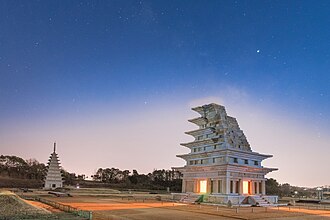
In Iksan, two sites complete the inscription. The Wanggungni Ruins are the remains of a royal palace, and the Mireuksa Temple Site is the largest Buddhist temple site ever discovered on the Korean peninsula. Mireuksa’s stone pagoda — or what remains of it — is the oldest and largest surviving stone pagoda in Korea, a monument to late Baekje ambitions and Buddhist piety.
“The Baekje Historic Areas represent the final flourishing of a kingdom that helped shape the cultural landscape of East Asia — a legacy written not in conquest, but in stone, bronze, and lotus blossoms.”
Why Did UNESCO Inscribe the Baekje Historic Areas in 2015?
UNESCO’s 2015 decision to inscribe the Baekje Historic Areas was grounded in the concept of Outstanding Universal Value — the threshold that all World Heritage Sites must meet. The Committee recognized that these sites collectively demonstrate an exceptional interchange of human values across East Asia during the first millennium CE.
Three core arguments supported the inscription:
- Testimony to Baekje Civilization: The sites preserve material evidence of Baekje’s urban planning principles, Buddhist religious architecture, and funerary traditions at a level of completeness rarely found for ancient Korean kingdoms. Together, they document how a sophisticated court culture was organized, expressed, and memorialized.
- Cultural Exchange Across East Asia: Baekje functioned as a critical conduit between the Chinese mainland and the Japanese islands. The kingdom’s absorption and retransmission of Buddhist iconography, architectural techniques, and statecraft deeply influenced the early development of Japanese culture — a role documented in both Korean and Japanese historical sources. The Baekje Historic Areas provide tangible proof of this exchange.
- Archaeological Integrity: Despite the passage of nearly 1,400 years since Baekje’s fall, these sites have retained a significant degree of authenticity. Royal tomb complexes remain largely intact, fortress walls still stand, and temple platforms preserve their original spatial relationships. This physical continuity gives the sites their power as historical witnesses.
The Tomb of King Muryeong: A Window Into Baekje’s Golden Age
Among all the discoveries connected to the Baekje Historic Areas, none has captured the imagination of historians and the public alike more than the tomb of King Muryeong. Discovered accidentally in 1971 during drainage work at the Songsan-ri tomb complex in Gongju, the tomb was found completely intact — unlooted and sealed since the king’s burial in 523 CE.
The tomb’s brick construction, Chinese in style, reflected Baekje’s deep ties with the Liang Dynasty of southern China. Inscribed stone epitaphs identified the tomb’s occupants beyond doubt: King Muryeong (r. 501–523 CE) and his queen. This was a historically rare moment — an ancient Korean royal tomb identified with absolute certainty through written evidence found inside it.
The more than 4,600 artifacts recovered — including gold crown ornaments, bronze mirrors, lacquerware, and Chinese coins — are now housed in the National Museum of Korea and the Gongju National Museum. They offer an unparalleled glimpse into the material world of Baekje’s aristocracy at the height of the kingdom’s power.
Baekje vs. the Other Three Kingdoms: A Cultural Comparison
| Kingdom | Cultural Emphasis | Key External Influence | Fate |
|---|---|---|---|
| Baekje | Arts, Buddhism, maritime trade | Chinese southern dynasties; strong ties to Japan | Fell to Silla–Tang alliance in 660 CE |
| Goguryeo | Military power, mural tomb art | Chinese northern dynasties; Central Asian motifs | Fell to Silla–Tang alliance in 668 CE |
| Silla | Gold metalwork, Buddhist devotion | Later Tang China; Silk Road influences | Unified much of Korea; declined by 935 CE |
Visiting the Baekje Historic Areas Today
The Baekje Historic Areas are fully accessible to visitors, and the South Korean government along with local municipalities have invested significantly in interpretation, conservation, and visitor infrastructure since the 2015 UNESCO inscription.
Gongju is the natural starting point for most visitors. Gongsanseong Fortress offers dramatic walls and river views, while the Gongju National Museum provides context through its extraordinary collection of Muryeong tomb artifacts. Buyeo, about an hour’s drive south, offers a more expansive experience — the Buyeo National Museum, the tranquil Jeongnimsa pagoda, and the Busosanseong Fortress park make for a full day of exploration. Iksan, further south into North Jeolla Province, rewards those who make the detour with the sheer scale of the Mireuksa Temple Site and its ancient pagoda.
South Korea’s well-developed intercity bus and express train networks make all three cities reachable from Seoul within two to three hours, and the region’s rural character means accommodations tend to offer a quieter, more immersive experience than major urban centers.
Continue Exploring
- The Three Kingdoms of Korea: Baekje, Goguryeo, and Silla Explained
- How Buddhism Transformed Ancient Korea
- Every UNESCO World Heritage Site in South Korea