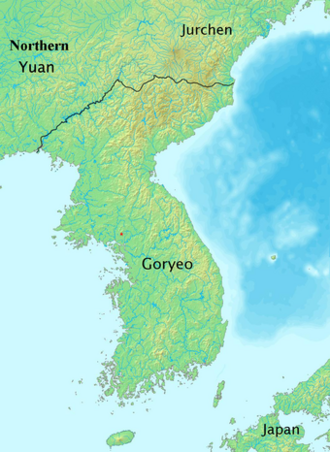
“From the ashes of a divided peninsula, Wang Geon forged a kingdom whose name would echo through the centuries — Korea.”
Few chapters in Korean history are as sweeping, as turbulent, or as consequential as the story of Goryeo. This medieval dynasty, which ruled the Korean peninsula from 918 to 1392, gave the world the very name by which Korea is known today. Over nearly five centuries, Goryeo produced stunning celadon ceramics, the world’s first metal movable type, and the monumental Tripitaka Koreana — a testament to Buddhist devotion carved onto tens of thousands of wooden blocks. It weathered Mongol invasion, absorbed foreign influence, and ultimately yielded to the forces of a new age. Yet its legacy endures in every syllable of the word “Korea” itself.
Quick Facts: The Goryeo Dynasty at a Glance
| Official Name | Goryeo (고려) |
| Founded | 918 CE by Wang Geon (Taejo of Goryeo) |
| Ended | 1392 CE, replaced by the Joseon dynasty |
| Capital | Gaegyeong (modern-day Kaesong, North Korea) |
| Religion | Buddhism (state religion) |
| Notable Achievements | Tripitaka Koreana, celadon ceramics, metal movable type |
| Key Challenge | Mongol invasions (13th century) |
| Legacy | Origin of the name “Korea” |
How Did Wang Geon Unite the Korean Peninsula?
The late ninth century was a time of profound disorder on the Korean peninsula. The once-powerful Unified Silla dynasty had fractured under the weight of aristocratic infighting and peasant rebellions, giving rise to the period historians call the Later Three Kingdoms — a chaotic struggle among Silla, Later Baekje, and a new northern state called Taebong. It was from this northern state that a military commander of unusual skill and political wisdom emerged: Wang Geon.
Wang Geon had served under the founder of Taebong before turning against him. In 918, he seized power and established his own kingdom, which he named Goryeo — a deliberate echo of the ancient kingdom of Goguryeo, signaling his ambition to reunite the Korean people under a single banner with a northern identity. His capital was set at Gaegyeong, a site he chose partly for its strategic position and partly because it was his home region.
Rather than conquering his rivals entirely through force, Wang Geon — who would reign under the temple name Taejo — pursued a policy of strategic marriage alliances, incorporating the regional lords of the peninsula into his court. When Later Silla peacefully submitted to Goryeo in 935, and Later Baekje was defeated militarily in 936, Wang Geon had achieved a degree of unification that Silla had only partially managed centuries before. His consolidation extended further north than Silla’s borders ever had, pushing toward the Cheongcheon River region.
3 Pillars of Goryeo’s Cultural Brilliance
1. The Tripitaka Koreana
Perhaps the most extraordinary cultural achievement of the Goryeo era was the creation of the Tripitaka Koreana — a complete collection of Buddhist scriptures carved onto wooden printing blocks. The project was undertaken not once, but twice. The first set of blocks was produced in the eleventh century as a national prayer for divine protection against Khitan invaders from the north. When Mongol forces burned that original set in the thirteenth century, the Goryeo court undertook the monumental task again. The second set, completed around 1251, comprised approximately 81,258 wooden blocks and is considered one of the most accurate and comprehensive editions of the Buddhist canon ever produced. These blocks survive today at Haeinsa Temple in South Gyeongsang Province, where they are preserved as a UNESCO World Heritage Site.
2. Goryeo Celadon
Goryeo celadon — known in Korean as cheongja — represents the dynasty’s most celebrated artistic export. Goryeo potters refined Chinese celadon techniques and developed their own innovations, most notably the sanggam inlay method, in which designs were carved into the clay, filled with white or black slip, and then glazed over. The result was a distinctive jade-green pottery of extraordinary beauty. Even Chinese observers of the era praised Goryeo celadon as among the finest in the world. These vessels — bowls, vases, incense burners, and ritual objects — reflected both the Buddhist sensibility of the court and the sophisticated tastes of a confident, outward-looking civilization.
3. Metal Movable Type
Goryeo is credited with producing the world’s first books printed using metal movable type, predating Gutenberg’s press in Europe by several decades. While the wooden block printing tradition had deep roots in East Asia, Goryeo craftsmen made the crucial leap to individual metal type characters that could be rearranged and reused. The earliest surviving book printed with metal movable type — the Jikji, a collection of Buddhist teachings — was printed in Goryeo in 1377, though the technology itself had been developed earlier in the dynasty.
“In the annals of human ingenuity, Goryeo’s metal movable type stands as a milestone — a technology that would transform how knowledge was created, copied, and shared across civilizations.”
Buddhism and the Goryeo State
Buddhism was not merely a personal faith in Goryeo — it was the ideological backbone of the state. Taejo himself was a devoted Buddhist and urged his successors to support the religion actively. Subsequent rulers built temples, sponsored the translation and printing of scriptures, and conferred high status upon the Buddhist clergy. The National Preceptor system gave leading monks significant influence at court, and Buddhist festivals became major state occasions.
This deep entanglement of religion and politics had practical consequences. The production of the Tripitaka Koreana, for instance, was framed explicitly as a religious act meant to invoke the protection of the Buddha against foreign enemies. The construction of temples throughout the kingdom served simultaneously as acts of piety and demonstrations of royal power. Buddhism shaped Goryeo’s art, architecture, philosophy, and governance in ways that are still visible in the cultural heritage of the Korean peninsula today.
The Mongol Invasions: A Kingdom Under Siege
The thirteenth century brought the most severe test Goryeo had ever faced. Beginning in 1231, the forces of the Mongol Empire launched a series of devastating invasions of the Korean peninsula. The Goryeo court, under the effective control of the Choe military clan, made the controversial decision to relocate the capital to Ganghwa Island — an island in the Han River estuary that the Mongols, lacking naval expertise, could not easily assault. For nearly three decades, the court held out on the island while the Mongol armies ravaged the mainland, burning cities, destroying the first Tripitaka Koreana blocks, and displacing enormous numbers of civilians.
The resistance was ultimately unsustainable. In 1259, Goryeo submitted to the Mongol Yuan dynasty, entering a period of vassal status that would last for roughly a century. The Goryeo kings married Mongol princesses, Mongol language and customs penetrated the court, and Korean soldiers were conscripted into Mongol campaigns — including the disastrous attempted invasions of Japan in 1274 and 1281.
Yet even in this period of subordination, Goryeo retained its royal line and a degree of internal autonomy unusual among Mongol vassals. And it was in this very era, during the refuge on Ganghwa Island, that the second and surviving set of the Tripitaka Koreana was painstakingly carved — an act of cultural defiance as much as religious devotion.
Goryeo vs. Its Neighbors: A Comparative View
| Feature | Goryeo (918–1392) | Unified Silla (668–935) | Joseon (1392–1897) |
|---|---|---|---|
| State Religion | Buddhism | Buddhism | Neo-Confucianism |
| Capital | Gaegyeong | Gyeongju | Hanyang (Seoul) |
| Major Threat | Khitans, Mongols | Tang China, Japan | Japan, Manchu |
| Signature Art | Celadon ceramics | Gold metalwork, Buddhist sculpture | White porcelain, genre painting |
| Written Script | Classical Chinese | Classical Chinese | Hangul (from 1443) + Classical Chinese |
The Fall of Goryeo and the Rise of Joseon
The fourteenth century saw Goryeo wracked by internal contradictions. As Mongol power collapsed across Asia following the disintegration of the Yuan dynasty, Goryeo found itself navigating a volatile regional order, caught between the rising Ming dynasty in China and domestic power struggles between reformist and conservative factions at court. Corruption among the Buddhist establishment had grown severe, and a rising class of Neo-Confucian scholars — educated officials who saw Buddhism as decadent and wasteful — argued passionately for a new political and moral order.
Into this volatile situation stepped Yi Seonggye, a military general who had distinguished himself in campaigns against Japanese pirates along the southern coast and against northern raiders near the Manchurian border. In 1388, dispatched to lead an invasion of Ming territory at the behest of a pro-Mongol faction at court, Yi Seonggye turned his army around at Wihwa Island and marched back to the capital — a decision that effectively ended Goryeo’s existing power structure. In 1392, having systematically eliminated his rivals and deposed the last Goryeo king, Yi Seonggye proclaimed a new dynasty: Joseon. Goryeo, after 474 years, was finished.
Why Does Goryeo Still Matter?
The influence of Goryeo on Korean identity cannot be overstated. The very word “Korea” — in English, French, German, Spanish, and dozens of other languages — derives from “Goryeo,” transmitted to the wider world through Persian and Arabic traders who encountered the kingdom during its medieval peak. The Buddhist heritage that Goryeo enshrined, from the surviving Tripitaka Koreana blocks at Haeinsa to the celadon vessels in museums worldwide, remains a living part of Korean cultural identity. The dynasty’s innovations in printing technology placed Korea among the world’s most advanced civilizations in the transmission of knowledge.
Perhaps most importantly, Goryeo represented the first genuine administrative unification of the Korean peninsula, incorporating not only the former territories of Silla but extending further north and integrating the diverse peoples and regional aristocracies of the peninsula into a single — if often fractious — political order. The tensions it navigated between native tradition and foreign influence, between Buddhism and emerging Confucian reform, between royal authority and aristocratic power, are tensions that would continue to define Korean history long after the last Goryeo king stepped aside.
Continue Exploring
- On This Site: Haeinsa Temple and the Tripitaka Koreana — Where Korea’s Sacred Texts Still Rest (coming soon)
- On This Site: Goryeo Celadon: The Art That Made a Dynasty Famous (coming soon)
- Goryeo — Wikipedia
- Encyclopedia of Korean Culture (Academy of Korean Studies)
- Goryeo — Britannica
- Haeinsa Temple Janggyeong Panjeon — UNESCO World Heritage
- National Museum of Korea — Goryeo Collections