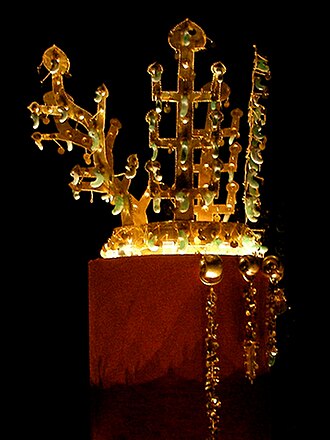
“Among all the relics recovered from the ancient tombs of Gyeongju, nothing speaks more powerfully of Silla’s golden age than its royal crowns — shimmering, towering, and unlike anything else in the ancient world.”
When archaeologists began excavating the great burial mounds of Gyeongju in the early twentieth century, they uncovered one of the most astonishing collections of royal regalia ever found in East Asia. The crowns of Silla — elaborate headdresses of pure gold, hung with jade comma-shaped ornaments and delicate golden spangles — have since become the defining symbol of one of Korea’s three ancient kingdoms. More than mere decoration, these crowns tell the story of a civilization at its peak: confident, cosmopolitan, and dazzlingly wealthy.
Quick Facts: The Crowns of Silla
| Kingdom | Silla (57 BCE – 935 CE) |
|---|---|
| Period of Creation | Approximately 5th–6th century CE |
| Primary Material | Gold sheet, jade (gogok), and glass beads |
| Key Examples | Gold Crown from Geumgwanchong, Gold Crown from Cheonmachong, Gold Crown from Hwangnamdaechong |
| Discovery Sites | Tumuli (burial mounds) in and around Gyeongju |
| Current Location | National Museum of Korea (Seoul); Gyeongju National Museum |
| Designation | Multiple crowns designated National Treasures of Korea |
What Makes the Silla Crowns Unique?
At first glance, a Silla crown seems almost impossibly ornate. Rising from a broad circular band of hammered gold, upright tree-shaped and antler-shaped prongs reach skyward, each one cut from flat gold sheet and decorated with tiny punched dots. Hundreds of small heart-shaped or circular gold spangles hang from the prongs on fine gold wire, trembling with the slightest movement and catching the light. Dangling on either side of the main band are long gold pendants tipped with the gogok — comma-shaped pieces of green jade — that are one of the most characteristic motifs of ancient Korean art.
No comparable crowns have been found anywhere else in the ancient world in this particular form. Chinese and Japanese royal regalia from the same era look entirely different. Scholars have long debated what the upright prongs represent: some argue they are stylized trees, connecting the wearer to shamanistic traditions of the steppe; others see antler imagery linked to deer symbolism in Korean and Central Asian cultures. What is beyond dispute is that the crowns were objects of extraordinary craftsmanship, produced by goldsmiths working at the very highest level of the ancient world’s metallurgical arts.
Crucially, the crowns are believed to have been primarily funerary objects. Their gold sheet construction — thin, carefully cut, but not robust enough for everyday wear — strongly suggests they were made to accompany the deceased into the tomb rather than to be worn in life. This interpretation fits the broader context of Silla elite burial culture, in which the tombs of kings and aristocrats were packed with gold jewelry, bronze vessels, iron weapons, and imported luxury goods from as far away as the Mediterranean world.
The Great Tumuli of Gyeongju
The crowns come from the burial mounds — known in Korean as tumuli — that still dominate the landscape of Gyeongju, the ancient capital of Silla. Today the city’s historic center contains dozens of these grassy earthen mounds, some rising more than twenty meters high, clustered together in what is now Daereungwon Tumuli Park. Gyeongju itself has been recognized by UNESCO as a place of outstanding universal value; the Historic Areas of Gyeongju are inscribed on the World Heritage List and have been described as an open-air museum of Silla civilization.
The tombs from which the greatest crowns were recovered have become famous in their own right. Geumgwanchong — literally “Tomb of the Gold Crown” — was excavated in 1921 and yielded one of the most celebrated of all Silla crowns. Cheonmachong, excavated in 1973, produced not only another gold crown but also the famous “Heavenly Horse” painting on birch bark that gave the tomb its name. Hwangnamdaechong, the largest of all the Gyeongju tumuli, was excavated between 1973 and 1975 and contained two burial chambers — one for a man, one for a woman — with exceptional quantities of gold artifacts including another royal crown.
3 Reasons the Silla Crowns Matter to Korean History
1. They Reveal the Wealth and Power of the Silla Elite
The sheer quantity of gold buried in Silla tombs is remarkable. The kingdom controlled gold-producing regions on the Korean peninsula and developed sophisticated techniques for working the metal into jewelry, crown fittings, belts, earrings, and vessels. The crowns, as the most visually dominant objects in the tomb, served to announce the status of the deceased in the most unambiguous possible terms. A ruler buried wearing — or accompanied by — a golden crown was proclaiming, even in death, a right to authority that transcended the earthly world.
2. They Connect Korea to a Wider World
Analysis of the artifacts found alongside the crowns — glassware, textiles, and personal ornaments — shows that Silla was no isolated kingdom. Trade and diplomatic contacts stretched along the Silk Road, and some of the glass beads found in the tombs originated in Western Asia or even the Roman world. The gogok jade ornaments, meanwhile, connect Silla to a shared aesthetic tradition stretching back to the Korean Bronze Age and shared with other Korean kingdoms. The crowns sit at the intersection of these local traditions and wider international networks.
3. They Document a Transition from Shamanism to Buddhism
The shamanistic symbolism many scholars see in the tree and antler prongs of the Silla crowns belongs to the period before Buddhism became the state religion of Silla in 527 CE. As Buddhism took hold, burial customs changed dramatically: elaborate tomb burials with rich grave goods gave way to cremation, which is why the great gold-filled tumuli largely belong to the 5th and 6th centuries. The crowns thus mark a specific and unrepeatable window in Korean history — the last flowering of an ancient belief system before a new faith transformed Korean civilization.
“The gold crowns of Silla are not simply beautiful objects. They are a window into a world of ritual, belief, and political authority that vanished when Buddhism swept across the peninsula — leaving only the silent mounds of Gyeongju to remember it.”
Where Can You See the Silla Crowns Today?
Several of the most important Silla crowns are on permanent display and accessible to the public. The Gyeongju National Museum holds a superb collection of Silla artifacts and is the best single destination for anyone who wants to understand the golden age of this kingdom in depth. The National Museum of Korea in Seoul also displays major Silla crown examples among its collection of Korean National Treasures. Both museums allow visitors to see these extraordinary objects at close range, often in dedicated galleries that contextualise the crowns within the broader story of Silla culture.
For those who want to experience the landscape that produced the crowns, Gyeongju itself is essential. Walking among the great grassy mounds of Daereungwon Tumuli Park, entering the reconstructed interior of Cheonmachong, and visiting the broader Historic Areas of Gyeongju — including the Anapji pond, the Cheomseongdae observatory, and the temple sites of Bulguksa and Seokguram — gives a sense of a civilization that, at its height, was one of the most sophisticated in all of East Asia.
The Legacy of Silla’s Gold
The crowns of Silla occupy a unique place in Korean cultural memory. They appear on museum brochures, tourist posters, and in the collections of some of the world’s great institutions. Their image has become shorthand for the grandeur of ancient Korea in international cultural conversations. Yet they remain, above all, artifacts of a very specific moment: the era when Silla’s kings and queens were buried beneath those great earthen mounds with everything they might need for the afterlife, including the crowns that marked them, even in death, as rulers of a golden kingdom.
The scholarly work of understanding these crowns continues. Questions about their precise ritual use, the identity of the individuals buried with them, and the exact meaning of their symbolic forms remain open. What is certain is that they represent one of the highest achievements of ancient Korean metalworking, and that they have secured Silla’s place in the consciousness of anyone who has ever been moved by the art of the ancient world.