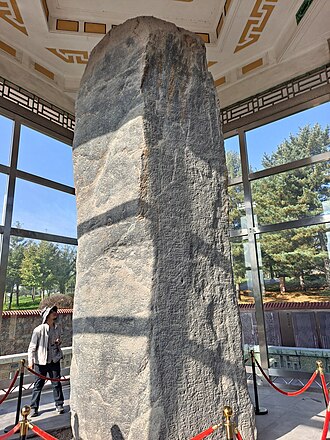
“He expanded the territory of Goguryeo to its greatest extent, earning a name that means ‘broad expander of territory’ — a legacy carved in stone for all time.”
In the long sweep of Korean history, few figures loom as large as Gwanggaeto the Great, the nineteenth monarch of the Goguryeo kingdom. Ruling from 391 to 412 CE, he transformed a regional power into one of the most formidable empires in East Asian history. His campaigns reshaped the political landscape of the Korean peninsula and far beyond, earning him a place among the greatest military commanders of the ancient world. Yet for centuries, much of what we know about him was preserved not in books but in stone — on a massive stele erected by his son on the banks of the Yalu River.
| Detail | Information |
|---|---|
| Born | 374 CE |
| Died | 412 CE |
| Reign | 391–412 CE |
| Kingdom | Goguryeo |
| Era | Three Kingdoms Period |
| Posthumous Name | Gwanggaeto (廣開土, “Broad Expander of Territory”) |
| Temple Name | Hotae Wang (好太王, “Good and Great King”) |
| Notable Monument | Gwanggaeto Stele, erected 414 CE in Ji’an, China |
From Prince to Conqueror: The Rise of a Warrior King
Gwanggaeto was born in 374 CE during a period of intense rivalry among the Three Kingdoms of Korea — Goguryeo in the north, Baekje in the southwest, and Silla in the southeast. The peninsula was a battleground of shifting alliances, and Goguryeo, despite its size and military tradition, faced constant pressure from neighboring states as well as from the nomadic peoples of Manchuria and the Chinese kingdoms to the west.
He ascended to the throne in 391 CE at just seventeen years of age, following the death of his father, King Gogukyang. Despite his youth, Gwanggaeto moved with remarkable speed and decisiveness. Within the first years of his reign, he launched campaigns that signaled a new era of Goguryeo expansion. The kingdom that he inherited was powerful but regionally constrained; the kingdom he left behind stretched across an enormous swath of the continent.
His military campaigns were wide-ranging and relentless. He fought against Baekje to the south, pushing Goguryeo’s frontier deep into the Han River basin — a strategically vital corridor that had long been contested. He campaigned in the north and west against various groups including the Khitan and the Paekje-allied forces, securing Goguryeo’s flanks and vastly expanding its territorial base. He also intervened on the Korean peninsula on behalf of the Silla kingdom, sending Goguryeo forces south to repel a Japanese (Wa) incursion — an event recorded prominently on the Gwanggaeto Stele and debated by historians to this day.
Why Is the Gwanggaeto Stele So Important to Korean History?
The single most important primary source for Gwanggaeto’s reign is the stele erected by his son and successor, Jangsu, in 414 CE — two years after the king’s death. Standing approximately 6.39 metres tall and carved from a single block of granite, the stele is located in what is today Ji’an, in Jilin Province, China, near the site of the ancient Goguryeo capital of Gungnaeseong.
The inscription runs to nearly 1,800 Chinese characters and is divided into three main sections. The first section recounts the founding myths and early history of Goguryeo. The second — the longest and most historically significant — describes Gwanggaeto’s military campaigns year by year, listing the territories seized, the armies defeated, and the tribute exacted. The third section records the regulations governing the tomb guardian households who were responsible for maintaining the king’s burial site.
“The stele stands not merely as a monument to a king, but as one of the most extraordinary pieces of historical evidence to survive from early Korean civilisation — a six-metre granite testament to an age of conquest.”
The stele’s text is the subject of considerable scholarly debate, particularly surrounding a passage that appears to describe the activities of Japanese Wa forces on the peninsula. Nationalist historians from both Korea and Japan have interpreted this passage in dramatically different ways, and the controversy has made the Gwanggaeto Stele one of the most politically charged archaeological texts in East Asia. What is beyond dispute, however, is that the stele confirms the extraordinary scale of Gwanggaeto’s conquests and the dominant position that Goguryeo had achieved by the early fifth century.
The Scale of His Conquests: What Did Gwanggaeto Actually Win?
The stele records that Gwanggaeto personally led sixty-four walled towns and 1,400 villages into submission over the course of his reign. While these numbers may reflect some degree of rhetorical inflation typical of royal inscriptions, they convey the sheer ambition and scope of his campaigns. Goguryeo under Gwanggaeto expanded its territory to include large parts of what is today Manchuria, the northern Korean peninsula, and areas along the Liao River basin.
| Direction | Opponents | Outcome for Goguryeo |
|---|---|---|
| South (Korean Peninsula) | Baekje, Wa (Japanese) forces | Seized Han River basin; repelled Wa incursion in Silla |
| North and West | Khitan, Paekje-allied groups | Secured northern and western frontiers; expanded into Manchuria |
| East | Eastern Buyeo | Absorbed Eastern Buyeo into Goguryeo territory |
The absorption of Eastern Buyeo was among his most significant northern achievements. This campaign, recorded on the stele, effectively eliminated a rival Korean state and brought thousands of households under Goguryeo rule. Combined with his southern campaigns, Gwanggaeto left his kingdom in possession of the largest territorial extent it had ever known — a foundation that his son Jangsu would consolidate and build upon during his own long reign.
3 Reasons Gwanggaeto’s Legacy Endures in Korea Today
1. A Symbol of Korean National Pride
In modern Korea, Gwanggaeto the Great occupies a special place in the national imagination. His name and image appear throughout Korean popular culture — in historical dramas, in textbooks, and in public monuments. At a time when Korea seeks to articulate its historical identity and its long heritage of civilisation, Gwanggaeto represents the idea of a Korean state that was not merely a regional player but a great power capable of projecting force across Northeast Asia. His posthumous name, meaning “broad expander of territory,” resonates powerfully in a peninsula that has spent much of its modern history navigating the competing pressures of larger powers.
2. A Window into the Three Kingdoms Period
The Gwanggaeto Stele is one of only a handful of primary sources that provide detailed, contemporaneous evidence for the Three Kingdoms period. Korean history from this era is often reconstructed from later Chinese sources or from chronicles written centuries after the events they describe. The stele, inscribed just two years after the king’s death, offers a rare direct voice — however ideologically shaped — from the period itself. For scholars of early Korean history, it is an irreplaceable document.
3. The Debate Over the Stele Keeps History Alive
The ongoing scholarly controversy over how to interpret the stele’s more contested passages has kept Gwanggaeto at the centre of academic and public debate for well over a century. The discovery of the stele in the late nineteenth century coincided with a period of intense nationalism across East Asia, and competing interpretations of its text became entangled with questions of territorial legitimacy and national identity that remain sensitive today. In this sense, Gwanggaeto is not simply a figure from the distant past — he is an active presence in contemporary discussions about Korean, Chinese, and Japanese historical relations.
Gwanggaeto and Buddhism: Faith Alongside Conquest
Gwanggaeto’s reign is associated not only with military expansion but also with the continuing spread of Buddhism within Goguryeo. Buddhism had been officially introduced to Goguryeo in 372 CE, during the reign of King Sosurim, and by the time Gwanggaeto ascended the throne it was already an established feature of court life. The king is recorded as having promoted Buddhist institutions, and temples were among the structures associated with his reign. This combination of martial prowess and religious patronage was characteristic of many great rulers of the period across East Asia, and it shaped how later generations understood Gwanggaeto as both a warrior and a builder of civilisation.
His death in 412 CE, at the age of thirty-nine, cut short a reign that had lasted just over two decades but had transformed the geopolitical order of Northeast Asia. He was succeeded by his son Jangsu, who would reign for an extraordinary seventy-nine years and continue many of his father’s policies — including the construction of the great stele that preserved Gwanggaeto’s memory in stone.
Visiting the Legacy: Where History Happened
The Gwanggaeto Stele stands today in Ji’an, Jilin Province, China, at the site of the ancient Goguryeo capital. The broader Ji’an archaeological zone, together with the Hwando Mountain Fortress and associated royal tombs, was inscribed as a UNESCO World Heritage Site in 2004 as part of the “Capital Cities and Tombs of the Ancient Koguryo Kingdom” nomination. For travellers and history enthusiasts, the site offers a remarkable encounter with the physical remnants of one of Korea’s greatest ancient kingdoms.
In South Korea, the National Museum of Korea in Seoul holds collections related to the Three Kingdoms period, including artefacts and scholarship that help contextualise Gwanggaeto’s era. His story is also told through the lens of Korea’s broader heritage at institutions dedicated to the study of Korean history and culture.
Continue Exploring
On Korea Through Time:
- The Three Kingdoms of Korea: Goguryeo, Baekje, and Silla
- King Jangsu and the Golden Age of Goguryeo
- The Gwanggaeto Stele Heritage Site: What to See and Know
External Sources: