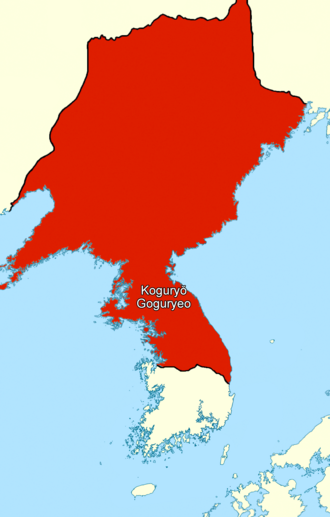
“Of the Three Kingdoms, Goguryeo stood tallest — a realm of warriors, muralists, and kings who refused to bow to the mightiest empires of their age.”
For nearly seven centuries, Goguryeo (고구려) dominated the northern Korean peninsula and vast stretches of Manchuria, standing as one of the most formidable states in all of East Asia. Founded in the first century BCE, this ancient Korean kingdom challenged the Han Chinese empire, repelled the Sui and Tang dynasties, and built a culture so rich and distinctive that its tomb murals are today recognized as a UNESCO World Heritage treasure. To understand Korea is, in many ways, to understand Goguryeo first.
Quick Facts: Goguryeo at a Glance
| Detail | Information |
|---|---|
| Founded | 37 BCE (traditional dating) |
| Dissolved | 668 CE |
| Duration | Approximately 705 years |
| Founder | Jumong (King Dongmyeong) |
| Capital (later) | Pyongyang |
| Region | Northern Korean peninsula and Manchuria |
| Fell to | Silla–Tang alliance |
| Key legacy | Tomb murals, military culture, territorial ambition |
Origins: The Legend of Jumong and the Birth of a Kingdom
The founding legend of Goguryeo centers on Jumong, a semi-divine archer of extraordinary skill who is said to have established the kingdom in 37 BCE. According to traditional sources, including the Samguk Sagi (Historical Records of the Three Kingdoms), Jumong fled persecution from the Buyeo kingdom, crossed rivers with miraculous help, and founded a new state in the Yalu River region. He is remembered as King Dongmyeong, and his legend became one of the most enduring founding myths in Korean history.
Modern historians place the actual emergence of Goguryeo as a recognizable state sometime in the first century BCE, centered around the Yemaek people of the Yalu and Tongge river basin areas. The kingdom grew steadily from a minor tribal confederation into a powerful centralized monarchy over the following two centuries, gradually absorbing neighboring peoples and territories.
By the time of King Taejo in the first and second centuries CE, Goguryeo had consolidated into a formidable state with a structured government, military aristocracy, and expansionist ambitions that would define it for the rest of its history.
At Its Height: A Northeast Asian Superpower
Goguryeo reached the peak of its power under King Gwanggaeto the Great (r. 391–413 CE), one of the most celebrated monarchs in Korean history. His campaigns dramatically expanded Goguryeo’s territory to its greatest extent, pushing deep into Manchuria to the north and west, subduing the Baekje kingdom to the south, and even receiving tribute from Silla. The famous Gwanggaeto Stele, erected in 414 CE by his son King Jangsu, records his conquests in detail and remains one of the most important primary sources for the history of this era.
King Jangsu (r. 413–491 CE), whose name literally means “Long Life,” continued his father’s expansionist legacy. It was Jangsu who moved the capital southward to Pyongyang in 427 CE, a strategic decision that brought Goguryeo’s administrative center closer to the Korean peninsula’s heartland and positioned the kingdom to exert greater influence over its southern rivals, Baekje and Silla.
At its territorial maximum, Goguryeo controlled a vast domain stretching across what is today northern Korea, much of Manchuria (northeastern China), and parts of the Russian Far East — making it by geographic measure the largest of the Three Kingdoms of Korea by a considerable margin.
“Goguryeo at its height was not merely a Korean kingdom — it was a Northeast Asian empire in everything but name, commanding territories that stretched from the Yellow Sea to the forests of Manchuria.”
Why Did Goguryeo Resist Three Chinese Invasions?
Few episodes in Korean history are as dramatic as Goguryeo’s repeated defeats of Chinese imperial forces. In the early seventh century, the Sui dynasty of China — then one of the most powerful empires in the world — launched multiple massive invasions of Goguryeo. Emperor Yang of Sui sent enormous armies into Goguryeo territory in 612, 613, and 614 CE. Each campaign ended in failure, with Goguryeo’s combination of fortified city defenses, scorched-earth tactics, and mobile cavalry proving devastatingly effective.
The Battle of Salsu River in 612 CE is remembered as one of the most complete military victories in Korean history. General Eulji Mundeok, commanding Goguryeo forces, lured a massive Sui army deep into enemy territory, then attacked as they attempted to cross the Salsu River. Historical sources record catastrophic losses for the Sui forces. The repeated failures of these campaigns contributed to the destabilization of the Sui dynasty itself, which collapsed in 618 CE — a collapse that historians have partly attributed to the enormous resources expended on the failed Korean campaigns.
The succeeding Tang dynasty under Emperor Taizong tried again in 645 CE, personally leading a campaign that also failed to defeat Goguryeo. These victories against Chinese imperial might became a cornerstone of Goguryeo’s — and later Korea’s — historical self-image as a people capable of defending their homeland against overwhelming odds.
Goguryeo Culture: Tombs, Murals, and a Warrior Aesthetic
Goguryeo’s cultural legacy is as remarkable as its military one. The kingdom developed a sophisticated artistic tradition most visibly expressed in its elaborate royal and aristocratic tomb murals. Painted on the stone walls of chambered burial mounds, these murals depict scenes of daily life, hunting, feasting, celestial beings, and Buddhist iconography — offering an extraordinary window into how Goguryeo people lived, believed, and saw the cosmos.
In 2004, the Complex of Koguryo Tombs was inscribed on the UNESCO World Heritage List, recognizing the murals as masterpieces of ancient East Asian art. The tombs represent some of the earliest surviving examples of Korean painting and demonstrate sophisticated techniques including foreshortening, dynamic figure movement, and complex narrative composition.
Buddhism was introduced to Goguryeo in 372 CE during the reign of King Sosurim, becoming an important element of court culture and ideology. Confucian education was also formalized during this period, with the establishment of the Taehak — a national academy for the training of elite administrators — in the same year Buddhism arrived. This pairing of foreign religious and philosophical systems with native Korean traditions was a hallmark of Goguryeo’s cultural sophistication.
Comparing the Three Kingdoms: How Did Goguryeo Stand Apart?
| Kingdom | Location | Known For | Fell In |
|---|---|---|---|
| Goguryeo | Northern peninsula + Manchuria | Military power, tomb murals, resistance to China | 668 CE |
| Baekje | Southwestern peninsula | Refined arts, transmission of culture to Japan | 660 CE |
| Silla | Southeastern peninsula | Gold artifacts, unification of Korea | Survived; unified 668 CE |
While all three kingdoms shared linguistic and cultural roots, Goguryeo’s sheer geographic scale, its sustained military confrontation with Chinese empires, and its distinct artistic tradition set it apart from its peninsular rivals. Baekje was famed for its refined arts and its role in transmitting Buddhism and Chinese culture to Japan. Silla, though initially the weakest, proved to be the most politically astute — ultimately allying with Tang China to bring down both Baekje and Goguryeo.
The Fall of Goguryeo: 668 CE
By the mid-seventh century, Goguryeo faced a convergence of internal and external pressures. Decades of warfare had drained resources and intensified factional struggles within the Goguryeo court. The powerful general Yeon Gaesomun seized control of the government in a coup in 642 CE, killing King Yeongnyu and installing a puppet king. While Yeon Gaesomun was a capable military leader — overseeing Goguryeo’s successful defense against Tang Emperor Taizong’s 645 CE invasion — his authoritarian rule created deep political divisions.
After Yeon Gaesomun’s death around 666 CE, his sons fell into bitter succession disputes, fatally weakening the kingdom. Silla, which had been methodically building its alliance with Tang China, seized the moment. A combined Silla-Tang campaign struck with overwhelming force. Pyongyang fell in 668 CE, and the Goguryeo kingdom was extinguished after more than 700 years.
Many Goguryeo refugees and aristocrats fled southward, eventually contributing to the cultural and political foundations of the later Goryeo dynasty — a kingdom whose very name echoed Goguryeo and whose founder, Wang Geon, explicitly framed his state as Goguryeo’s successor.
Goguryeo’s Legacy in Korean Identity
The memory of Goguryeo has never faded from Korean consciousness. The name “Korea” itself is derived not from the Joseon dynasty but from Goryeo, which in turn derived its name from Goguryeo — making this ancient warrior kingdom the etymological ancestor of the country’s name in the English language and many others.
Goguryeo’s resistance against Chinese imperial power has been invoked repeatedly across Korean history as a symbol of national resilience. Its murals, preserved in tombs straddling the modern border between North Korea and China, continue to inspire artists and historians alike. The Gwanggaeto Stele, still standing in Jilin, China, remains one of the most studied historical monuments related to Korean history.
Today, Goguryeo occupies a sometimes contested space in historical memory. Both North Korea and China have invested significantly in research and claims relating to Goguryeo heritage — North Korea emphasizing its role as the direct ancestor of Korean civilization, while Chinese state historians have at times attempted to frame Goguryeo as a regional Chinese polity, a claim strongly rejected by Korean scholars and the broader international academic community.
Whatever the political dimensions of its memory, the historical reality of Goguryeo is clear: for seven centuries, this kingdom of warriors, artists, and kings stood at the crossroads of Northeast Asia and refused to be erased.
Continue Exploring
On Korea Through Time
- The Three Kingdoms of Korea: Goguryeo, Baekje, and Silla Explained
- Gwanggaeto the Great: Korea’s Greatest Conqueror
- Inside the Goguryeo Tomb Murals: Art From the Ancient World
- How Silla United Korea: The Alliance That Changed Everything