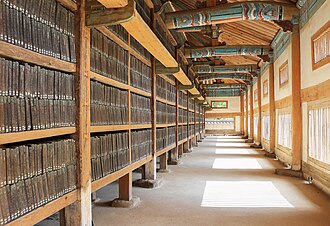
“The Tripitaka Koreana stands as one of the most complete and accurate collections of Buddhist scriptures ever produced — a monument not only to faith, but to human precision and endurance.”
Quick Facts: The Tripitaka Koreana at a Glance
| Detail | Information |
|---|---|
| Korean Name | 팔만대장경 (Palman Daejanggyeong) |
| Meaning of Name | “Eighty Thousand Great Canon” |
| Era | Goryeo Dynasty (918–1392) |
| First Edition Carved | 1011–1087 CE |
| Second Edition Carved | 1236–1251 CE |
| Number of Woodblocks | Approximately 81,258 |
| Number of Characters | Approximately 52 million |
| Current Location | Haeinsa Temple, South Gyeongsang Province |
| UNESCO Status | Memory of the World (1997); Haeinsa is a World Heritage Site |
| National Treasure | National Treasure of South Korea No. 32 |
Deep in the mountains of South Gyeongsang Province, sheltered within the ancient halls of Haeinsa Temple, rests one of the most extraordinary achievements in the history of world civilization. The Tripitaka Koreana — known in Korean as Palman Daejanggyeong, or the “Eighty Thousand Great Canon” — is a complete collection of Buddhist scriptures carved onto more than 81,000 wooden printing blocks during the Goryeo Dynasty. It is the world’s most comprehensive and best-preserved version of the Buddhist Tripitaka in classical Chinese script, and it has endured for nearly eight centuries without significant deterioration.
For English-speaking readers approaching Korean history, the Tripitaka Koreana offers a window into a civilization that combined extraordinary religious devotion with remarkable technical sophistication. Its creation was not a single act of faith, but a repeated one — undertaken twice in the face of foreign invasion, each time as a collective prayer for national salvation.
What Is the Tripitaka, and Why Did Goryeo Create It?
The word Tripitaka comes from Sanskrit, meaning “Three Baskets” — a reference to the three traditional categories of Buddhist scripture: the Vinaya (monastic rules), the Sutras (discourses of the Buddha), and the Abhidharma (philosophical analysis). Compiling a complete Tripitaka was considered both a supreme act of Buddhist piety and an enormous intellectual undertaking, requiring the gathering, comparison, and editing of thousands of individual texts from across the Buddhist world.
Korea’s Goryeo Dynasty (918–1392) was deeply Buddhist in character. Buddhism was effectively the state religion, patronized by the royal court and embedded in the social fabric of the kingdom. When Goryeo monks and scholars set about compiling their own Tripitaka, they were doing so within a tradition that already included Chinese and Khitan versions of the canon. But the Goryeo project was distinctive in its ambition to surpass all earlier editions in both scope and accuracy.
The first Goryeo edition of the Tripitaka was begun in 1011, during the reign of King Hyeonjong, shortly after a devastating Khitan invasion. The decision to carve the scriptures onto woodblocks was explicitly tied to a prayer for divine protection — the hope that the power of the Buddhist teachings, physically embodied in wood and ink, would drive away the invaders. This first set of woodblocks was completed around 1087 but was tragically destroyed during the Mongol invasions of the 13th century.
The Second Carving: Faith Under Fire (1236–1251)
The Mongol invasions of Korea, which began in earnest in 1231, brought catastrophic destruction to the Goryeo kingdom. Cities were burned, populations displaced, and cultural treasures lost. It was in this context of crisis and exile — the Goryeo court had relocated to Ganghwa Island — that the decision was made to carve an entirely new edition of the Tripitaka.
Work began in 1236 and was completed in 1251, spanning fifteen years of labor under conditions of enormous difficulty. The monks and craftsmen who undertook this project worked while their country was under siege, driven by the conviction that the creation of this sacred text would invoke the Buddha’s protection and help restore peace to the peninsula.
What resulted was not merely a faithful reproduction of earlier versions. The Goryeo scholars consulted the Chinese Song edition, the Khitan edition, and the first Goryeo edition to produce a text of unparalleled scholarly accuracy. Errors in earlier editions were identified and corrected. The result was the most reliable version of the Buddhist canon then in existence in East Asia — a reputation it has maintained to this day.
“Carved in exile, completed under Mongol siege, the second Tripitaka Koreana was not simply an act of survival — it was an act of civilizational affirmation. Goryeo was saying: we are still here, and we still believe.”
The Woodblocks: A Technical Marvel
Understanding the Tripitaka Koreana requires appreciating just how extraordinary a physical object it is. The surviving set consists of approximately 81,258 wooden printing blocks, each one two-sided, with text carved in relief so that pages could be printed by pressing paper against the inked surface. The total number of characters across all blocks is estimated at around 52 million — each one carved by hand with a precision that scholars and scientists have marveled at for centuries.
The wood used for the blocks was carefully selected and prepared through a multi-stage process. Timber — believed to have included birch and other hardwoods — was soaked in seawater for several years to prevent warping and cracking, then dried slowly in the shade, cut to size, and planed smooth. The edges of each block were reinforced with metal frames to prevent splitting. This painstaking preparation is one reason why the blocks have survived in such remarkable condition.
Perhaps most astonishingly, scholars who have studied the Tripitaka Koreana report that the carving is of extraordinary uniformity. Individual characters across thousands of blocks maintain consistent size, spacing, and stroke quality — suggesting either a team of highly disciplined craftsmen working to exacting standards, or a process of supervision and correction that ensured near-perfection throughout.
3 Reasons the Tripitaka Koreana Survived Eight Centuries
- The Design of Janggyeong Panjeon (The Storage Halls at Haeinsa): The wooden blocks were moved to Haeinsa Temple in the late 14th century, where they have been housed ever since in a complex of four storage buildings known as Janggyeong Panjeon. These structures, designated a UNESCO World Heritage Site in 1995, were designed with extraordinary environmental intelligence. The placement of the buildings on the mountainside, the size and positioning of the windows at different heights on opposing walls, and the use of charcoal, salt, and lime beneath the clay floors all contribute to a natural ventilation system that maintains stable temperature and humidity year-round — without any modern climate control. This passive environmental regulation has been the single most important factor in preserving the blocks.
- The Quality of the Original Craftsmanship: The preparation of the wood — years of soaking in seawater, slow drying, careful planing — resulted in materials of exceptional stability. The metal corner reinforcements prevented the most common form of damage to wooden objects over time. The quality of the ink and the depth of the carving have also contributed to the blocks’ longevity. In essence, the people who made the Tripitaka Koreana built it to last.
- The Continued Care of the Haeinsa Community: Haeinsa Temple has been an active Buddhist monastery throughout the centuries since the blocks were deposited there. The monastic community has maintained a tradition of stewardship, ensuring that the blocks were protected, periodically inspected, and never subjected to destructive use. Even during the Korean War, when much of the surrounding area was affected by conflict, the blocks survived — reportedly because an air force commander refused orders to bomb the temple complex.
The Tripitaka Koreana in the Modern World
Today, the Tripitaka Koreana occupies an honored place in both Korean national identity and global cultural heritage. It was inscribed on UNESCO’s Memory of the World Register in 1997, recognizing it as a document of world significance. The storage halls of Janggyeong Panjeon at Haeinsa were designated a UNESCO World Heritage Site in 1995, acknowledged as an outstanding example of traditional architectural ingenuity.
Within Korea, the Tripitaka Koreana is designated National Treasure No. 32. It is a source of deep national pride — a reminder that even in times of invasion and crisis, Korean civilization produced works of enduring beauty and scholarship. The popular name Palman Daejanggyeong (the Eighty Thousand Great Canon) reflects the awe with which Koreans have always regarded this achievement.
Scholars from around the world continue to consult the Tripitaka Koreana as a primary reference for Buddhist textual studies. Its accuracy has made it a standard against which other versions of the Buddhist canon are measured. Digital projects have made images of the woodblocks and their printed texts available to researchers globally, extending the reach of this medieval Korean achievement into the digital age.
Visiting Haeinsa: Where History Lives
For travelers to Korea, Haeinsa Temple in South Gyeongsang Province offers the rare experience of standing in the presence of a living heritage site. The temple itself dates to 802 CE and is one of Korea’s “Three Jewel Temples” — each dedicated to one of the three jewels of Buddhism (the Buddha, the Dharma, and the Sangha). Haeinsa represents the Dharma, the teachings, and the presence of the Tripitaka Koreana is the reason why.
Visitors can view the Janggyeong Panjeon storage halls and observe the woodblocks through the slatted windows — an experience that many describe as quietly overwhelming. The rows of ancient blocks, stretching the length of the long halls in their precise wooden racks, convey both the sheer scale of the undertaking and its remarkable state of preservation. Access to the halls themselves is restricted to protect the blocks, but the exterior view and the atmosphere of the mountain temple complex make Haeinsa one of the most distinctive heritage destinations in Korea.