“I still have twelve ships.” — Admiral Yi Sun-sin, before the Battle of Myeongnyang, 1597
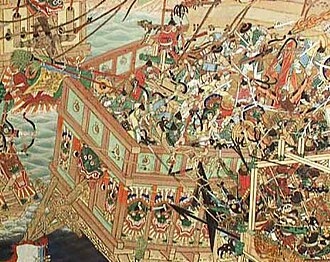
On October 26, 1597, one of the most extraordinary naval engagements in world history unfolded in the narrow strait of Myeongnyang, off the southwestern coast of the Korean peninsula. Outnumbered more than ten to one, the Joseon admiral Yi Sun-sin led a fleet of just 13 warships against a Japanese armada of 133 vessels. Against all odds, the Joseon navy not only survived — it won a decisive victory that would alter the course of the Imjin War and preserve Korea from complete Japanese conquest.
The Battle of Myeongnyang stands today as a defining moment in Korean history: a testament to brilliant military strategy, extraordinary personal leadership, and the unyielding determination of a nation fighting for its survival. It is remembered not merely as a military triumph, but as a story of what is possible when courage and intellect are deployed against seemingly insurmountable odds.
Quick Facts: The Battle of Myeongnyang
| Date | October 26, 1597 (lunar calendar: September 16, 1597) |
| Location | Myeongnyang Strait, near Jindo Island, Jeollanam-do, Korea |
| Joseon Commander | Admiral Yi Sun-sin |
| Joseon Fleet | 13 warships (panokseon) |
| Japanese Fleet | 133 warships, with approximately 200 logistical vessels |
| Outcome | Decisive Joseon victory; Japanese advance halted |
| Significance | Prevented Japanese naval advance into the Yellow Sea; protected Joseon’s supply lines |
| War Context | Second phase of the Japanese invasions of Korea (Imjin War), known as the Jeongyu War |
The Road to Myeongnyang: How Did Korea Reach the Brink of Collapse?
To understand the stakes at Myeongnyang, one must first understand the desperate circumstances that preceded it. Japan’s invasions of Korea — launched first in 1592 and again in 1597 — were the brainchild of the warlord Toyotomi Hideyoshi, who harbored sweeping ambitions to conquer China and establish Japanese dominance across East Asia. Korea, positioned as the land bridge between Japan and China, became the primary theater of war.
During the first invasion, Admiral Yi Sun-sin had proven himself an almost supernaturally effective naval commander. His use of the celebrated turtle ships (geobukseon) and his mastery of Korean coastal waters allowed the Joseon navy to win a series of remarkable victories, severing Japanese supply lines and frustrating Hideyoshi’s continental ambitions. The Japanese were eventually pushed into a coastal enclave through a combination of Joseon resistance, Chinese Ming intervention, and Yi’s naval dominance.
However, by 1597, Yi Sun-sin’s enemies — both Japanese and Korean — had conspired against him. Through a combination of political intrigue and deliberate deception, Yi was removed from his command, arrested, and tortured. He was demoted to the rank of common soldier. His replacement, Won Gyun, led the combined Joseon-Ming fleet to catastrophic defeat at the Battle of Chilchonryang in August 1597. In a single engagement, the Joseon navy was virtually annihilated: nearly the entire fleet was destroyed and Won Gyun was killed. The Japanese were now free to advance by sea.
Facing total disaster, King Seonjo had no choice but to reinstate Yi Sun-sin to command. When Yi arrived to take stock of his remaining forces, he found a shattered fleet — barely 12 to 13 operational warships — and deeply demoralized sailors. Some royal advisors urged the king to abandon the navy entirely and redeploy its men as land soldiers. Yi’s famous response, recorded in historical sources, was unequivocal: he had ships, and with ships, he would fight.
Why Did Yi Sun-sin Choose the Myeongnyang Strait?
The choice of the Myeongnyang Strait as the battlefield was itself the first act of genius in Yi’s plan. Rather than attempting to meet the Japanese fleet on the open sea — where his tiny force would simply be overwhelmed by sheer numbers — Yi sought a location where the geography itself could become a weapon.
The Myeongnyang Strait, also known as Uldolmok, is a narrow waterway between the southwestern tip of the Korean peninsula and Jindo Island. It is notorious for its powerful and rapidly reversing tidal currents. The strait is so narrow — barely 300 meters at its tightest point — that only a limited number of ships could pass through at any one time. The tidal currents in the strait reverse direction multiple times each day, running at exceptional speeds. A fleet attempting to navigate the strait would be at the mercy of these currents; ships caught in an unfavorable tide could be rendered almost immobile or forced into chaotic disorder.
Yi Sun-sin had intimate knowledge of these waters. He understood that the tidal cycle would be his greatest ally. By timing the engagement carefully and positioning his fleet at the northern mouth of the strait, he could force the Japanese to funnel their ships through the channel in relatively small groups, negating their overwhelming numerical advantage. The strait would do much of the work of evening the odds.
“The fate of our nation depends on this moment. Every ship and every sailor must fight to the last.” — Yi Sun-sin, rallying his commanders before the battle
The Battle: Thirteen Ships Against an Armada
On the morning of October 26, 1597, the Japanese fleet — 133 warships with roughly 200 additional logistical and support vessels — entered the Myeongnyang Strait. The sheer scale of the Japanese force must have been terrifying. Yi’s 13 panokseon warships waited at the northern end of the strait.
As the Japanese vanguard advanced with the incoming tide, they found themselves in a narrowing channel, unable to deploy their full force. Yi led his flagship directly into the attack, engaging the lead Japanese vessels at close range with cannon fire. The concentrated firepower of the Joseon ships, combined with the bottleneck created by the strait, inflicted severe early casualties on the Japanese lead elements.
Then came the moment of crisis. Whether from panic or a deliberate feint, some of Yi’s ships began to withdraw, threatening to abandon their admiral. Yi held his position alone, maintaining fire against the pressing Japanese fleet. The sight of their commander refusing to retreat is said to have shamed his captains back into the fight.
As the tide reached its peak and began to reverse, disaster struck the Japanese fleet. The powerful current of the Myeongnyang Strait abruptly changed direction, catching the Japanese ships as they pressed forward. Vessels were driven into one another. The tight formation of the advancing Japanese fleet became a source of vulnerability rather than strength — ships collided, men were swept overboard, and the orderly advance disintegrated into confusion.
Yi seized the moment. His 13 ships advanced aggressively, concentrating cannon fire on the disorganized Japanese vanguard. Japanese ships were sunk or disabled in significant numbers. Historical accounts record that the Japanese flagship of the naval commander Kurushima Michifusa was sunk during the engagement, and Kurushima himself was killed. With their lead ships wrecked and the tide working against them, the Japanese fleet retreated from the strait.
The battle was over. Yi Sun-sin had lost no ships and suffered minimal casualties. The Japanese had lost at least 31 warships confirmed sunk, with accounts suggesting considerably higher losses among the support vessels. The Japanese naval advance had been stopped completely.
Why Does the Battle of Myeongnyang Still Matter?
The strategic consequences of the Battle of Myeongnyang were immediate and profound. The Japanese strategy in the second invasion depended on coordinating land and sea advances simultaneously. Their naval force was tasked with advancing northward through the Yellow Sea to support army operations and threaten Joseon’s remaining strongholds. Yi’s victory denied them this option entirely. With their naval flank shattered, Japanese land forces were left isolated, unable to receive reliable resupply by sea and unable to push further north as planned.
The battle also restored Joseon morale at a moment of near-total despair. After the catastrophe of Chilchonryang and the subsequent Japanese land advances, many in Korea had begun to believe that resistance was futile. Myeongnyang demonstrated that Japanese forces were not invincible — that Korean arms, intelligently wielded, could prevail against far superior numbers.
Over the longer term, the battle contributed to the eventual withdrawal of Japanese forces from Korea following Toyotomi Hideyoshi’s death in 1598. The Japanese invasions ended without achieving any of their strategic objectives. Korea — battered and scarred — survived as a sovereign nation.
Joseon vs. Japanese Naval Power: A Comparison
| Factor | Joseon Fleet (Yi Sun-sin) | Japanese Fleet |
|---|---|---|
| Number of warships | 13 | 133 |
| Primary weapon | Naval cannons (cheonja, jija type) | Boarding tactics, arquebuses |
| Ship design | Panokseon (high-sided, cannon-platform warships) | Atakebune and smaller vessels |
| Local knowledge | Extensive — Yi had surveyed Korean waters | Limited; unfamiliar with tidal patterns |
| Strategic position | Defending narrow strait; tidal advantage | Attacking through funnel; vulnerable to tides |
| Losses at Myeongnyang | No ships lost | At least 31 warships sunk |
Yi Sun-sin: The Admiral Who Would Not Yield
No account of Myeongnyang can be separated from the figure of Yi Sun-sin himself. Born in 1545 in Hanseong (present-day Seoul), Yi followed a path to military service that was marked by repeated setbacks and political adversity. He passed the military examination late, served in difficult frontier postings, and was twice demoted before the Imjin War began. Yet he consistently demonstrated an unusual combination of tactical creativity, meticulous preparation, and an almost preternatural calm under pressure.
Yi’s personal war diary, the Nanjung Ilgi (War Diary), survives as one of the most remarkable first-person accounts of military service in Korean history. Written in classical Chinese, it records the daily minutiae of naval command — the condition of ships and men, the weather and tides, the constant struggle to maintain a fighting force under conditions of severe hardship. It is also a deeply human document: Yi wrote of grief, doubt, exhaustion, and the weight of responsibility. Yet again and again, he found ways to persist.
Yi Sun-sin was killed in the final naval battle of the Imjin War — the Battle of Noryang in December 1598 — reportedly struck by a stray bullet as the last Japanese fleet attempted to withdraw from Korea. His final reported words were a command not to let his death be known, lest it disrupt the pursuit of the retreating enemy. He died as he had lived: thinking of the mission above himself.
Today Yi Sun-sin is revered in Korea as one of the greatest figures in national history. His statue stands prominently in Gwanghwamun Square in the heart of Seoul. His image appears on the Korean 100-won coin. The Hyundai destroyer ROKS Yi Sun-sin carries his name. In 2023, a major Korean film further brought his story to a new generation of viewers. He is, in the truest sense, a hero who belongs to Korean history permanently.