“The scholar who passes through these gates does not merely seek learning — he seeks to become the foundation upon which a just kingdom is built.”
At the heart of Seoul’s Jongno District, tucked behind ancient walls and shaded by centuries-old ginkgo trees, stands one of the most consequential institutions in Korean history. Sungkyunkwan — known in its historical romanization as Sŏnggyun’gwan — was the supreme national academy of the Joseon Dynasty, a place where Korea’s most brilliant minds were forged into the scholars and statesmen who would govern an entire civilization for nearly five centuries.
Founded in 1398, the very year after the Joseon Dynasty established its new capital at Hanyang (present-day Seoul), Sungkyunkwan was never merely a school. It was a statement of philosophical intent — a declaration that the new dynasty would be built on the principles of Neo-Confucianism, and that the cultivation of virtuous, educated men was the surest path to a well-ordered state. Today, its surviving buildings remain one of the most significant historical sites in South Korea, and its legacy endures in the modern Sungkyunkwan University that bears its name.
| Founded | 1398 (Joseon Dynasty) |
|---|---|
| Location | Jongno District, Seoul, South Korea |
| Purpose | Supreme national Confucian academy and shrine |
| Philosophical Basis | Neo-Confucianism |
| Key Functions | Education of the yangban elite; Confucian ritual observances; preparation of scholars for state examinations |
| Modern Legacy | Sungkyunkwan University (founded 1895 in the modern era); historic site preserved in Seoul |
| Heritage Status | Historic Site, South Korea |
The Founding of a Scholarly Kingdom
To understand why Sungkyunkwan mattered so profoundly, one must understand the ambitions of the men who founded Joseon. When General Yi Seonggye overthrew the Goryeo Dynasty in 1392 and proclaimed a new kingdom, he and his allies — particularly the influential Neo-Confucian scholar-official Jeong Dojeon — envisioned a state radically different from what had come before. Where Goryeo had been deeply entangled with Buddhist institutions and aristocratic privilege, Joseon would be reshaped around Confucian principles of governance, social hierarchy, and moral cultivation.
Education was central to this vision. A state governed by virtuous, learned men required a supreme institution where such men could be produced. Thus, just one year after the dynasty’s founding and immediately following the establishment of the new capital, Sungkyunkwan was inaugurated in 1398. Its location in the new capital was deliberate — placing the highest seat of learning at the very center of dynastic power sent an unmistakable message about the values the new regime wished to project.
The institution was not invented from nothing. Joseon’s founders drew on earlier precedents, including the Goryeo-era Gukjagam, a state academy that had itself been modeled on Tang Dynasty Chinese institutions. But Sungkyunkwan represented a more thoroughgoing commitment to Confucian education than anything Korea had previously attempted, and it quickly became the pinnacle of an elaborate educational pyramid that extended across the entire peninsula.
What Did Sungkyunkwan Actually Do?
Sungkyunkwan served two distinct but deeply intertwined functions: it was both a place of learning and a place of ritual. These two aspects were inseparable in the Confucian worldview, where scholarship and proper ceremonial observance were two sides of the same coin of moral cultivation.
As an educational institution, Sungkyunkwan was open only to the most accomplished scholars — typically young men of the yangban (aristocratic) class who had already passed lower-level examinations. Students resided within the academy’s walls, immersed in the study of the Confucian classics: texts such as the Four Books and Five Classics that formed the intellectual backbone of East Asian civilization. The curriculum was demanding, the expectations high. Graduates were expected to go on to sit the higher-level civil service examinations, the gwageo, and from there enter the ranks of government officials who administered the kingdom.
The student body at any given time was relatively small — typically a few hundred scholars — but their influence was outsized. These were the men who would occupy the highest positions in the Joseon bureaucracy. A degree earned through the rigorous process that culminated at Sungkyunkwan was the surest route to power, prestige, and the ability to shape national policy.
“Sungkyunkwan did not simply produce officials — it produced a particular kind of official: one who believed that learning, virtue, and service to the state were not separate pursuits but a single, unified calling.”
As a ritual institution, Sungkyunkwan housed the Munmyo — a Confucian shrine dedicated to Confucius himself and to a select group of his most revered disciples, as well as to Korean Confucian scholars who had been granted the honor of enshrinement. Twice yearly, elaborate ceremonies called Seokjeon Daeje were performed at the Munmyo, rites that connected the Korean court and its scholars to the great tradition of Confucian civilization stretching back to ancient China. These ceremonies were not mere formality — they were solemn affirmations of the values upon which Joseon society was founded.
The Architecture of Learning: What Still Stands Today
The physical campus of Sungkyunkwan was a carefully planned complex whose layout itself encoded Confucian values. The grounds were divided between the ritual and the educational: the Munmyo shrine precinct occupied a position of sacred primacy, while the lecture halls, dormitories, and administrative buildings of the academy proper were arranged around it.
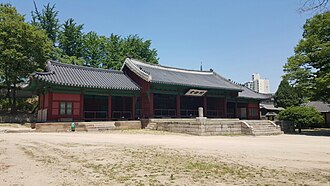
Several of the original or reconstructed buildings survive to this day, making the Sungkyunkwan site one of the most atmospheric historical destinations in Seoul. The Daeseongjeon, the main hall of the Munmyo shrine, is the heart of the complex — a stately, austere building whose very simplicity speaks to Confucian ideals of restraint and seriousness. The Myeongnyundang served as the principal lecture hall, the space where generations of Korea’s most gifted scholars sat and wrestled with the classical texts. The Dongmu and Seomu — the east and west wings of the shrine — housed the spirit tablets of Confucian sages and worthy Korean scholars.
Perhaps most evocative of all are the ancient ginkgo trees that shade the courtyards — living witnesses to centuries of scholarship, their longevity a fitting symbol for an institution devoted to the transmission of ancient wisdom across generations.
Why Did Sungkyunkwan Endure for Nearly 500 Years?
Institutions rarely survive half a millennium without significant reasons. Sungkyunkwan’s extraordinary longevity rested on several mutually reinforcing foundations.
1. Its inseparability from state power. The Joseon government did not merely support Sungkyunkwan — it depended on it. The civil service examination system, the gwageo, was the primary mechanism through which the state recruited its officials, and Sungkyunkwan was the apex of the educational system that fed into those examinations. Destroying or neglecting Sungkyunkwan would have meant undermining the very system by which the government reproduced itself. The institution was thus protected by the self-interest of the ruling class as much as by any ideological commitment.
2. Its role as the keeper of Confucian orthodoxy. Throughout the Joseon period, Neo-Confucianism was not just a philosophical school but the official state ideology. Sungkyunkwan’s scholars were the authoritative interpreters of that ideology, and the institution served as a kind of intellectual conscience for the dynasty. On more than one occasion, Sungkyunkwan students and scholars used their institutional prestige to remonstrate with kings and officials who deviated from Confucian norms — a remarkable form of intellectual-political power that only an institution of such deep legitimacy could exercise.
3. Its ritual significance. The ceremonies conducted at the Munmyo shrine gave Sungkyunkwan a sacred dimension that transcended its purely educational function. Kings personally participated in or oversaw these rites, lending the institution a royal prestige that insulated it from the vicissitudes of factional politics and dynastic upheaval.
4. Its adaptability. While Sungkyunkwan remained committed to the Confucian canon, the institution was not entirely static. Different periods of the Joseon Dynasty saw shifts in emphasis, debates about curriculum, and engagement with new intellectual currents — including, in the dynasty’s later years, the practical learning movement known as Silhak, which challenged some aspects of orthodox Neo-Confucianism while still operating within the broader Confucian framework.
Sungkyunkwan and the Lives of Joseon Scholars
Life within Sungkyunkwan’s walls was rigorous and highly regimented. Students — called yuhaksaeng or simply yuseong — lived in dormitories and followed a demanding daily schedule of study, ritual observance, and intellectual debate. Attendance was tracked, behavior was monitored, and the culture of the institution rewarded seriousness and application. At the same time, the community of scholars who lived and studied together formed bonds that would persist throughout their careers, creating networks of intellectual kinship that shaped Korean political and cultural life for generations.
The image of Sungkyunkwan scholars has captured the Korean popular imagination in later centuries — perhaps most visibly in the modern era through films and television dramas that have romanticized life at the academy, introducing its history to new generations of Koreans and international audiences alike.
| Institution | Country | Founded | Key Role |
|---|---|---|---|
| Sungkyunkwan | Korea (Joseon) | 1398 | Supreme national academy; training ground for government officials |
| Imperial Academy (Guozijian) | China (various dynasties) | Established variously from Han Dynasty onward | Central state institution for Confucian education and examination preparation |
| Shōheikō | Japan (Edo period) | Formally established 1797 | Official Confucian academy under Tokugawa shogunate |
The End of an Era — and a Remarkable Survival
The Joseon Dynasty’s long decline in the nineteenth century inevitably affected Sungkyunkwan. The gwageo examination system, which had given the academy its central place in Korean public life, was abolished in 1894 as part of the Gabo Reform movement that sought to modernize Korean institutions under the pressure of external forces and internal crisis. Without the examinations to feed, Sungkyunkwan’s original educational function was effectively ended.
Yet the institution did not disappear. In 1895, a modern successor institution — Gyeonghakwon, later transformed into what would become Sungkyunkwan University — was established, drawing on the prestige and legacy of the old academy while adapting to the requirements of a modernizing Korea. The ritual functions of the Munmyo shrine also survived, and the Seokjeon Daeje ceremonies continue to be performed to this day, maintaining a living connection to Joseon-era Confucian practice that is remarkable by any measure.
The physical site itself survived the upheavals of Japanese colonial rule (1910–1945), the liberation, the Korean War, and the rapid urbanization of Seoul — a survival that speaks both to the site’s deep cultural significance and to deliberate efforts at preservation. Today it is protected as a Historic Site by the South Korean government, and the Munmyo shrine and its surrounding buildings attract visitors, scholars, and participants in the traditional ceremonies that still animate this ancient place.
Why Sungkyunkwan Still Matters
Nearly 630 years after its founding, Sungkyunkwan remains one of the most important windows into Korean civilization. It embodies the profound seriousness with which Joseon Korea approached the project of education — the conviction that learning was not a private pursuit but a public duty, that the cultivation of virtuous and capable individuals was the foundation of a just society, and that the transmission of wisdom across generations was among the most sacred obligations a civilization could undertake.
These ideas, rooted in the Confucian tradition, shaped Korean society in ways that scholars continue to debate and explore. The emphasis on education, the respect for scholarship, the deep investment in examinations as a meritocratic ideal — threads that run through Korean culture to the present day have roots, at least in part, in the institution that stood at the heart of Joseon’s intellectual world.
To walk through the gates of the Sungkyunkwan complex today is to step into one of the longest and most consequential stories in Korean history — the story of a civilization that believed, with extraordinary persistence, that how you educated your people was how you shaped your future.
Continue Exploring
On Korea Through Time
- The Joseon Dynasty: Five Centuries of Confucian Korea
- The Gwageo: Korea’s Civil Service Examination and the Meritocratic Ideal
- Neo-Confucianism and the Shaping of Joseon Society
- Seokjeon Daeje: The Living Confucian Ceremony That Has Survived 600 Years