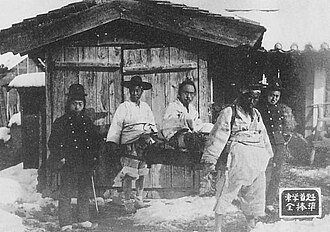
“The people are the most precious element in a nation; the sovereign is the least important.” — A principle that echoed through the hearts of the Tonghak movement as ordinary Koreans rose against centuries of oppression in 1894.
In the spring of 1894, something unprecedented swept across the Korean peninsula. Tens of thousands of farmers, artisans, and disaffected commoners — armed with bamboo spears and a burning sense of injustice — rose against the corruption of the Joseon dynasty in what would become the largest peasant rebellion in Korean history. The Tonghak Peasant Revolution was not merely a local disturbance; it was a seismic event that would draw in Chinese and Japanese military forces, dramatically accelerate the collapse of the 500-year-old Joseon dynasty, and ultimately reshape the entire East Asian political order.
To understand the revolution, one must first understand the world that produced it — a Korea in which ordinary people had been ground down for generations by a system that seemed designed to extract every last grain of rice from those least able to afford it.
Quick Facts: The Tonghak Peasant Revolution
| Detail | Information |
|---|---|
| Date | 1894 |
| Location | Korean peninsula (Joseon dynasty) |
| Primary Participants | Tonghak religious followers, peasant farmers, Joseon government forces, Chinese (Qing) troops, Japanese Imperial Army |
| Key Leaders | Jeon Bong-jun (peasant leader), Choe Si-hyeong (Tonghak religious leader) |
| Outcome | Rebellion suppressed; triggered the First Sino-Japanese War (1894–1895) |
| Also Known As | Donghak Peasant Revolution; Gabo Peasant War |
| Significance | Largest peasant uprising in Korean history; accelerated fall of the Joseon dynasty |
The World That Made the Revolution: Joseon in Crisis
By the late nineteenth century, the Joseon dynasty was showing every sign of an empire in terminal decline. The ruling yangban aristocracy had long since abandoned the Confucian ideal of virtuous governance in favour of naked self-interest. Local magistrates — appointed not for competence but for connections — routinely extorted the peasantry through illegal taxation, forced labour, and the manipulation of the grain loan system known as hwan’gok. Farmers who borrowed grain in the lean months found themselves paying back interest rates that could consume their entire harvest.
At the same time, Korea was being forced open to foreign trade. The 1876 Treaty of Ganghwa with Japan had cracked open the peninsula’s markets, and a flood of cheap Japanese goods devastated traditional Korean crafts and commerce. Merchant classes found themselves squeezed out while foreign traders prospered. The combination of internal corruption and external economic pressure created a population primed for revolt.
Into this volatile atmosphere came the Tonghak movement — a Korean religious and philosophical tradition founded in 1860 by Choe Je-u. The name Tonghak means “Eastern Learning,” and it was conceived explicitly as a counterweight to Seohak (“Western Learning,” meaning Catholicism) and to the perceived threat of Western imperialism. Tonghak blended elements of Confucianism, Buddhism, shamanism, and Taoism into a syncretic system that placed extraordinary emphasis on human dignity and the equality of all people before heaven. Its central teaching — that every human being carries the divine within them — was quietly revolutionary in a society built on rigid hierarchies of class and gender.
Choe Je-u was executed by the Joseon government in 1864, which regarded Tonghak as a dangerous heresy. But martyrdom only deepened the movement’s roots among the common people. By the 1890s, Tonghak had spread widely across the Jeolla and Chungcheong provinces of southwestern Korea, precisely the regions where peasant misery was most acute.
Why Did the Tonghak Rebellion Explode in 1894?
The immediate trigger came from Gobu County in North Jeolla Province. In early 1894, a notoriously corrupt local magistrate named Jo Byeong-gap had been forcing farmers to build a new reservoir using unpaid labour, then charging them for the water it stored. When petitions to higher authorities went unanswered, local Tonghak leader Jeon Bong-jun organised a protest that stormed the county office and distributed the magistrate’s illegally hoarded grain to the poor.
The government’s response — sending in troops to punish not the corrupt magistrate but the protesting farmers — ignited a full-scale revolt. Jeon Bong-jun emerged as the rebellion’s military commander, a charismatic and tactically gifted leader who would become one of the most celebrated figures in Korean popular memory. Under his leadership, Tonghak forces won a remarkable series of early victories against government troops.
“We rise not to overthrow the king, but to drive out corrupt officials and save the people. Our cause is righteous and our hearts are one.” — Attributed to Jeon Bong-jun at the outset of the rebellion, expressing the movement’s reformist rather than revolutionary intent.
In May 1894, the rebels achieved their most stunning victory at the Battle of Hwangnyongjae, routing government forces and capturing Jeonju — the administrative capital of Jeolla Province and a city of enormous symbolic importance as the ancestral home of the Joseon royal family. The fall of Jeonju sent shockwaves through the corridors of power in Seoul.
The Jeonju Agreement and the Foreign Intervention That Changed Everything
Facing a military crisis it could not resolve alone, the Joseon court made a fateful decision: it requested military assistance from Qing China under the terms of the 1885 Convention of Tientsin. China dispatched troops to Korea — and, crucially, Japan used this as justification to send its own military forces to the peninsula, citing the same convention’s requirement that each signatory notify the other before deploying troops to Korea.
Suddenly what had begun as a domestic peasant revolt had become an international crisis. In June 1894, Jeon Bong-jun and the Tonghak leadership negotiated the Jeonju Agreement with the government, agreeing to withdraw their forces in exchange for a list of sweeping reform demands. These demands — known as the Jipgang reforms — called for the abolition of the discriminatory social status system, the elimination of illegal taxation, land redistribution, and punishment of corrupt officials. The rebels had, in effect, articulated a programme of comprehensive social transformation.
But the foreign troops did not leave. Japan, which had been planning to contest Chinese influence on the peninsula for years, was not going to waste the opportunity that Korean instability had handed it. In July 1894, Japanese forces seized the Gyeongbokgung Palace in Seoul and installed a pro-Japanese government. The First Sino-Japanese War began. Korea, the stated reason for the conflict, had become a chessboard for its more powerful neighbours.
3 Lasting Consequences of the Tonghak Peasant Revolution
1. It Triggered the First Sino-Japanese War
The Joseon court’s decision to invite Chinese military assistance gave Japan its long-sought pretext to deploy forces to Korea. The resulting conflict between China and Japan — fought largely on Korean soil — ended in humiliating defeat for the Qing dynasty. The 1895 Treaty of Shimonoseki forced China to recognise Korean independence (which in practice cleared the way for Japanese dominance), cede Taiwan to Japan, and pay enormous reparations. The regional balance of power was fundamentally reordered, with consequences that would echo through the twentieth century.
2. It Accelerated the Gabo Reforms
The Japanese-backed government installed in Seoul in 1894 implemented a sweeping set of modernising reforms known as the Gabo Reforms. Many of these reforms — including the abolition of the traditional class system, the elimination of the civil service examination based on classical Chinese texts, and legal reforms — directly reflected demands that the Tonghak rebels had articulated in the Jeonju Agreement. The peasant revolution had, in a bitter irony, helped produce the reforms it demanded, but under the auspices of a foreign occupier rather than a reformed Korean government.
3. It Left a Permanent Mark on Korean National Memory
Jeon Bong-jun was captured in December 1894 and executed by the Korean government in March 1895. His death did not end the Tonghak movement’s legacy. In the twentieth century, the revolution was reinterpreted as a proto-nationalist struggle — a forerunner of the resistance against Japanese colonial rule that would define Korean political consciousness for generations. Today, Jeon Bong-jun is celebrated as a national hero in South Korea, and the revolution is commemorated as a defining moment in the long Korean struggle for popular sovereignty and social justice.
The Second Phase: Autumn 1894 and Final Defeat
Following the Jeonju Agreement, the Tonghak forces had formally stood down. But as it became clear that Japan intended to dominate Korea regardless of the revolution’s outcome, Jeon Bong-jun called the Tonghak armies back into action in September 1894. This second phase of the rebellion was far more explicitly anti-Japanese in character than the first, which had focused primarily on domestic corruption.
The rebels faced a transformed military situation. Japanese forces, fresh from their successes against Chinese troops, were now fully deployed across Korea and actively supporting the Joseon government’s efforts to suppress the rebellion. At the Battle of Ugeumchi in November 1894 — the decisive engagement of the revolution — Tonghak forces armed largely with traditional weapons faced Japanese rifle volleys and suffered catastrophic casualties. Some accounts describe the rebels advancing wave after wave against prepared Japanese positions, only to be cut down by modern firepower. The revolution’s military capacity was effectively destroyed.
Jeon Bong-jun fled south but was betrayed and captured in December 1894. He was brought to Seoul and executed in March 1895. With him died the last organised armed resistance of the Tonghak revolution, though the Tonghak religious movement itself survived and eventually transformed into the Cheondogyo religion, which would play an important role in the March First Independence Movement of 1919.
Comparing the Two Phases of the Revolution
| Feature | First Phase (Spring 1894) | Second Phase (Autumn 1894) |
|---|---|---|
| Primary Target | Corrupt Joseon officials and aristocracy | Japanese military presence in Korea |
| Military Outcome | Initial rebel successes; capture of Jeonju | Decisive defeat at Battle of Ugeumchi |
| Political Context | Domestic crisis; foreign troops not yet deployed | First Sino-Japanese War underway; Japan dominant |
| Key Agreement/Event | Jeonju Agreement with Joseon government | No agreement; full military suppression |
| Character of Movement | Anti-corruption, social reform | Nationalist, anti-foreign intervention |
Why the Tonghak Revolution Still Matters Today
It would be easy to view the Tonghak Peasant Revolution as simply a failed uprising — a moment when ordinary people reached for a better world and were crushed by forces too powerful to resist. But that reading misses what the revolution actually accomplished and what it represents in the longer arc of Korean history.
The revolution demonstrated, for the first time in Korean history, that commoners could organise on a massive scale and articulate a coherent vision of social transformation. The Jeonju Agreement’s reform demands were sophisticated, detailed, and morally serious. They showed that the people at the bottom of Korea’s rigid hierarchy had not merely absorbed their oppression — they had thought carefully about alternatives and were prepared to fight for them.
The revolution also revealed the fatal vulnerability of the late Joseon state: its inability to reform itself from within, and its dangerous dependence on foreign military power to suppress domestic dissent. By inviting Chinese troops to suppress Korean peasants, the Joseon court set in motion the chain of events that would eventually lead to Japan’s annexation of Korea in 1910. In this sense, the Tonghak revolution did not cause Korea’s colonisation — it exposed the conditions that made colonisation possible.
For modern Koreans, the revolution carries a powerful emotional resonance that transcends historical analysis. Jeon Bong-jun’s face appears on postage stamps. Films and television dramas have retold his story to new generations. The sites of the revolution — particularly in North Jeolla Province — draw visitors who come not just as tourists but as pilgrims to a founding moment of Korean democratic consciousness. The Tonghak revolution reminds Koreans, and anyone who studies Korea, that history is not only made by kings and generals. Sometimes it is made by farmers with bamboo spears who decided they had had enough.
Continue Exploring
On Coreaverse
- The Joseon Dynasty: Five Centuries of Korean Civilisation
- The March First Movement: Korea’s Declaration of Independence
- Cheondogyo: From Tonghak Roots to Modern Religion