“A kingdom that had endured for nearly seven centuries was extinguished in a single summer campaign — yet its people refused to accept the verdict.”
In the summer of 660 CE, one of the three great kingdoms of ancient Korea ceased to exist. Baekje, a sophisticated state that had flourished on the southwestern Korean peninsula for roughly 678 years, fell to a devastating coordinated invasion by the Tang dynasty of China and its Korean ally, the kingdom of Silla. The campaign was swift, the collapse dramatic, and the aftermath fiercely contested. Understanding how and why Baekje fell reveals not only the military and political realities of seventh-century East Asia, but also the remarkable resilience of a people who fought on long after their king had surrendered.
Quick Facts: The Fall of Baekje
| Detail | Information |
|---|---|
| Conflict | Baekje–Tang War (Paekche–Tang War) |
| Date | 660 CE (main campaign) |
| Location | Southwestern Korean peninsula (modern South Chungcheong and North Jeolla provinces) |
| Key Combatants | Baekje vs. Tang dynasty + Silla alliance |
| Tang Commander | Su Dingfang |
| Silla Commander | General Kim Yushin |
| Baekje King at Fall | King Uija (r. 641–660) |
| Decisive Battle | Battle of Hwangsanbeol (660 CE) |
| Outcome | Baekje conquered; king captured and taken to Tang China |
| Resistance Ended | 663 CE (Battle of Baekgang) |
Three Great Kingdoms: The World Baekje Inhabited
To understand Baekje’s fall, we must first understand its world. The Korean peninsula in the sixth and seventh centuries was dominated by three competing kingdoms: Goguryeo in the north, Baekje in the southwest, and Silla in the southeast. These three states — collectively known in Korean history as the Samguk, or Three Kingdoms — had coexisted, competed, and occasionally cooperated for centuries. Each developed distinct cultures, administrative systems, and diplomatic relationships with the great powers of continental East Asia.
Baekje occupied a strategically valuable position. Its territory encompassed rich agricultural lowlands and a long coastline that facilitated maritime trade and cultural exchange. Baekje had historically maintained close cultural and diplomatic ties with Japan, transmitting Buddhism, Chinese writing, and sophisticated artistic traditions to the Japanese archipelago. Its relationship with the Tang dynasty of China, however, was far more complicated, and it was Baekje’s geopolitical positioning between Goguryeo to the north and Silla to the east that would ultimately doom it.
Throughout the sixth century and into the seventh, Baekje and Silla had fought repeatedly over border territories, particularly the fertile Nakdong River basin. These wars left lasting enmity. When Silla’s Queen Seondeok sought Tang assistance against her enemies in the 640s, the diplomatic groundwork was being laid for a coalition that Baekje could not survive.
Why Did the Tang Dynasty Target Baekje?
The Tang dynasty’s interest in Korean affairs was not simply territorial ambition. Tang Emperor Taizong and his successor Gaozong viewed the Korean peninsula through the lens of strategic necessity. Goguryeo, the northern Korean kingdom, had famously repelled multiple Sui dynasty invasions in the early seventh century and continued to resist Tang pressure. To isolate and eventually defeat Goguryeo, Tang strategists recognized that Baekje — which had formed a de facto alliance with Goguryeo — needed to be neutralized first.
Silla, meanwhile, had cultivated a close tributary relationship with the Tang court, presenting itself as a loyal and cooperative partner. Silla rulers adopted Tang administrative models, sent students to Tang academies, and framed their requests for military assistance in terms of loyalty to the Tang emperor. This diplomatic strategy paid enormous dividends in 660 CE, when Emperor Gaozong authorized a massive expeditionary force to assist Silla against Baekje.
“The alliance between Tang and Silla was not born of friendship — it was a marriage of strategic convenience that would reshape the entire Korean peninsula.”
The Campaign of 660: A Kingdom Falls in Weeks
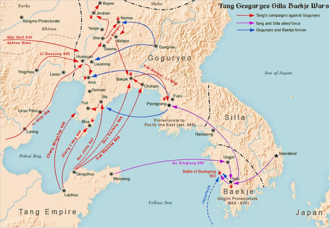
The military campaign that destroyed Baekje was a model of coordinated strategic action for its era. In the summer of 660 CE, a Tang fleet commanded by the general Su Dingfang transported an army of reportedly 130,000 soldiers across the Yellow Sea, landing near the mouth of the Geum River in Baekje territory. Simultaneously, a Silla army under the celebrated general Kim Yushin marched westward from Silla territory, intending to link up with the Tang forces.
Baekje’s military response was hampered by internal political divisions. King Uija, who had come to power in 641 CE, faced criticism in later Korean sources for surrounding himself with favorites and neglecting sound governance — though historians treat such characterizations with appropriate caution, recognizing that victors often shape the historical narrative of the defeated. What is clear is that Baekje failed to mount an effective coordinated defense.
The critical land engagement came at the Battle of Hwangsanbeol, where a Baekje army commanded by the general Gyebaek attempted to block Silla’s westward advance. Gyebaek’s force was vastly outnumbered. According to Korean historical tradition, before the battle Gyebaek killed his own family rather than leave them to potential capture, a story that has made him one of the most tragic and celebrated figures in Korean military history. His army fought ferociously but was overwhelmed. The road to the Baekje capital of Sabi (modern Buyeo) lay open.
With Tang forces advancing from the coast and Silla forces converging from the east, Sabi fell rapidly. King Uija initially fled northward to the secondary capital of Ungjin but soon surrendered. He was taken as a prisoner to Tang China, where he died. The Baekje royal court, nobility, and thousands of captives were transported to Tang territory. After nearly seven centuries, the kingdom of Baekje had ceased to exist as a sovereign state.
The Baekje Restoration Movement: Resistance After Collapse
The conquest of the Baekje capital did not end the story. Across the former Baekje territory, local aristocrats, military commanders, and ordinary people refused to accept the new order. A remarkable and prolonged resistance movement emerged almost immediately after the fall of Sabi in 660 CE.
Baekje loyalists rallied around surviving members of the royal family and regional strongholds. They sent urgent appeals to their long-standing ally, the kingdom of Yamato Japan, requesting military assistance. Japan responded with a substantial naval and military force, reflecting both the deep historical ties between Baekje and Japan and the strategic concern that a Tang-Silla dominated Korea would threaten Japanese interests.
The culminating moment of the Baekje restoration effort came in 663 CE at the Battle of Baekgang (also known as the Battle of the Baekgang River or Hakusukinoe in Japanese sources). A combined Baekje loyalist and Japanese fleet confronted Tang and Silla naval forces near the mouth of the Geum River. The engagement was a decisive defeat for the Baekje-Japanese coalition. After Baekgang, organized Baekje resistance collapsed, and Japan, alarmed by the defeat, retreated from continental ambitions and turned inward, initiating a remarkable period of defensive consolidation and internal reform.
Comparing the Three Kingdoms’ Fates
| Kingdom | Fell To | Year of Fall | Circumstances |
|---|---|---|---|
| Baekje | Tang + Silla | 660 CE | Rapid military conquest; loyalist resistance until 663 CE |
| Goguryeo | Tang + Silla | 668 CE | Prolonged campaign; internal divisions weakened resistance |
| Silla | N/A (Survived) | Unified peninsula 668 CE | Alliance with Tang enabled conquest of rivals; later expelled Tang forces |
What Did the Fall of Baekje Mean for Korean History?
The destruction of Baekje in 660 CE was the first step in a transformation that would define the Korean peninsula for centuries. Within eight years, Goguryeo had also fallen to the same Tang-Silla alliance. Silla then found itself in direct conflict with Tang, which sought to administer the conquered territories as Tang provinces rather than return them to Silla control. In a remarkable reversal, Silla fought off Tang forces and achieved what historians call the Unification of the Three Kingdoms by the late 670s — though it is worth noting that this unification excluded the northern territories of the former Goguryeo kingdom, where the state of Balhae would eventually emerge.
For the people of former Baekje, the conquest meant absorption into the Unified Silla state. Baekje elites were gradually integrated into Silla’s aristocratic order, and Baekje cultural traditions — including its rich Buddhist artistic heritage — were absorbed and transformed within the broader culture of Unified Silla. The memory of Baekje, however, persisted in regional identity and in historical consciousness. The modern city of Buyeo, site of the former Baekje capital Sabi, remains a center of Baekje heritage, and the Baekje Historic Areas were inscribed on the UNESCO World Heritage List in 2015.
The story of Baekje’s fall also resonates as a reminder of how geopolitical alignments can override even deep cultural and historical bonds. Silla and Baekje were linguistically and culturally related Korean kingdoms, yet Silla’s alliance with a foreign empire brought about the destruction of its neighbor. The Tang dynasty, for its part, sought to use the Korean campaigns for imperial expansion but ultimately found that Silla was a more formidable and independent partner than expected.
General Gyebaek, who died at Hwangsanbeol fighting against overwhelming odds, has become an enduring symbol in Korean cultural memory — a man who embodied loyalty and martial courage in the face of certain defeat. His story, like that of Baekje itself, reminds us that history is written by survivors, but remembered by descendants who find meaning in loss as well as triumph.