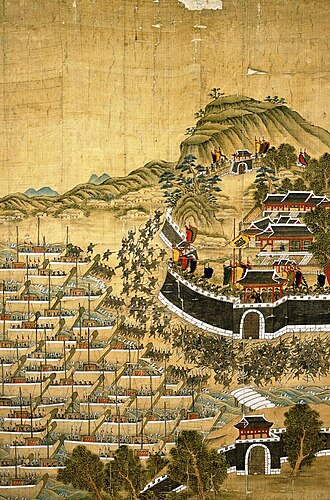
“The mountains and rivers are the same, but the country is no longer the same.” — Korean lament from the Imjin War period
In the spring of 1592, a massive Japanese army crossed the Korea Strait and set foot on the Korean peninsula, launching one of the most destructive conflicts in East Asian history. Known in Korean as the Imjin War (임진왜란, Imjin Waeran), the conflict raged from 1592 to 1598, leaving the Joseon dynasty shattered, its population decimated, and its cultural heritage looted or burned. Yet Korea survived — through the brilliance of its naval commander Admiral Yi Sun-sin, the eventual intervention of Ming China, and the fierce resistance of ordinary Korean people.
For English-speaking readers, the Imjin War remains one of history’s most underappreciated conflicts. It reshaped the power balance of East Asia, hastened the decline of the Ming dynasty, and planted seeds of historical grievance between Korea and Japan that persist to this day.
Quick Facts: The Imjin War at a Glance
| Fact | Detail |
|---|---|
| Dates | 1592–1598 |
| Korean name | 임진왜란 (Imjin Waeran) |
| Belligerents | Japan vs. Joseon Korea and Ming China |
| Japanese commander | Toyotomi Hideyoshi (overall), Konishi Yukinaga (field) |
| Korean naval hero | Admiral Yi Sun-sin |
| First invasion | 1592–1593 (Imjin year) |
| Second invasion | 1597–1598 (Jeong-yu year) |
| Outcome | Japanese withdrawal after Hideyoshi’s death (1598) |
| Legacy | Devastating population loss; rise of Yi Sun-sin as national hero |
Why Did Japan Invade Korea in 1592?
The invasion did not emerge from nowhere. By the late sixteenth century, Japan had endured over a century of civil war — the Sengoku period — during which powerful warlords competed for supremacy. By 1590, Toyotomi Hideyoshi had unified Japan under his authority and was left with a massive, battle-hardened military machine and ambitious generals with no domestic enemies left to fight.
Hideyoshi’s stated goal was extraordinary in its ambition: the conquest of Ming China. Korea, sharing a land border with China, was the natural corridor for such an invasion. When Hideyoshi demanded that the Joseon court allow his armies safe passage, King Seonjo’s court refused. Japan’s response was invasion.
Modern historians are careful to note that Hideyoshi’s true motivations remain a matter of scholarly discussion. Some emphasize his personal megalomania; others point to the structural pressures of managing a newly unified Japan whose warrior class needed outlets for their energy and ambitions. What is not disputed is the scale and ferocity of the force he assembled.
The First Invasion (1592–1593): A Kingdom in Collapse
In the fourth month of 1592, a Japanese army estimated at over 150,000 soldiers landed at Busan on Korea’s southeastern coast. The Joseon army, long untested in major warfare and unprepared for the speed and firepower of Japan’s arquebusier-equipped forces, crumbled with shocking speed. Busan fell almost immediately. Within weeks, the Japanese had advanced up the peninsula and captured the capital, Hanseong (modern Seoul). King Seonjo fled northward toward the Chinese border, an act that deeply shook the confidence of the Korean people in their monarch.
Japanese forces pushed further north, capturing Pyongyang. It seemed as though the complete conquest of the peninsula was only a matter of time. The Japanese army had demonstrated that Korea’s conventional defenses could not stop them in open battle.
“On land, Korea’s armies were swept aside. But on the sea, a very different story was unfolding — one that would ultimately determine the fate of the invasion.”
While Korean armies struggled on land, Admiral Yi Sun-sin was building a record of extraordinary naval victories. Commanding Korea’s fleet from his base in the southwestern province of Jeolla, Yi intercepted Japanese supply lines along the southern coast. His use of the famous turtle ships (geobukseon) — ironclad vessels with a covered deck bristling with cannons and iron spikes — has become legendary. Yi won a remarkable series of victories at Okpo, Sacheon, and Hansando, denying the Japanese navy control of Korea’s coastline and severing the supply lines that the invasion depended upon.
Meanwhile, Korean irregular forces — the uibyeong, or righteous armies — rose across the peninsula, harassing Japanese supply lines and garrisons. Buddhist monks took up arms to defend their country. This decentralized, grassroots resistance complicated Japanese control of territory even when conventional armies failed.
The Ming dynasty of China, alarmed by the fall of Pyongyang and unwilling to allow a hostile Japan to reach its border, dispatched a large army to Korea’s aid. After initial setbacks, a combined Joseon-Ming force recaptured Pyongyang in early 1593. The Japanese, their supply lines harassed at sea and facing a fresh Chinese army, withdrew southward and established fortified positions along the southern coast. A period of difficult and ultimately fruitless peace negotiations followed.
The Second Invasion (1597–1598): Renewed Fury
Negotiations between Japan and Ming China broke down completely by 1597, and Hideyoshi launched a second invasion. This time, Japanese commanders moved with particular brutality. The practice of collecting the ears and noses of Korean victims — as proof of kills submitted to Hideyoshi — became widespread, a horrifying atrocity documented in historical sources. The second invasion met stiffer resistance and could not replicate the rapid advances of the first.
Admiral Yi Sun-sin, who had been removed from command by political intrigue and imprisoned during the interlude between invasions, was reinstated as the situation became desperate. In one of history’s most remarkable naval feats, Yi defeated a Japanese fleet of over 130 ships at the Battle of Myeongnyang in 1597, commanding only 13 Korean vessels. The battle effectively halted the Japanese naval advance and preserved Korea’s ability to contest the sea.
Toyotomi Hideyoshi died in September 1598. His council of regents, eager to end the costly and fruitless war, ordered a withdrawal. The final battle of the war, the Battle of Noryang in the eleventh month of 1598, saw Yi Sun-sin intercept the withdrawing Japanese fleet. The battle was a decisive Korean and Chinese victory, but Admiral Yi was struck by a stray bullet and died during the fighting. His reported last words — “The battle is at its height. Beat my war drums. Do not announce my death” — have become among the most celebrated in Korean history.
3 Reasons the Imjin War Changed East Asia Forever
1. Korea Was Left Devastated — But Survived
The human cost was catastrophic. Korea’s population, agricultural land, and cultural heritage were profoundly damaged. Countless government records and cultural artifacts were destroyed or carried off to Japan. Yet the Joseon dynasty survived, bolstered by the loyalty of its people and the eventual withdrawal of Japanese forces. The war produced a deep national consciousness of shared suffering and resistance that echoes in Korean culture to this day.
2. The Ming Dynasty Was Fatally Weakened
The enormous financial and military cost of intervention in Korea drained Ming China’s resources at a critical moment. Historians widely regard the strain of the Imjin War as one of the factors that accelerated the Ming dynasty’s decline, contributing to conditions that would eventually allow the Manchu Qing dynasty to conquer China in 1644. The war that was meant to stop Japan reaching China’s borders may have indirectly helped bring China’s ruling dynasty to its knees.
3. Japan Was Transformed by Korean Knowledge and Craftsmanship
Japanese forces returned from Korea with thousands of captive Korean artisans, scholars, and craftspeople. Korean potters, in particular, are credited with transforming Japanese ceramic traditions — a legacy still visible in Japanese pottery today. Confucian texts and printing technologies brought back from Korea influenced Japanese intellectual life during the subsequent Edo period. The invasion’s cultural transfers, however brutal their origins, left permanent marks on Japanese civilization.
Comparing the Two Invasions
| Feature | First Invasion (1592–1593) | Second Invasion (1597–1598) |
|---|---|---|
| Initial momentum | Rapid Japanese advance; Seoul and Pyongyang captured | Slower progress; stiffer resistance from the outset |
| Naval situation | Yi Sun-sin commands Korean fleet from the start | Yi reinstated after removal; wins Battle of Myeongnyang |
| Chinese role | Ming forces retake Pyongyang (early 1593) | Ming forces cooperate closely with Joseon armies |
| End cause | Stalemate; peace negotiations begin | Hideyoshi’s death triggers Japanese withdrawal |
| Final battle | — | Battle of Noryang (1598); Yi Sun-sin killed |
Admiral Yi Sun-sin: Korea’s Greatest Hero
No account of the Imjin War is complete without dwelling on Yi Sun-sin. Born in 1545, Yi came to prominence relatively late in life, earning command of a naval district only in 1591 — just one year before the invasion. What followed was one of the most extraordinary military careers in world history. Yi is credited with never losing a single battle during the war. His victories at Hansando and Myeongnyang are studied in naval academies to this day.
Yi was not only a brilliant tactician but also a skilled administrator and inventor. The turtle ship, while not entirely his invention, was developed and deployed under his direction. He kept detailed diaries — the Nanjung Ilgi — that survive as primary historical sources and have been designated a UNESCO Memory of the World document.
Today, Yi’s bronze statue stands at the heart of Gwanghwamun Square in Seoul, facing south — the direction from which the Japanese came. He is widely regarded as Korea’s greatest historical figure, a symbol of resilience and patriotism.
Continue Exploring
Deepen your understanding of the Imjin War and the era it transformed with these resources:
- Imjin War — Wikipedia: Comprehensive overview of the conflict, its battles, and its aftermath.
- Encyclopedia of Korean Culture (AKS): Authoritative Korean-language and English entries on the Joseon dynasty and the war’s figures.
- Imjin War — Britannica: Concise scholarly summary of the invasions and their historical significance.
- National Museum of Korea: Collections including artifacts and documents from the Joseon period and the Imjin War era.
- Asia Society: Essays and educational resources on Korean and East Asian history.
- Korean Heritage Portal: Official information on designated cultural heritage sites connected to the Imjin War period.
On Coreaverse, you can also read our companion piece on the fortress architecture that defended Korea during the Joseon dynasty, and our profile of Admiral Yi Sun-sin’s legacy in modern Korean culture.