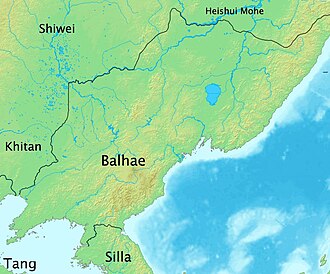
“A vast territory stretching from the Amur River to the Korean peninsula — Parhae was, at its height, one of the most powerful kingdoms in all of East Asia.”
Few kingdoms in Korean history have been as consequential — or as contested — as Parhae (발해), known in Chinese sources as Balhae and sometimes called the “Prosperous Kingdom of the East.” Founded in 698 CE in the aftermath of Goguryeo’s dramatic collapse, Parhae endured for more than two centuries, governing a vast multi-ethnic territory across what is today Manchuria, the Russian Far East, and the northern Korean peninsula. Yet despite its scale and sophistication, Parhae remains one of the least-known chapters of Korean history for many English-speaking readers.
Understanding Parhae means grappling with questions that still animate historians today: Who were its people? Was it a successor state to Goguryeo, or something altogether new? And why did it vanish so suddenly in 926 CE, leaving behind so little that later generations could claim?
Quick Facts: The Kingdom of Parhae at a Glance
| Detail | Information |
|---|---|
| Founded | 698 CE |
| Dissolved | 926 CE |
| Founder | Go of Balhae (대조영, Dae Joyeong) |
| Capital | Sanggyeong (Upper Capital), near modern Ning’an, Heilongjiang |
| Territory | Manchuria, Russian Far East, northern Korean peninsula |
| Major Ethnic Groups | Mohe (Malgal), Goguryeo descendants |
| Religion | Buddhism (state-sponsored), shamanism |
| Known As | “Haedong Seongguk” (Prosperous Kingdom of the East) |
Origins: Rising from the Ruins of Goguryeo
To understand Parhae, we must first understand what was lost when Goguryeo — one of the Three Kingdoms of Korea — fell to the combined forces of Tang China and Silla in 668 CE. Goguryeo had dominated the northern Korean peninsula and much of Manchuria for centuries. Its collapse sent shockwaves through the region, scattering its ruling elite and displacing tens of thousands of people.
Among the survivors was a man named Dae Joyeong (大祚榮), who led a community of Goguryeo refugees and Mohe (말갈, also written Malgal) people northeastward, away from Tang Chinese control. After a decisive victory over Tang forces at the Battle of Tianmenling in 698 CE, Dae Joyeong established a new state in the Dongmo Mountain area. He called it Jin (振) initially, and it would later become known as Parhae — a name derived from a Chinese commandery title granted by the Tang court.
Dae Joyeong became King Go of Balhae, and his new state was from the very beginning a hybrid entity: drawing on Goguryeo administrative traditions, incorporating the culture of the Mohe tribal confederacies, and consciously modeling its court culture on Tang China. This layered identity would define Parhae throughout its existence.
Why Is Parhae So Significant in Korean History?
Parhae’s significance in Korean history stems from several interlocking factors — its territorial scope, its cultural ambition, and the debates it continues to inspire.
1. It Preserved the Goguryeo Legacy
For Korean historians, one of the most important aspects of Parhae is its claimed continuity with Goguryeo. A substantial portion of Parhae’s ruling aristocracy were descendants of Goguryeo’s nobility. The state’s administrative systems, and even certain burial practices, showed continuity with Goguryeo traditions. Later Korean states, particularly Goryeo — whose very name echoed Goguryeo — viewed themselves as heirs to this legacy. The period in which both Parhae in the north and Unified Silla in the south coexisted is often called the “North-South States Period” (남북국시대) in Korean historiography, emphasizing Parhae’s place within the Korean historical narrative.
2. It Was a Major Regional Power
At its height under King Seon (재위 818–830 CE), Parhae controlled five capitals, fifteen provinces, and sixty-two districts. Its territory stretched from the Amur River basin in the north to the northern reaches of the Korean peninsula in the south, and from the coastline of the Sea of Japan (East Sea) westward into the heart of Manchuria. Tang China recognized its stature by calling it “Haedong Seongguk” (海東盛國) — the Prosperous Kingdom of the East — a title that speaks to the respect Parhae commanded among its contemporaries.
3. It Was a Hub of International Exchange
Parhae was far from isolated. It maintained active diplomatic and trade relationships with Tang China, Japan, and the Turkic steppe kingdoms to the west. Its ambassadors traveled regularly to the Tang capital of Chang’an, and Parhae students studied at the Tang imperial academy. The kingdom also sent numerous diplomatic missions to Japan, with surviving records documenting these exchanges in considerable detail. Through these contacts, Parhae served as a conduit for Buddhist art, Chinese administrative culture, and luxury goods flowing across Northeast Asia.
“Tang China called Parhae the ‘Prosperous Kingdom of the East’ — a recognition that this northern realm had become one of the most sophisticated states in the region.”
Society, Culture, and the Cities of Parhae
What do we know of daily life and culture in Parhae? Archaeology has proven invaluable here, as written records from within Parhae itself are almost entirely lost. Excavations at the site of the Upper Capital (Sanggyeong), near present-day Ning’an in China’s Heilongjiang province, have revealed a city built on a Tang-style grid plan, with a grand central boulevard, Buddhist temple complexes, and sophisticated ceramic kilns.
Buddhism was the dominant religion of Parhae’s court and urban elite. Temple ruins unearthed across former Parhae territory show impressive stone pagodas and Buddha statues that blend Tang Chinese iconographic styles with distinct local features. This blending — Chinese form, local spirit — characterizes much of Parhae’s material culture.
Beyond the capitals, however, much of Parhae’s population lived in ways that owed more to Mohe and other northeastern tribal traditions than to Tang urbanism. Parhae was genuinely multi-ethnic, and the diversity of its people is reflected in the range of archaeological finds, from Chinese-style glazed ceramics to nomadic-style horse equipment.
Parhae vs. Unified Silla: A Comparison of Two Korean Kingdoms
| Feature | Parhae (698–926 CE) | Unified Silla (668–935 CE) |
|---|---|---|
| Location | Manchuria, Russian Far East, northern peninsula | Southern Korean peninsula |
| Heritage Claimed | Goguryeo | Silla, Baekje |
| Population | Multi-ethnic (Mohe, Goguryeo-descended) | Predominantly ethnic Korean |
| State Religion | Buddhism (Tang-influenced) | Buddhism (Tang-influenced) |
| Administrative Model | Tang system adapted | Tang system adapted |
| End | Conquered by Khitan Liao dynasty, 926 CE | Surrendered to Goryeo, 935 CE |
The Fall of Parhae: A Kingdom Extinguished
Parhae’s end came with startling speed. In 926 CE, the Khitan people — founders of the Liao dynasty — launched a devastating military campaign against Parhae. The kingdom, which had endured for over two centuries, collapsed within a matter of weeks. The Khitan forces overwhelmed the last Parhae king, and the state ceased to exist almost overnight.
Historians have long debated why Parhae fell so rapidly. Some point to internal divisions between its Goguryeo-descended elite and its Mohe population. Others highlight the extraordinary military power of the rising Khitan confederation. What is clear is that the collapse was total: unlike Silla, which negotiated its own end and passed much of its culture to Goryeo, Parhae left behind no successor state to preserve its records and traditions.
Many Parhae nobles and their followers fled south, finding refuge in the newly rising kingdom of Goryeo. Goryeo’s founder, Wang Geon, is recorded as having welcomed these refugees warmly, consciously embracing the idea that Goryeo was heir to all of Goguryeo’s legacy — including that embodied by Parhae. This southward migration meant that a thread of Parhae’s aristocratic culture was woven into the fabric of medieval Korean civilization, even as the kingdom itself was erased.
Whose History Is Parhae? The Modern Debate
Few historical questions in Northeast Asia are as politically charged as the question of Parhae’s national identity. Korean historians generally classify Parhae as a Korean kingdom — part of the “North-South States Period” — emphasizing the Goguryeo heritage of its ruling class and its eventual absorption of refugees into Goryeo. Chinese historians, by contrast, have tended to classify Parhae as a local regime within Chinese history, emphasizing the Mohe ethnic background of its founder Dae Joyeong and the tributary relationship Parhae maintained with the Tang court.
The debate intensified in the early 2000s as part of China’s Northeast Project (東北工程), a government-sponsored academic initiative that reclassified a number of ancient northeastern kingdoms — including Goguryeo and Parhae — as part of Chinese rather than Korean history. This prompted strong objections from Korean scholars and the South Korean government, and the controversy continues to shape how Parhae is discussed in academic and popular contexts.
What most historians can agree on is that Parhae defies simple national categorization. It was a genuinely multi-ethnic state that drew on multiple cultural traditions simultaneously. Its ruling dynasty had Goguryeo roots; its largest population group were the Mohe; its court culture was Tang-derived; and its memory lived on primarily in Korea. All of these facts are true at the same time.
Continue Exploring
- Parhae — Wikipedia: Full historical overview
- Encyclopedia of Korean Culture — Academy of Korean Studies
- Balhae (Parhae) — Britannica Encyclopedia
- Three Kingdoms of Korea — Asia Society Educational Resources
- National Museum of Korea — Explore Artifacts from Korea’s Early Kingdoms
Korea Through Time explores the full sweep of Korean history — from ancient kingdoms to modern transformations. Share this article to help more readers discover the forgotten kingdoms of the northeast.