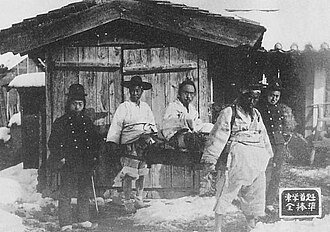
“We rise not to rebel against the king, but to save the people from corruption and foreign domination.”
In the spring of 1894, something extraordinary swept across the Korean peninsula. Tens of thousands of farmers, peasants, and laborers — long ground down by corrupt officials, crushing taxes, and the growing shadow of foreign powers — rose up in what would become one of the most significant mass movements in Korean history. The Tonghak Peasant Revolution (동학농민혁명), also romanized as the Donghak Peasant Revolution, was not merely a local disturbance. It was a seismic event that shook the foundations of the Joseon dynasty, drew foreign armies onto Korean soil, and helped ignite the First Sino-Japanese War.
To understand the revolution, you must first understand the world that made it inevitable.
Quick Facts: The Tonghak Peasant Revolution
| Detail | Information |
|---|---|
| Date | 1894 (Gabo Year) |
| Location | Joseon Korea, primarily Jeolla Province |
| Key Figure | Jeon Bong-jun, peasant leader |
| Ideological Root | Tonghak (Eastern Learning) religious movement |
| Opposing Forces | Joseon royal army, Qing Chinese troops, Japanese forces |
| Key Battle | Battle of Ugeumchi (October–November 1894) |
| Outcome | Uprising suppressed; First Sino-Japanese War triggered |
| Legacy | Precursor to modern Korean nationalism and democratic consciousness |
What Was the Tonghak Movement, and Why Did It Inspire Revolution?
The Tonghak movement — literally meaning “Eastern Learning” — was founded in 1860 by Choe Je-u as a spiritual and philosophical response to the growing Western and foreign influence in Korea. It blended elements of Confucianism, Buddhism, and Taoism with a distinctly Korean sensibility, and its core teaching was one of radical equality: all human beings carry the divine within them. This was a deeply subversive idea in a rigidly hierarchical Joseon society where class, birth, and status determined virtually every aspect of life.
Choe Je-u was executed by the government in 1864, accused of spreading heretical ideas. But rather than dying with its founder, the movement grew. By the late 19th century, Tonghak had spread widely among the rural poor, offering not just spiritual comfort but a language of dignity and resistance. When corrupt local officials began squeezing peasants ever harder — extorting grain, demanding illegal taxes, seizing land — that language became a call to action.
The immediate trigger for the 1894 uprising came from Gobu County in Jeolla Province, where a particularly rapacious local magistrate, Jo Byong-gap, built a new reservoir and then forced local farmers to pay for it through compulsory labor and illegal grain levies. It was an act of greed too far. Under the leadership of Jeon Bong-jun, local Tonghak-affiliated farmers rose up in January 1894, stormed the county office, and redistributed the illegally seized grain.
Three Phases That Defined the Revolution
1. The First Uprising: Jeolla Province Ignites (January–June 1894)
What began as a local grievance in Gobu rapidly escalated. Jeon Bong-jun proved to be a gifted organizer, and his forces swelled as peasants from across Jeolla Province joined the cause. In May 1894, the peasant army scored a stunning victory at the Battle of Hwangtojae, routing a government force and demonstrating that this was no ordinary mob but a disciplined fighting force motivated by deep conviction. The rebels went on to capture Jeonju, the provincial capital — a moment that shocked the royal court in Hanseong (modern Seoul).
Panicked, the Joseon government made two fateful decisions. First, it opened negotiations with the rebels, eventually signing the Jeonju Convention, which ended the first phase of fighting and promised reform. Second — and catastrophically — it requested military assistance from Qing China.
2. Foreign Intervention and the Road to Wider War (June–September 1894)
China’s decision to send troops under the terms of the 1885 Convention of Tientsin obligated Japan to be notified. Japan, seeing an opportunity, sent its own forces to Korea — far more than the situation seemed to require. With the Jeonju Convention signed and the immediate crisis over, both foreign powers refused to withdraw. The presence of Chinese and Japanese armies on Korean soil created an explosive situation.
In July 1894, Japanese forces seized the Gyeongbokgung Palace, captured the Korean king Gojong, and installed a pro-Japanese government. Within weeks, Japanese and Chinese forces clashed, beginning the First Sino-Japanese War. Korea — the place where the revolution had begun — was now a battleground for the ambitions of its powerful neighbors.
“The peasants rose to reclaim Korea for Koreans. Instead, their uprising became the spark that invited foreign powers to decide Korea’s fate.”
3. The Second Uprising and Final Defeat (September–December 1894)
When Jeon Bong-jun and the Tonghak leadership saw Japanese forces occupying the palace and effectively controlling the Korean government, they made the decision to rise again — this time explicitly framing their cause as one of national resistance against foreign domination. The second phase of the revolution had a strongly anti-Japanese character, uniting many who might not have joined the first uprising purely over economic grievances.
But the odds were now overwhelmingly against the peasant army. At the Battle of Ugeumchi in October and November 1894, Tonghak forces — estimated in the tens of thousands and armed largely with traditional weapons — faced a combined Korean government and Japanese military force equipped with modern rifles and artillery. The battle was catastrophic for the peasant army. They charged the hill position at Ugeumchi reportedly forty times over several days. Each charge was met with devastating firepower. The revolution was broken.
Jeon Bong-jun was captured in December 1894 and executed in Seoul in March 1895. The suppression that followed the revolution’s collapse was brutal, with tens of thousands killed across the peninsula.
Why the Tonghak Revolution Still Matters in Korean History
The revolution failed in its immediate objectives. The corrupt officials remained. The foreign powers stayed. The reforms that had been promised under the Jeonju Convention were implemented under the name of the Gabo Reform, but driven by Japanese pressure rather than the will of the Korean people. And yet history has increasingly recognized the Tonghak Peasant Revolution as a pivotal and deeply significant moment in Korea’s long story.
First, the revolution demonstrated the power of organized popular resistance. The peasants who marched under the Tonghak banner were not following a king or an aristocratic faction — they were asserting their own rights and their own vision of what Korean society should be. That consciousness, once awakened, did not disappear.
Second, the revolution’s second phase — with its explicit anti-Japanese, pro-sovereignty framing — prefigured the nationalist movements that would emerge in the early 20th century as Japan tightened its grip on Korea and eventually annexed the peninsula in 1910. The spirit of Jeon Bong-jun and his followers can be traced in a direct line to the March First Movement of 1919 and the decades of resistance that followed.
Third, the Tonghak ideology itself — with its insistence on the inherent worth of every human being regardless of class or birth — contributed to the gradual erosion of the rigid social hierarchies of Joseon. The revolution helped make equality a living aspiration rather than an abstract idea in Korean political thought.
Comparison: First and Second Uprisings at a Glance
| Feature | First Uprising (Jan–June 1894) | Second Uprising (Sept–Dec 1894) |
|---|---|---|
| Primary Cause | Local corruption, illegal taxation | Japanese military occupation of Korea |
| Main Goal | Social and economic reform | National sovereignty, expulsion of Japanese |
| Geographic Focus | Jeolla Province, Jeonju | Chungcheong and broader peninsula |
| Enemies Faced | Joseon government forces | Combined Joseon-Japanese military |
| Key Outcome | Jeonju Convention; initial reforms promised | Crushing defeat at Ugeumchi |
The Revolution in Memory: How Korea Remembers 1894
For much of the 20th century, the Tonghak Peasant Revolution occupied an ambiguous place in Korean memory. Under Japanese colonial rule, it was not a story the authorities wanted told. In the early decades of the Republic of Korea, anti-communist sensitivities made mass peasant uprisings a complicated subject. It was not until the democratization movements of the 1980s that the revolution began to be fully rehabilitated in the South Korean public consciousness.
Today, Jeon Bong-jun is regarded as a national hero. The sites of key battles — including Ugeumchi in Chungcheongnam-do — are maintained as historical memorials. The South Korean government officially designated May 11 as Donghak Peasant Revolution Memorial Day in recognition of the uprising’s place in the nation’s democratic heritage. Museums and cultural centers across Jeolla Province preserve the memory of those who marched and died under the Tonghak banner.
The revolution’s legacy is inseparable from Korea’s long journey toward democracy and self-determination — a journey that, like the peasants of 1894, was driven by the belief that ordinary people have the right to determine their own destiny.
Continue Exploring
More on Coreaverse
- The Joseon Dynasty: 500 Years of Korean Civilization
- The March First Movement of 1919: Korea’s Cry for Independence
- Korea Caught Between Empires: The First Sino-Japanese War