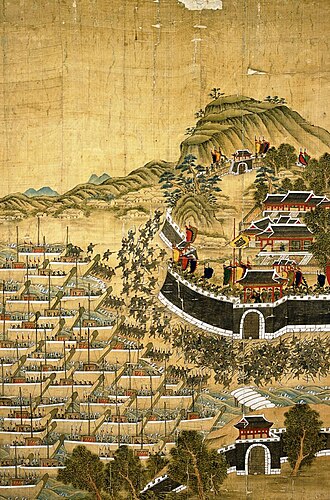
“The enemy came like a flood. Within twenty days, they had taken three of our eight provinces.”
Few events in Korean history were as catastrophic — or as transformative — as the Imjin War. Between 1592 and 1598, the armies of Japan’s warlord Toyotomi Hideyoshi swept across the Korean peninsula in two successive invasions, leaving behind a landscape of burned palaces, displaced populations, and shattered institutions. Yet out of that destruction emerged stories of extraordinary resistance: a navy that never lost a single ship under its great admiral, righteous armies of ordinary citizens who took up arms, and a peninsula that ultimately held firm against one of the largest amphibious invasions the world had ever seen.
To understand Korea’s late Joseon period, its relationship with China and Japan, and its enduring cultural memory of resilience, one must understand the Imjin War.
Quick Facts: The Imjin War at a Glance
| Detail | Information |
|---|---|
| Dates | 1592–1598 (two phases) |
| Korean Name | 임진왜란 (Imjin Waeran) |
| Aggressor | Japan under Toyotomi Hideyoshi |
| Defenders | Joseon Korea, Ming Dynasty China |
| First Invasion | 1592–1593 (Imjin Waeran) |
| Second Invasion | 1597–1598 (Jeongyu Jaeran) |
| End of War | Death of Toyotomi Hideyoshi, 1598 |
| Key Korean Hero | Admiral Yi Sun-sin |
Why Did Japan Invade Korea in 1592?
By the late sixteenth century, Toyotomi Hideyoshi had achieved the near-impossible: he had unified Japan after more than a century of brutal civil war. Yet unification brought its own dangers. Hideyoshi commanded a vast coalition of feudal lords whose loyalty was bound to military success and reward. To satisfy those lords — and to feed his own extraordinary ambitions — Hideyoshi looked beyond Japan’s shores.
His stated goal was nothing less than the conquest of China itself. Korea, sitting between Japan and the Chinese mainland, was to serve as a corridor. Hideyoshi sent envoys to the Joseon court demanding safe passage and Korean submission. The Joseon king Seonjo refused. In April 1592, a Japanese force estimated at over 150,000 soldiers crossed the Korea Strait and landed at Busan.
The speed of the initial advance was shocking. The Japanese armies, battle-hardened from decades of civil war and equipped with firearms introduced through Portuguese traders, tore through Joseon defenses that had atrophied during nearly two centuries of relative peace. Busan fell within hours. The city of Seoul — then called Hanseong — fell in less than three weeks. King Seonjo fled northward toward the Chinese border, a retreat that deeply damaged royal prestige and left the Korean population feeling abandoned.
The Three Pillars of Korean Resistance
The story of the Imjin War is not simply a story of conquest. It is equally a story of how Korea fought back — through its navy, through its civilian armies, and through Chinese intervention.
1. Admiral Yi Sun-sin and the Joseon Navy
While the Joseon army crumbled in the face of the Japanese advance, the Joseon navy proved a different matter entirely. Admiral Yi Sun-sin, commanding the naval forces of the southern Jeolla Province, launched a series of devastating counterattacks that disrupted Japanese supply lines and sea communications from the very first month of the war.
Yi’s fleet included the celebrated geobukseon, or turtle ships — iron-plated vessels whose design made them extraordinarily resistant to Japanese boarding tactics. In engagements at Okpo, Sacheon, and Hansan Island, Yi’s forces destroyed hundreds of Japanese warships while losing virtually none of their own. The Battle of Hansando in August 1592 is considered one of the most decisive naval engagements in Korean history, effectively trapping Japanese land forces and denying them reliable resupply.
Yi Sun-sin’s record across the entire war was remarkable: he is believed never to have lost a naval battle. When political intrigue engineered by his enemies at court led to his temporary removal from command in 1597, the consequences were immediate and disastrous. The replacement commander suffered a catastrophic defeat at the Battle of Chilcheonryang, losing nearly the entire Korean fleet. Yi was hastily reinstated. With only twelve ships remaining, he faced a Japanese fleet of hundreds at the Battle of Myeongnyang in October 1597 — and won.
2. The Righteous Armies (Uibyeong)
Across the Korean countryside, ordinary people did not wait for the government to save them. Scholars, farmers, monks, and former officials organized themselves into uibyeong — righteous armies — that harassed Japanese supply lines, defended local communities, and kept resistance alive even when the formal military had collapsed.
Buddhist monk Hyujeong, already in his seventies when the war began, issued a call to arms and led thousands of monk-soldiers into battle — a remarkable mobilization given the low social status Buddhism occupied in Confucian Joseon. Guerrilla leader Gwak Jaeu, known as the “Red-Robed General” for the distinctive clothing he wore in battle, became legendary for his operations in the Gyeongsang region.
These irregular forces could not win set-piece battles against the Japanese, but they made occupation costly and dangerous. Combined with the disruption of Japanese naval supply lines, the uibyeong played a crucial role in turning the war’s momentum.
3. Ming China Intervenes
For the Joseon court, relief came in the form of Ming Chinese intervention. China dispatched successive waves of troops — ultimately tens of thousands of soldiers — to support its Korean ally. The logic was straightforward: a Japan that controlled Korea would sit directly on China’s northeastern frontier. The Ming could not permit that outcome.
Chinese and Korean forces retook the city of Pyongyang from the Japanese in early 1593. The Japanese advance stalled, and negotiations began — negotiations that would drag on inconclusively for years before breaking down entirely and triggering the second invasion in 1597.
“Yi Sun-sin is remembered not only as Korea’s greatest admiral but as one of the most gifted naval commanders in all of recorded history — a man who turned strategic hopelessness into improbable victory.”
The Second Invasion and the War’s End
The second invasion, known in Korean as the Jeongyu Jaeran, began in 1597 when peace negotiations between Japan and Ming China collapsed. Japanese forces landed again in the south, but this time they encountered a more prepared — and more determined — resistance. The Japanese advance never penetrated as deeply as in 1592.
The war came to an abrupt end not through military defeat on either side but through the death of Toyotomi Hideyoshi in September 1598. Without Hideyoshi’s driving ambition, the Japanese leadership lost its rationale for continuing a costly and inconclusive war. Japanese forces began withdrawing from the Korean peninsula. In November 1598, a combined Korean-Chinese naval force intercepted the withdrawing Japanese fleet in what became the Battle of Noryang. Admiral Yi Sun-sin died in that final engagement, struck by a musket ball during the fighting — his last act, according to tradition, was to ask that his death be kept secret so his men would not lose heart.
Comparison: The Two Invasions
| Feature | First Invasion (1592–1593) | Second Invasion (1597–1598) |
|---|---|---|
| Korean Name | Imjin Waeran | Jeongyu Jaeran |
| Japanese Advance | Rapid; Seoul fell in under 3 weeks | Stalled in southern provinces |
| Joseon Navy | Yi Sun-sin dominates from month one | Near-destroyed; rebuilt and victorious |
| End Cause | Chinese intervention; stalemate | Death of Hideyoshi; Japanese withdrawal |
| Key Battle | Battle of Hansando (naval) | Battle of Myeongnyang; Battle of Noryang |
Legacy: How the Imjin War Reshaped Korea and East Asia
The human and material cost of the Imjin War was staggering. Scholars estimate that Korea’s population may have declined by as much as a third during the conflict through death, displacement, and famine. Farmland was devastated. Palaces, including the great Gyeongbokgung in Seoul, were burned — a destruction so complete that the palace would not be rebuilt for nearly three centuries. Skilled Korean artisans, potters, and scholars were forcibly taken to Japan, a cultural transfer that profoundly influenced Japanese ceramics and printing technology.
For the Joseon dynasty, the war exposed deep structural weaknesses: in the military system, in court governance, and in the relationship between the state and its people. The experience of ordinary Koreans organizing themselves into righteous armies, fighting without direction from a government that had fled, left a lasting imprint on Korean political consciousness.
For Ming China, the enormous cost of intervention accelerated the dynasty’s fiscal and military decline, contributing to the conditions that would eventually enable the Manchu conquest and the establishment of the Qing dynasty in the following century.
For Japan, the failure of the Korean campaigns meant that the vast military force Hideyoshi had assembled remained unsatisfied. The rivalries and tensions that erupted after his death would culminate in the Battle of Sekigahara in 1600 and the eventual establishment of the Tokugawa shogunate.
In Korea, the Imjin War is remembered not primarily as a defeat but as a story of survival against overwhelming odds — and of the individuals, from admirals to monks to farmers, who made that survival possible. Admiral Yi Sun-sin occupies a place in Korean memory comparable to that of national founders; statues of him stand across the country, most famously at the heart of Gwanghwamun Square in Seoul.
Continue Exploring
On Korea Through Time
- Admiral Yi Sun-sin: Korea’s Greatest Naval Hero
- The Turtle Ship: Engineering and Myth in Joseon Korea
- The Joseon Dynasty: Five Centuries of Korean Civilization
- Gyeongbokgung Palace: From Royal Seat to National Symbol