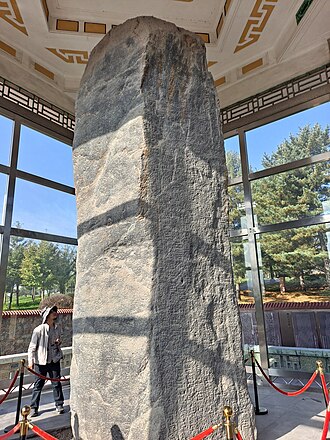
“He who expands the territory and benefits the people” — the meaning encoded in the very name Gwanggaeto, a title that defined an entire reign.
Quick Facts: Gwanggaeto the Great
| Full Posthumous Title | Gukngang Gwanggaeto Gyeongpyeong Hotae Wangho |
|---|---|
| Born | 374 CE |
| Died | 412 CE |
| Kingdom | Goguryeo |
| Era | Three Kingdoms Period |
| Religion | Buddhism |
| Notable Legacy | Gwanggaeto Stele, massive territorial expansion of Goguryeo |
Who Was Gwanggaeto the Great?
In the long and storied history of the Korean peninsula, few rulers have left an impression as commanding — or as physically enduring — as Gwanggaeto the Great. Born in 374 CE, he became the nineteenth monarch of Goguryeo, one of the Three Kingdoms of ancient Korea, ascending to the throne at just eighteen years of age. In the short span of twenty-two years of rule, before his death in 412 CE, he transformed Goguryeo from a formidable regional power into the dominant force across a vast swath of Northeast Asia.
His posthumous name — Gukngang Gwanggaeto Gyeongpyeong Hotae Wangho — translates roughly as “the broad expander of territory, the pacifier of the state, the great king.” It is a title that reads less like an honor and more like a historical fact. Under his command, Goguryeo absorbed territories stretching from the Liaodong Peninsula in the north to the Han River basin in the south, and from the eastern coastline deep into Manchuria. He was, by any measure, the most consequential military and political leader in Goguryeo’s five-century history.
The World Gwanggaeto Inherited
To understand what Gwanggaeto achieved, it helps to picture the world he inherited. The Korean peninsula in the late fourth century was a theater of constant rivalry. Goguryeo in the north competed fiercely with Baekje in the southwest and Silla in the southeast. Beyond the peninsula’s borders, the political landscape was equally turbulent. China was fragmenting under the instability of the Sixteen Kingdoms period, while various nomadic and semi-nomadic confederacies — including the Khitan, the Sushen, and others — pressed against Goguryeo’s northern and western frontiers.
Goguryeo itself had suffered a catastrophic blow in 371 CE, just a few years before Gwanggaeto’s birth, when the Baekje king Geunchogo led a military campaign that resulted in the death of Goguryeo’s King Gogukwon in battle. That defeat lingered as both a wound and a motivation for the generation that followed. When Gwanggaeto took the throne around 391 CE, he did so with the knowledge that restoration — and expansion — were the twin imperatives of his reign.
5 Major Military Campaigns That Defined His Reign
1. Subjugating Baekje to the South
One of Gwanggaeto’s earliest and most decisive moves was to press southward against Baekje. In his early campaigns, Goguryeo forces captured a string of Baekje fortresses and pushed the kingdom into a subordinate position. Baekje was forced to submit and provide hostages to the Goguryeo court, a humiliation that reversed the dynamics of the previous generation’s conflict. The Han River region, long contested, fell under Goguryeo’s sphere of influence.
2. Repelling Wa (Japanese) Forces and Aiding Silla
Around 400 CE, in one of the most dramatic interventions of the Three Kingdoms era, Gwanggaeto dispatched fifty thousand troops south to aid the kingdom of Silla, which was under pressure from Wa forces — groups from the Japanese archipelago who had allied with Baekje. The campaign successfully expelled the Wa from the peninsula and left Goguryeo’s military reputation unmatched. This event is recorded on the famous Gwanggaeto Stele and remains one of the most discussed episodes of the era, in part because it touches on the sensitive historical question of early interactions between the Korean kingdoms and Japan.
3. Campaigns Against Northern Peoples
Gwanggaeto was equally aggressive on his northern and western frontiers. He launched repeated campaigns against the Khitan, the Sushen, and various groups occupying former Buyeo territories in Manchuria. These victories pushed Goguryeo’s northern boundary deep into what is today northeastern China, securing resources and tribute from a broad arc of peoples and polities.
4. Recovery of Buyeo Territory
The recovery and absorption of former Buyeo lands held particular symbolic weight. Goguryeo traced part of its founding mythology to Buyeo, and reclaiming these territories was framed not merely as conquest but as a form of historical restoration. Gwanggaeto’s expansion into these areas reinforced the ideological as well as military dimensions of his kingship.
5. Campaigns Against Later Yan
On his western flank, Gwanggaeto engaged in conflict with Later Yan, one of the Sixteen Kingdoms of northern China. Goguryeo forces captured significant territory in the Liaodong region — a strategically crucial area that had long been contested between Chinese states and the Korean kingdoms. Control of Liaodong gave Goguryeo both a buffer zone and access to important trade and communication routes.
“In the space of two decades, Goguryeo under Gwanggaeto grew to encompass territory stretching from Manchuria to the Han River — an expansion unmatched in the kingdom’s history.”
Why Does the Gwanggaeto Stele Still Matter Today?
No discussion of Gwanggaeto the Great would be complete without the monument that bears his name. The Gwanggaeto Stele — a massive stone monument standing approximately 6.39 meters tall — was erected in 414 CE by his son and successor, Jangsu, in what is today Ji’an, Jilin Province, China. The stele is inscribed with roughly 1,775 Chinese characters, making it one of the most extensive and historically significant inscriptions surviving from ancient Korea.
The text on the stele records Gwanggaeto’s military campaigns, lists the villages and populations brought under Goguryeo’s control, and details the rules governing the families tasked with maintaining the royal tomb. It is, in essence, an ancient press release — a monument designed to proclaim the legitimacy and greatness of Goguryeo’s ruling house to all who encountered it.
But the stele is also a source of historical controversy. In the late nineteenth century, a rubbing of the stele came to the attention of Japanese military officers, and certain portions — particularly those relating to the Wa forces on the peninsula — were interpreted in ways that served imperial Japan’s political narratives about Korea. Subsequent scholarship, including careful re-examination of the stone itself, has challenged many of those readings, and the stele remains a site of active historiographical debate among Korean, Japanese, and Chinese scholars.
Goguryeo Under Gwanggaeto vs. Other Korean Kingdoms
| Kingdom | Position During Gwanggaeto’s Reign | Relationship with Goguryeo |
|---|---|---|
| Goguryeo | Dominant power, expanded into Manchuria and the Han River basin | — |
| Baekje | Forced into submission, lost northern territories | Defeated rival, vassal status imposed |
| Silla | Smaller southeastern kingdom, vulnerable to Wa incursions | Protected ally, effectively dependent on Goguryeo |
| Later Yan (China) | Declining northern Chinese state | Defeated, lost Liaodong to Goguryeo |
Buddhism and the Ideology of Kingship
Gwanggaeto the Great ruled not only through military force but through ideology. He was a Buddhist monarch, and his reign coincided with the deepening influence of Buddhism within Goguryeo’s court and aristocracy. Buddhism, which had been officially introduced to Goguryeo in 372 CE, provided a framework for understanding royal authority in cosmic terms — the king as a righteous ruler whose victories were expressions of divine sanction. The construction of temples and the patronage of Buddhist institutions were as much political acts as religious ones.
This ideological dimension helps explain the tone of the Gwanggaeto Stele, which frames his campaigns not as brutal conquests but as the restoration of a proper order — bringing wayward peoples under the benevolent rule of a heaven-mandated king. The language of the stele draws on both native Goguryeo traditions and Chinese cosmological concepts, reflecting the hybrid cultural world in which Gwanggaeto operated.
A Legacy Carved in Stone — and in History
Gwanggaeto the Great died in 412 CE, having ruled for approximately twenty-two years. He was succeeded by his son Jangsu, who would reign for an extraordinary seventy-nine years and continue many of his father’s policies, including the famous relocation of the Goguryeo capital from Gungnae to Pyongyang in 427 CE.
Gwanggaeto’s legacy is complex and contested, as the legacies of powerful conquerors so often are. Within Korean historical memory, he occupies a position of near-mythic status — a symbol of national strength and ambition at a time when a Korean kingdom stood as a genuine great power in Northeast Asia. His image appears on the Korean ten-thousand won banknote, and his name is invoked whenever Koreans reflect on moments of historical confidence and expansion.
Yet the territory he conquered was largely lost in the centuries that followed, and the kingdom he so dramatically enlarged would itself fall to the combined forces of Tang China and Silla in 668 CE. Goguryeo’s collapse transformed the political map of Korea permanently, and the land Gwanggaeto had carved out of Manchuria passed out of Korean political control, eventually becoming part of what is today China.
That geographical reality has given his legacy an added layer of meaning in modern times. Historians in China, Korea, and Japan have all staked claims to interpreting Goguryeo’s history, and debates over whether Goguryeo belongs to Korean or Chinese historical heritage have made figures like Gwanggaeto the Great flashpoints in contemporary diplomatic and academic controversies — a remarkable afterlife for a king who died sixteen centuries ago.