“The first of all things under heaven is the jade-like celadon of Goryeo.”
— Song Yingxing (attributed), reflecting the admiration of neighboring cultures for Goryeo’s ceramic mastery
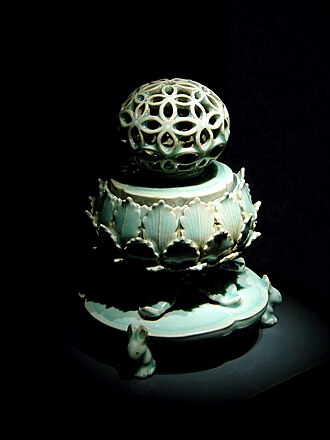
Among all the artistic achievements of Korea’s Goryeo dynasty (918–1392), none has captured the world’s imagination quite like Goryeo celadon — the hauntingly beautiful jade-green pottery known in Korean as cheongja (청자). Admired across East Asia in its own time and treasured in the world’s greatest museums today, Goryeo celadon represents a pinnacle of ceramic art: technically sophisticated, aesthetically refined, and deeply expressive of the cultural world that produced it.
From small wine cups to elaborate incense burners shaped like lions and cranes, Goryeo potters pushed the boundaries of what clay, glaze, and fire could achieve. Their most celebrated innovation — a technique called sanggam, or inlaid decoration — set Korean ceramics apart from anything produced in China or Japan, establishing a distinctly Korean aesthetic language that continues to influence artists to this day.
Quick Facts: Goryeo Celadon at a Glance
| Korean Name | 청자 (Cheongja) |
| Dynasty | Goryeo (918–1392) |
| Peak Period | 12th century |
| Signature Technique | Sanggam (inlay decoration) |
| Key Production Centers | Gangjin and Buan, South Korea |
| Characteristic Color | Jade green (비색, bisaek) |
| Notable Forms | Melon-shaped bottles, crane-inlaid vases, lion-shaped incense burners |
Origins: How Did Goryeo Celadon Begin?
Celadon pottery was not invented in Korea. The tradition of high-fired, green-glazed stoneware originated in China, where kilns in the Yue region of Zhejiang province had been producing green wares for centuries before the Goryeo dynasty was even established. Korean potters learned from Chinese techniques, and in the early Goryeo period — roughly the 10th and early 11th centuries — Korean celadon closely resembled its Chinese counterparts.
But something remarkable happened in the 12th century. Korean craftsmen began to diverge from their Chinese models, developing their own approaches to glaze color, vessel form, and surface decoration. The result was a ceramic tradition that, while indebted to China, was unmistakably and brilliantly Korean.
The jade-green color that became the hallmark of Goryeo celadon — called bisaek (비색), meaning “secret color” or “jade color” — was achieved through careful control of the kiln atmosphere during firing. When clay rich in iron oxide was fired under low-oxygen (reduction) conditions, the iron compounds transformed to produce the characteristic blue-green hue. Achieving this color consistently required immense technical skill and deep knowledge of materials, temperature, and kiln management.
The Sanggam Revolution: Korea’s Unique Innovation
If one technique defines Goryeo celadon in the eyes of the world, it is sanggam (상감) — the art of inlaid decoration. Developed in the 12th century, this technique involved carving designs into the surface of leather-hard clay, then filling those incised grooves with white or black slip (liquid clay). After the slip dried, the excess was scraped away, leaving crisp white or black designs embedded flush with the surface. When covered with the translucent celadon glaze and fired, the inlaid patterns glowed beneath the green surface like images seen through still water.
The sanggam technique transformed the surface of a ceramic vessel into a canvas — one where cranes flew through fields of clouds and chrysanthemums bloomed in perpetual stillness beneath a veil of jade-green glaze.
Inlay techniques existed in other Korean crafts — lacquerware, metalwork, and woodwork all made use of contrasting materials set into a base — but applying inlay to ceramics was a distinctly Korean achievement. Chinese potters of the Song dynasty, who were themselves masters of celadon, did not develop this technique. Goryeo potters arrived at it independently, and it became the defining mark of Korean ceramic genius.
The imagery used in sanggam decoration was rich with symbolic meaning. Cranes, clouds, chrysanthemums, peonies, willows, and parrots were among the most common motifs. Cranes in particular held deep significance in Korean culture, representing longevity, good fortune, and spiritual transcendence. A famous water ewer shaped like a crane — now considered one of the masterpieces of Korean ceramic art — demonstrates how Goryeo potters integrated form and decoration into a single unified vision.
4 Reasons Goryeo Celadon Stood Apart from Chinese and Japanese Ceramics
1. The Signature Jade-Green Glaze
While Chinese celadon glazes ranged from olive green to deep grey-green, Goryeo potters perfected a particular shade of blue-tinged jade green that Song dynasty Chinese observers themselves praised as the finest in the world. This color, bisaek, was not merely pleasing to the eye — it resonated with East Asian symbolic associations between jade and virtue, purity, and the ideal of the refined scholar-official.
2. The Inlay (Sanggam) Technique
As described above, the sanggam inlay technique was uniquely Korean. No other ceramic tradition of the period produced anything comparable in technical sophistication or visual effect. It transformed celadon from a vessel defined primarily by its glaze into one where glaze and decoration worked in concert.
3. Sculptural Vessel Forms
Goryeo potters excelled not only in surface decoration but in the modeling of complex three-dimensional forms. Incense burners shaped like lions with openwork lids, ewers modeled as bamboo shoots or melons, and vessels whose handles were sculpted as dragons or phoenixes demonstrate a playful yet masterful approach to ceramic form that went beyond the more restrained aesthetic of Song Chinese ceramics.
4. Integration with Aristocratic Buddhist Culture
Goryeo celadon was produced for a specific social context: the aristocratic and Buddhist culture of the Goryeo court. Celadon vessels were used in Buddhist rituals, at aristocratic banquets, and as grave goods for the elite. This close connection to a sophisticated patronage network drove both the refinement of technique and the elaboration of iconographic programs, resulting in objects that were simultaneously functional, devotional, and aesthetic.
Production Centers: Gangjin and Buan
The finest Goryeo celadon was produced at kiln sites located in the southwestern coastal regions of the Korean peninsula, particularly in Gangjin (강진) in South Jeolla Province and Buan (부안) in North Jeolla Province. These locations were not chosen at random. They offered abundant deposits of the specific clay and feldspar needed for high-quality celadon production, as well as plentiful supplies of wood for fueling the large kilns. Proximity to coastal transport routes also made it practical to ship finished wares to the capital, Gaeseong, and to other centers of consumption.
The Gangjin kiln sites, in particular, have been extensively excavated by Korean archaeologists and are now recognized as among the most important ceramic heritage sites in East Asia. The Goryeo Celadon Museum in Gangjin preserves thousands of fragments and finished pieces recovered from these sites, offering a vivid picture of the range and quality of production at its height.
Comparison: Goryeo Celadon vs. Chinese Celadon
| Feature | Goryeo Celadon (Korea) | Song Celadon (China) |
|---|---|---|
| Glaze Color | Blue-tinged jade green (bisaek) | Olive to grey-green |
| Inlay Technique | Yes — sanggam (black and white inlay) | Not developed |
| Decorative Motifs | Cranes, clouds, chrysanthemums, peonies | Carved floral patterns, undecorated surfaces |
| Sculptural Forms | Elaborate (lions, cranes, bamboo, melons) | Generally restrained and formal |
| Cultural Context | Aristocratic Buddhist court culture | Imperial and scholar-official culture |
Decline and Legacy
The golden age of Goryeo celadon lasted roughly from the mid-11th century through the 12th century. In the 13th century, the Mongol invasions of Korea brought catastrophic destruction to the peninsula, disrupting trade networks, displacing craftsmen, and devastating the aristocratic patronage system that had sustained the finest ceramic production. Kiln output did not cease entirely, but the quality and refinement of celadon declined sharply in the late Goryeo period.
By the time the Joseon dynasty replaced Goryeo in 1392, aesthetic preferences at court had shifted. The new Confucian-influenced culture of Joseon favored white porcelain (baekja) over the elaborate jade-green celadon of the Buddhist Goryeo period. White porcelain’s restraint and purity aligned better with Neo-Confucian ideals of simplicity and moral seriousness. Goryeo celadon did not simply vanish — some production continued into the early Joseon period — but it gradually faded as the dominant ceramic tradition.
Yet the legacy of Goryeo celadon has only grown with time. Today, pieces recovered from kiln sites, royal tombs, and shipwrecks — most famously the Sinan shipwreck discovered off Korea’s southwestern coast in the 1970s and 1980s — are among the most prized objects in Korean cultural heritage. Major museums around the world, from the National Museum of Korea in Seoul to the Metropolitan Museum of Art in New York and the British Museum in London, hold significant Goryeo celadon collections.
Modern Korean potters continue to study and revive the sanggam technique, and Gangjin hosts an annual celadon festival that celebrates the living connection between contemporary Korean ceramics and this ancient tradition. In 2018, the traditional knowledge and craft of Korean celadon was recognized on UNESCO’s Representative List of the Intangible Cultural Heritage of Humanity — a fitting acknowledgment of a tradition that, for centuries, was considered the finest ceramic art in the world.
Continue Exploring
More from Korea Through Time
- The Goryeo Dynasty: A Kingdom of Culture and Conflict
- Joseon White Porcelain: From Simplicity to Sublime
- The Sinan Shipwreck: A Treasury from the Sea
- Sacred and Beautiful: Buddhist Art of the Goryeo Court