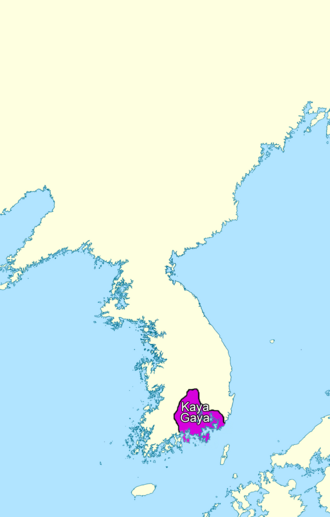
“Between the great kingdoms of the ancient peninsula, Kaya forged its power not through conquest alone, but through the fire of iron and the currents of trade.”
When most people think of ancient Korea, three names come to mind: Goguryeo, Baekje, and Silla — the famous Three Kingdoms. Yet for nearly six centuries, a fourth power flourished in the southeastern corner of the peninsula. The Kaya Confederacy (also spelled Gaya) was a loose alliance of small but formidable polities nestled along the Nakdong River basin and the southern coast. Though it was eventually absorbed by the expanding kingdom of Silla in the 6th century CE, Kaya left behind a remarkable legacy of iron production, maritime trade, and cultural achievement that modern historians are only beginning to fully appreciate.
Quick Facts: The Kaya Confederacy at a Glance
| Detail | Information |
|---|---|
| Also Known As | Gaya, Karak, Mimana (in Japanese sources) |
| Period | Approximately 1st century CE – 562 CE |
| Location | Nakdong River basin and southern coast of the Korean peninsula |
| Type of State | Tribal confederacy of multiple polities |
| Key Resource | Iron production and export |
| Major Trading Partners | Lelang commandery (Han China), Wa (Japan), and other Korean kingdoms |
| End | Conquered and absorbed by Silla; last polity fell in 562 CE |
| Notable Cultural Legacy | Iron artifacts, ceramic pottery, gayageum (12-string zither) |
Origins: A Confederacy Born Along the Nakdong River
The Kaya Confederacy emerged in the southern reaches of the Korean peninsula during the early centuries of the Common Era, in a region that had long been part of the broader Samhan (Three Han) tribal territories known as Byeonhan. Unlike the more centralized kingdoms of Goguryeo or Baekje, Kaya never fully unified under a single monarch. Instead, it remained a confederation — a coalition of semi-independent polities that shared cultural traits, trade networks, and occasionally military cooperation, while each retained its own local leadership.
The earliest and most prominent of these polities was Geumgwan Gaya (also called Bon Gaya or Garak), centered near present-day Gimhae in South Gyeongsang Province. According to the Samguk Yusa (Memorabilia of the Three Kingdoms), a 13th-century Korean text, Geumgwan Gaya was founded by a legendary king named Kim Suro, who was said to have descended from the heavens in a golden egg. While the mythological details belong to legend, the founding narrative underscores the deep cultural memory surrounding Kaya’s origins.
During what historians call the Early Kaya period (roughly the 1st through 3rd centuries CE), Geumgwan Gaya held a position of dominance within the confederation. Its coastal location near the mouth of the Nakdong River gave it direct access to sea trade routes connecting the peninsula with the Lelang commandery in the north and the Wa polities of the Japanese archipelago.
Why Was Iron So Central to Kaya’s Power?
No discussion of Kaya is complete without iron. The region’s rich iron deposits made it the foremost producer of iron on the Korean peninsula during the ancient period, and iron was the engine of Kaya’s economy, diplomacy, and military capacity.
Kaya iron — in the form of iron ingots and finished tools — served as a kind of currency across Northeast Asia. Archaeological excavations at Kaya sites have unearthed vast quantities of iron artifacts, including iron plate armor, helmets, weapons, and agricultural tools. Notably, iron ingots have been found in burial mounds, indicating that iron held symbolic and ritual significance beyond mere utility.
“Kaya’s iron was not merely a commodity — it was the foundation of a regional economy that linked the Korean peninsula to China and Japan for centuries.”
Chinese historical records, including the Wei Zhi (Records of Wei), describe iron being exported from the Byeonhan region — the precursor to Kaya — to neighboring peoples including the Lelang commandery and the Wa. This early iron trade established trade patterns that would persist throughout much of Kaya’s history. The Wa polities of ancient Japan were especially dependent on Kaya iron for the production of weapons and tools, a dependency that gave Kaya considerable diplomatic leverage in the region.
Iron production also supported Kaya’s military strength. Kaya warriors were equipped with sophisticated iron armor and weapons that were among the finest in the ancient Korean world. Elaborate iron lamellar armor — reconstructed from fragments found in Kaya tombs — reveals a level of metallurgical craftsmanship that rivaled anything produced elsewhere on the peninsula at the time.
The Shift to Later Kaya: Daegaya’s Rise
The political balance within the confederacy shifted dramatically in the late 4th and early 5th centuries. Goguryeo, expanding aggressively from the north, launched a major military campaign into the southern peninsula around 400 CE in response to a Baekje-Wa-Kaya alliance that had threatened Silla. The Goguryeo military invasion devastated Geumgwan Gaya and its coastal allies, breaking the dominance of the Early Kaya period.
In the aftermath, leadership within the confederacy shifted inland to Daegaya, centered near present-day Goryeong in North Gyeongsang Province. The period of Daegaya’s prominence — often called the Later Kaya period (5th–6th centuries CE) — saw renewed cultural flourishing. Daegaya developed sophisticated ceramic traditions and maintained active trade and diplomatic contacts with Baekje and even with the southern Chinese kingdoms.
It was also during this period that Kaya’s most enduring cultural contribution is said to have emerged: the gayageum, a 12-string zither that remains one of Korea’s most iconic traditional musical instruments. According to historical accounts, the instrument was created in Daegaya and brought to Silla after the confederacy’s collapse, where it became a cornerstone of Korean court music.
Kaya and Its Neighbors: A Comparison of the Southern Kingdoms
| Feature | Kaya Confederacy | Silla | Baekje |
|---|---|---|---|
| Political Structure | Loose confederacy of polities | Centralized monarchy | Centralized monarchy |
| Key Strength | Iron production and trade | Military expansion, Buddhism | Maritime trade, culture |
| Relationship with Wa (Japan) | Close trade and cultural ties | Periodic conflict and alliance | Strong cultural transmission |
| Fate | Absorbed by Silla (42–562 CE) | Unified the peninsula (668 CE) | Conquered by Silla-Tang alliance (660 CE) |
| Archaeological Heritage | Iron artifacts, burial mounds, ceramics | Gold crowns, tumuli | Jewelry, Buddhist art, tombs |
The Fall of Kaya: Swallowed by Silla
The Kaya Confederacy did not fall in a single dramatic defeat. Rather, it was dismantled piece by piece over several generations as the kingdom of Silla grew stronger and more expansionist. Geumgwan Gaya — the original leading polity — submitted to Silla as early as 532 CE under King Beophung of Silla. The remaining Kaya polities resisted for three more decades before Daegaya, the last significant holdout, was finally conquered by Silla’s King Jinheung in 562 CE.
The absorption of Kaya into Silla was not merely a political event. It represented the end of a distinct cultural tradition and the integration of Kaya’s population, craftsmen, and knowledge into the expanding Silla state. Kaya’s ironworkers, potters, and musicians became part of Silla’s cultural fabric, contributing to the artistic and technological achievements of what would eventually become the Unified Silla period.
The nobility of certain Kaya polities were granted status within the Silla bone-rank system, suggesting that the integration was at least partly accommodating rather than purely oppressive. The famous Silla general Kim Yusin, one of the heroes of Korean unification in the 7th century, was a descendant of the royal family of Geumgwan Kaya — a telling example of how Kaya’s elite bloodlines persisted within Silla society.
Why Does Kaya Matter Today?
For much of Korean historiography, Kaya occupied a secondary position — an interesting but ultimately peripheral footnote to the Three Kingdoms narrative. That view has changed significantly in recent decades. Ongoing archaeological excavations at Kaya sites in the Nakdong River basin have produced remarkable finds that are reshaping scholarly understanding of the confederacy’s sophistication.
In 2023, a cluster of Kaya burial mounds in the Gimhae, Hamyang, Goryeong, Changnyeong, and Hapcheon areas was inscribed on the UNESCO World Heritage List under the name “Gaya Tumuli.” This inscription marked a major milestone in the global recognition of Kaya’s cultural significance. The tumuli — ancient burial mounds containing iron artifacts, ceramic vessels, ornaments, and horse trappings — offer invaluable windows into Kaya society, ritual practice, and artistic achievement.
The UNESCO inscription also acknowledged the Kaya tumuli’s importance for understanding the patterns of exchange between the Korean peninsula and the Japanese archipelago in the ancient period, a topic that remains of great scholarly and diplomatic interest. Kaya’s position as a bridge culture — connecting Chinese, Korean, and Japanese civilizations through trade, technology, and cultural exchange — gives it an importance that extends well beyond its relatively modest territorial footprint.
Today, museums in Gimhae and Goryeong maintain dedicated exhibitions on Kaya culture, and the National Museum of Korea in Seoul houses significant collections of Kaya artifacts. The gayageum continues to be played by Korean musicians, carrying the sound of this ancient confederacy into the present.
Continue Exploring
On coreaverse.com
- The Rise of Silla and the Three Kingdoms Era
- Iron and Identity: The Korean Iron Age
- Gaya Tumuli: Korea’s Newest UNESCO World Heritage Site