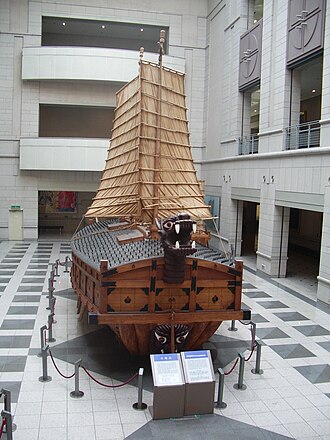
“The enemy will not be able to invade us as long as our warships stand ready.” — Admiral Yi Sun-sin
Few weapons in world history carry the mythic weight of Korea’s geobukseon — the turtle ship. Built in the final years of the sixteenth century, this armored warship became the symbol of Korean ingenuity, naval resilience, and the fierce will to defend a homeland under siege. When Japan launched its massive invasion of the Korean peninsula in 1592, the turtle ship became one of the most decisive instruments of resistance — and the man behind it, Admiral Yi Sun-sin, became a national hero whose legacy endures to this day.
Quick Facts: The Turtle Ship at a Glance
| Feature | Detail |
|---|---|
| Korean Name | Geobukseon (거북선) |
| Meaning | “Turtle Ship” |
| Era | Joseon Dynasty, late 16th century |
| First Deployed | 1592, during the Imjin War |
| Commander | Admiral Yi Sun-sin (이순신) |
| Primary Role | Ramming and close-range cannon fire |
| Distinguishing Feature | Covered, spiked deck to prevent boarding |
| Propulsion | Oars and sail |
What Was the Imjin War, and Why Did the Turtle Ship Matter?
To understand the turtle ship, one must first understand the catastrophe it was built to meet. In 1592, the Japanese warlord Toyotomi Hideyoshi sent a massive invasion force across the Korea Strait. The Japanese army swept rapidly northward, capturing the capital Hanyang (modern Seoul) within weeks. The Joseon court fled in disarray. On land, the situation was dire.
But the sea told a different story.
Admiral Yi Sun-sin, commanding the Joseon naval forces from the southern coast, had spent the months before the invasion preparing. He drilled his sailors, strengthened his fleet, and oversaw the completion of a radical new vessel — the turtle ship. When Japanese warships attempted to dominate Korea’s sea lanes, Yi’s fleet met them with a weapon they had never encountered before.
Control of the sea mattered enormously. Japan’s strategy depended on supplying its land forces by ship. If those supply lines could be cut, the invasion would falter. Admiral Yi understood this, and the turtle ship was one of his key tools for achieving naval supremacy.
3 Revolutionary Features That Made the Turtle Ship Formidable
1. The Armored, Covered Deck
The turtle ship’s most distinctive feature was its roof — a curved, covered deck that enclosed the vessel from bow to stern. Unlike conventional warships of the era, which had open upper decks exposing rowers and soldiers to enemy fire, the turtle ship’s crew fought from within a protected shell. The roof is believed to have been covered with iron plates or iron spikes — or both — making it extraordinarily difficult for enemy soldiers to board the vessel. The spikes, in particular, were designed to impale anyone who tried to leap onto the deck from an opposing ship, turning the turtle ship’s surface into a lethal trap.
2. Cannon Ports on All Sides
The turtle ship bristled with cannon ports along its sides, bow, and stern. This allowed the vessel to deliver fire in multiple directions simultaneously. Rather than needing to bring a single broadside to bear — as European ships of the era typically did — the turtle ship could project force in nearly every direction at once. In the close-quarters naval combat of the Imjin War, this was a devastating advantage. The ship could ram into an enemy formation, fire in all directions, and withdraw before opponents could organize a response.
3. The Dragon Head Prow
At the bow of the turtle ship sat a carved dragon head, which could emit smoke or fire. Historical sources differ on whether this was primarily a functional weapon or a psychological tool designed to terrify enemy sailors. Regardless, the image of an armored vessel with a fire-breathing dragon’s head bearing down on a fleet would have been a deeply unnerving sight. The smoke produced could also serve tactical purposes, obscuring the ship’s movements and confusing enemy archers and gunners.
“The turtle ship was not merely a warship — it was a statement of purpose. It said to every enemy sailor: you cannot board us, you cannot stop us, and you cannot outlast us.”
Admiral Yi Sun-sin: The Mind Behind the Vessel
No account of the turtle ship can be separated from the man who brought it to the battlefield. Yi Sun-sin is one of the most celebrated military commanders in Korean history — and by many measures, in world history. Born in 1545 in Hanyang, Yi came from a family of modest means and rose through the military ranks through dedication and merit. He was appointed as the commander of the Left Jeolla Naval District in 1591, just one year before the Japanese invasion began.
In that single year, Yi transformed his command. He repaired and built warships, stockpiled weapons and provisions, and trained his sailors relentlessly. The turtle ship was completed in the weeks just before the Japanese fleet arrived. When the war began, Yi was ready.
Over the course of the Imjin War, Yi Sun-sin fought in numerous naval engagements — and he did not lose a single one. His victories at battles such as Okpo, Hansando, and Myeongnyang became the stuff of legend. At the Battle of Myeongnyang in 1597, Yi famously defeated a Japanese fleet of over 130 warships with only 13 Korean vessels — one of the most celebrated underdog victories in naval history.
Yi Sun-sin was killed by a stray bullet at the Battle of Noryang in 1598, the final major naval engagement of the war. His last recorded words were a request that his death not be announced until the battle was won, so as not to break the morale of his sailors. He died as he had lived — in service to his country.
How Did the Turtle Ship Perform in Battle?
The turtle ship was not the only warship in Yi Sun-sin’s fleet — the larger and more numerous panokseon (판옥선), a broad, high-sided warship, formed the backbone of the Joseon navy. But the turtle ship served a unique function as a shock weapon and ram. Its role was to pierce into the heart of an enemy formation, creating chaos and breaking apart the enemy’s line before the rest of the fleet moved in.
In practice, this tactic proved devastatingly effective. Japanese naval strategy at the time relied heavily on boarding — closing with enemy ships, throwing grappling hooks, and overwhelming opponents in hand-to-hand combat. The turtle ship was specifically designed to make this impossible. Its armored roof could not be climbed or stood upon, its cannon fired in all directions, and its ram could smash through enemy hulls. Japanese tactics, optimized for boarding warfare, were almost useless against it.
Comparing the Turtle Ship to Other Warships of Its Era
| Feature | Turtle Ship (Korea) | Japanese Atakebune | European Galleon (16th c.) |
|---|---|---|---|
| Deck Type | Enclosed, armored | Open upper deck | Open upper deck |
| Primary Tactic | Ramming + multi-directional cannon | Boarding | Broadside cannon fire |
| Boarding Resistance | Very high (spiked roof) | Low | Moderate |
| Crew Protection | High (enclosed hull) | Low to moderate | Moderate |
| Propulsion | Oars + sail | Oars + sail | Primarily sail |
| Symbolic Role | National icon | Military transport | Colonial power projection |
The Turtle Ship in Korean Memory and Identity
The turtle ship occupies a place in Korean national consciousness that goes far beyond its military record. It appears on currency, in museums, at historical parks, and in countless cultural references. In a nation whose history includes repeated experiences of invasion and occupation, the turtle ship represents something profound: the idea that Korean ingenuity and determination could overcome overwhelming odds.
The Imjin War itself — fought between 1592 and 1598 — was one of the most destructive conflicts in Korean history. Hundreds of thousands of Korean civilians died, vast stretches of the country were burned or looted, and the social fabric of the Joseon Dynasty was severely strained. Yet amid that catastrophe, the naval victories of Yi Sun-sin and his fleet — powered in part by the turtle ship — prevented a complete Japanese conquest of the peninsula.
Today, replica turtle ships can be visited at several locations in South Korea, and the National Maritime Museum in Mokpo holds significant collections related to Joseon-era naval history. The ship remains one of the most recognizable symbols of Korean heritage.
Mysteries and Debates: What Do We Still Not Know?
Despite its fame, the turtle ship remains surrounded by historical uncertainty. No original vessel survives — all existing representations are reconstructions based on historical documents, drawings, and scholarly interpretation. Key questions remain unresolved among historians and maritime experts:
- Was the roof truly iron-plated? Some sources strongly suggest iron armor; others indicate wooden planks with iron spikes. The debate continues.
- How many turtle ships were in service? Numbers mentioned in historical records are small — perhaps three to five at any one time — suggesting the vessel was a specialist weapon rather than the backbone of the fleet.
- Exactly how was the dragon head used? The mechanisms for producing smoke or fire from the dragon head prow are not fully understood from surviving documents.
These uncertainties do not diminish the turtle ship’s historical significance. They remind us that history is often more complex — and more fascinating — than legend allows.