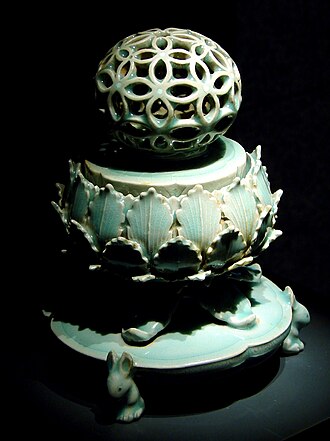
“The first is the azure color of Goryeo celadon. The second is… the intricate inlay work. These are the two finest things in the world.” — Xu Jing, Chinese envoy, 1124 CE
Korean Celadon: The Art of Goryeo Pottery and Porcelain
Few artistic traditions in East Asia command as much admiration as Korean pottery and porcelain. Spanning thousands of years, Korean ceramic art evolved from humble earthenware vessels into some of the most technically sophisticated and aesthetically celebrated objects ever produced in the ancient world. At its peak during the Goryeo dynasty (918–1392), Korean celadon achieved a quality of jade-green glaze that stunned even sophisticated Chinese observers, earning praise that echoed across the continent. Later, during the Joseon dynasty (1392–1897), Korean potters developed a refined white porcelain tradition that expressed an entirely different aesthetic philosophy — one rooted in Confucian ideals of purity and restraint. Together, these two traditions form one of the great chapters in Korean cultural heritage.
Quick Facts: Korean Pottery and Porcelain
| Category | Detail |
|---|---|
| Earliest known pottery | Neolithic period (Jeulmun pottery, comb-pattern ware) |
| Golden age of celadon | Goryeo dynasty, 10th–14th centuries CE |
| Signature Goryeo technique | Sanggam (inlaid celadon decoration) |
| Joseon signature ware | Baekja (white porcelain) |
| Major production centers | Gangjin and Buan (celadon); Gwangju, Gyeonggi-do (Joseon white porcelain) |
| UNESCO recognition | Goryeo celadon kiln sites included in national heritage designations |
From Earth to Art: The Origins of Korean Pottery
The story of Korean pottery begins long before dynasties were formed. Archaeological evidence shows that the Korean peninsula’s inhabitants were producing pottery as far back as the Neolithic period. The earliest examples are known as Jeulmun pottery — recognizable by their distinctive comb-pattern decorations pressed into the clay surface before firing. These vessels were functional objects, used for storing and cooking food by communities living along rivers and coastlines.
During the Bronze Age and into the Three Kingdoms period (roughly 57 BCE to 668 CE), Korean pottery grew more refined. The kingdoms of Goguryeo, Baekje, and Silla each developed their own ceramic traditions, influenced partly by contact with China but shaped significantly by Korean aesthetic sensibilities and local clay resources. Silla’s stoneware — hard, grey, and fired at high temperatures — was particularly notable, with elegant shapes and restrained surfaces that already hinted at the Korean preference for understated beauty.
The Unified Silla period (668–935 CE) brought greater cultural exchange with Tang dynasty China, and Korean potters began experimenting with glazed surfaces. This laid essential groundwork for what would become one of the most celebrated ceramic traditions in all of East Asia.
Why Did Goryeo Celadon Captivate the World?
When the Goryeo dynasty unified the peninsula in 918 CE, Korean potters found themselves in an era of extraordinary cultural ambition. Drawing on techniques learned from Chinese kilns — particularly those of the Yue ware tradition in southeastern China — Korean artisans developed their own approach to celadon, a type of pottery distinguished by its translucent, blue-green glaze achieved through careful iron-oxide chemistry and precise kiln conditions.
What emerged was something entirely Korean. The specific clay found near kiln sites in Gangjin, South Jeolla Province, combined with local glaze materials and the accumulated skill of Korean potters, produced a color that contemporaries could only describe as resembling jade — the most precious material in East Asian culture. The Chinese envoy Xu Jing, who visited Korea in 1124 and recorded his observations in the text Xuanhe Fengshi Gaoli Tujing, declared the color of Goryeo celadon among the finest things in the world.
But color alone does not explain the prestige of Goryeo ceramics. Korean potters invented and perfected the sanggam technique — a method of inlaying decoration into the clay body itself before glazing. Artisans would incise designs into the leather-hard clay, fill the incisions with white or black slip (liquid clay), and then carefully scrape away the excess before applying the celadon glaze and firing. The result was imagery of extraordinary delicacy: cranes in flight among clouds, willow trees bending over water, chrysanthemum blossoms, and geometric patterns that seemed to float beneath the surface of the glaze like visions glimpsed through mist.
“Goryeo celadon did not simply borrow from Chinese ceramic tradition — it transformed it, creating an aesthetic language that was unmistakably Korean in its elegance and technical innovation.”
The range of objects produced in Goryeo celadon was vast: wine ewers, cups, incense burners, pillows, roof tiles for Buddhist temples, and medicine containers. Many were destined for the royal court or for Buddhist monasteries, reflecting the deep connection between Goryeo ceramic culture and the dynasty’s official patronage of Buddhism. The kilns at Gangjin and Buan were not casual workshops — they were sophisticated industrial and artistic enterprises operating under royal patronage and producing objects of the highest refinement.
The Rise of Joseon White Porcelain
The Goryeo dynasty fell in 1392, replaced by the Joseon dynasty founded by General Yi Seonggye. With the change of dynasty came a profound shift in official ideology — from Buddhism to Neo-Confucianism — and this philosophical transformation had direct consequences for Korean ceramic art.
Joseon’s ruling class, known as the yangban, embraced Confucian values of simplicity, moral rectitude, and restraint. The lush, decorated surfaces of Goryeo celadon fell out of favor at court. In their place rose baekja — white porcelain — whose pure, unadorned surfaces perfectly embodied Confucian ideals of clarity and virtue. A plain white porcelain bowl on a scholar’s desk was not merely a vessel; it was a statement of moral philosophy.
Joseon white porcelain was produced in official kilns known as bunwon, most famously at Gwangju in Gyeonggi Province, which supplied the royal court. The clay used was a pure, white-firing kaolin, and the glaze was typically a clear or slightly bluish white. Unlike Goryeo celadon, the emphasis was on form — the elegant curve of a jar, the perfect proportions of a bottle — rather than surface decoration.
That said, Joseon potters did produce decorated white porcelain, painting designs in cobalt blue (imported from China and the Middle East) or iron-red pigments beneath the glaze. These cheonghua (blue-and-white) pieces depicted plum blossoms, bamboo, dragons, and landscapes in a painterly style that reflected the calligraphic traditions of Joseon literati culture. Later in the dynasty, chulhwa (iron-painted porcelain) and jinsa (copper-red decorated ware) expanded the decorative repertoire further.
3 Ways Korean Ceramics Shaped East Asian Art History
1. The Invention of Sanggam Inlay
The sanggam technique, developed by Korean potters during the Goryeo period, was a genuine Korean innovation with no direct precedent in Chinese ceramics. This method of inlaying contrasting-colored slips into incised designs beneath a celadon glaze created a visual effect unique in the ceramic world. Scholars and collectors across East Asia recognized its novelty, and it remains one of the defining contributions of Korean art to global ceramic history.
2. Influencing Japanese Ceramics Through the Imjin War
The Japanese invasions of Korea in 1592 and 1597 — known in Korean as Imjin Waeran — had devastating consequences for the Korean population and cultural infrastructure. Among the most lasting side effects was the forced relocation of Korean potters to Japan by Japanese feudal lords who recognized the extraordinary skill of Korean ceramicists. These potters, taken to regions such as Kyushu, became the founders of celebrated Japanese ceramic traditions including Arita ware (the origin of Japanese porcelain) and Satsuma ware. The history of Japanese porcelain is, in significant measure, a chapter of Korean ceramic history.
3. Establishing an Aesthetic of Understated Beauty
Korean ceramics — particularly Joseon white porcelain — deeply influenced the concept of wabi aesthetics in Japan and contributed to broader East Asian conversations about the beauty of simplicity, irregularity, and natural form. The moon jars (dal hangari) of the Joseon dynasty, perfectly spherical white porcelain vessels assembled from two separately thrown halves, became icons of Korean aesthetic philosophy: objects that achieved monumentality through utter simplicity.
Comparison: Goryeo Celadon vs. Joseon White Porcelain
| Feature | Goryeo Celadon | Joseon White Porcelain |
|---|---|---|
| Period | 10th–14th century | 15th–19th century |
| Color | Jade green (bi-color variants existed) | Pure white to bluish-white |
| Dominant ideology | Buddhism | Neo-Confucianism |
| Signature decoration | Sanggam (inlay), incised and stamped motifs | Plain surface or blue-and-white painting |
| Main patrons | Royal court, Buddhist monasteries | Royal court, Confucian scholars |
| Key kiln sites | Gangjin, Buan | Gwangju (Gyeonggi), Bunwon kilns |
| Global legacy | Recognized as world’s finest celadon | Influenced Japanese porcelain traditions |
The Living Legacy of Korean Ceramics
Korean pottery and porcelain did not remain frozen in museum cases. The ceramic tradition continued through the tumultuous twentieth century and into the present day. After the Japanese colonial period (1910–1945), during which Korean cultural production was suppressed and many traditions disrupted, Korean ceramicists undertook a systematic effort to recover and revitalize their heritage. Master potters studied surviving historical examples, analyzed kiln sites, and worked to reconstruct traditional techniques including the sanggam inlay method and the formulas for authentic Goryeo celadon glaze.
Today, the kiln sites at Gangjin — where Goryeo celadon was produced at its finest — are recognized as nationally significant heritage sites, drawing researchers, ceramicists, and visitors from across the world. The National Museum of Korea in Seoul houses one of the world’s great collections of historic Korean ceramics, where visitors can encounter Goryeo celadon vessels of heartbreaking beauty alongside the serene white moon jars of the Joseon period.
Contemporary Korean ceramic artists work in dialogue with this deep tradition — some aiming for faithful historical reconstruction, others using traditional techniques as a springboard for thoroughly modern artistic expression. Korean ceramics are collected by major museums worldwide, from the Metropolitan Museum of Art in New York to the Victoria and Albert Museum in London, confirming what Xu Jing observed nine centuries ago: that Korean potters have produced some of the most remarkable objects the human hand has ever made.
Continue Exploring
On Coreaverse
- The Goryeo Dynasty: Korea’s Age of Buddhism and Culture
- Joseon Dynasty: Five Centuries of Confucian Korea
- Korea’s Most Important Heritage Sites