“The sea will be our fortress, and the turtle ships our walls.”
— A sentiment attributed to the spirit of Admiral Yi Sun-sin’s naval campaigns during the Imjin War
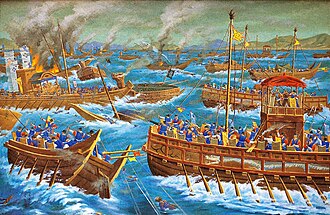
In the summer of 1592, the Korean peninsula was in crisis. Japanese forces under Toyotomi Hideyoshi had invaded in force, and Joseon’s land armies were struggling to hold the line. Yet on the open waters near Hansan Island — a small island off the southern coast of what is now South Gyeongsang Province — Korea’s greatest naval commander engineered one of the most decisive naval victories in East Asian history. The Battle of Hansan Island, fought on August 14, 1592, not only reversed the momentum of the Japanese naval advance but ultimately helped determine the course of the entire Imjin War.
Quick Facts: The Battle of Hansan Island
| Detail | Information |
|---|---|
| Date | August 14, 1592 (Korean lunar calendar: July 8, Imjin year) |
| Location | Near Hansan Island, off the southern coast of Korea |
| Korean Commander | Admiral Yi Sun-sin, joined by Yi Eok-gi and Won Gyun |
| Japanese Commander | Wakizaka Yasuharu |
| Conflict | Imjin War (Japanese invasions of Korea, 1592–1598) |
| Result | Decisive Joseon victory; Japanese fleet largely destroyed |
| Key Tactic | Hakgwi-jin (鶴翼陣) — the crane wing formation |
Why Did the Battle of Hansan Island Matter So Much?
To understand the significance of Hansan Island, one must first grasp the strategic situation of 1592. When Hideyoshi’s forces landed on the Korean peninsula in the spring of that year, they advanced with terrifying speed. Seoul (then called Hanyang) fell within weeks. The Joseon court fled northward. Japanese commanders were supremely confident and planned to use sea lanes along Korea’s western and southern coasts to ferry supplies and reinforcements northward, ultimately aiming at Ming China itself.
Control of the sea was not merely advantageous — it was essential. Without reliable supply lines running along the coast, the Japanese land campaign would grind to a halt. This is precisely what Admiral Yi Sun-sin understood, and it is why he committed his combined fleet to a series of aggressive naval engagements throughout the summer of 1592. Hansan Island was the culmination of those efforts.
Before Hansan, Yi had already won notable victories at Okpo and Dangpo. Each engagement built his commanders’ confidence and refined their tactics. But Hansan would be different in scale and consequence. Wakizaka Yasuharu commanded a powerful Japanese squadron — reportedly numbering around 73 warships — and was moving aggressively westward. If his fleet broke through, Japan would effectively command the sea routes that Yi had been working so hard to deny them.
The Crane Wing Formation: A Masterpiece of Naval Tactics
Admiral Yi Sun-sin’s tactical genius was never more evident than at Hansan Island. Rather than engaging the Japanese fleet in the narrow channel near Gyeonnaeryang — where the confined waters would have hampered Korean ships’ superior firepower and given Japanese boarding parties an advantage — Yi used a feint. He sent a small detachment of fast vessels into the straits to provoke the Japanese fleet, then retreated into the open waters of the broader bay near Hansan Island.
The Japanese, confident and perhaps overaggressive, took the bait. They gave chase into open water. And there, Yi sprung his trap.
“Yi Sun-sin lured the Japanese fleet into open water, then unfolded his warships in the hakgwi-jin — the crane wing formation — enveloping the enemy on three sides and unleashing a devastating barrage of cannon fire.”
The hakgwi-jin, or crane wing formation, was a classic East Asian military tactic adapted brilliantly to naval warfare. Yi’s ships fanned outward in a great arc, like the outstretched wings of a crane, encircling the Japanese fleet. Korean panokseon warships — large, multi-decked vessels armed with cannon — poured fire into the trapped Japanese ships from multiple angles simultaneously. The Japanese, whose naval doctrine favored grappling and boarding, found themselves unable to close the distance against withering artillery fire.
The turtle ship, or geobukseon (거북선), Yi’s famous ironclad-style vessel, also played a role in the engagement, spearheading the attack and disrupting Japanese formations. Covered with iron spikes and plates to prevent boarding, the turtle ship could push directly into enemy formations while its cannon fired in multiple directions.
The result was catastrophic for the Japanese. Estimates suggest that the majority of Wakizaka’s fleet was sunk or captured. Wakizaka himself barely escaped with his life. The Japanese lost dozens of ships and hundreds, if not thousands, of sailors and soldiers. Korean casualties, by contrast, were remarkably light.
Three Reasons Why Hansan Island Changed the War
1. Japan Lost Control of the Western Sea Routes
The destruction of Wakizaka’s fleet meant that Japan could no longer safely move ships along Korea’s southern and western coasts. The supply lines connecting the Japanese land armies to their home islands became dangerously vulnerable. This was not merely a logistical inconvenience — it was a strategic catastrophe. Japanese land forces in the north of Korea found themselves increasingly short of food and ammunition, and the grand advance toward China stalled.
2. It Bought Time for Korean and Ming Resistance to Organize
The naval victory at Hansan Island did not win the war overnight, but it fundamentally altered the timeline of the conflict. Japanese commanders could no longer count on an uninterrupted flow of reinforcements by sea. This delay gave the Joseon court time to appeal to Ming China for military assistance, and Chinese forces eventually intervened in force in 1593, turning the tide on land as Yi had turned it at sea.
3. It Elevated Yi Sun-sin to the Status of a National Hero
News of the victory spread rapidly. In a time of national catastrophe, Yi Sun-sin’s series of naval victories — culminating at Hansan Island — provided a desperately needed source of hope and pride. He became a symbol of Korean resistance, a figure whose genius and courage seemed to stand against impossible odds. His legacy would only grow in the years that followed, cemented by his final, posthumous victory at the Battle of Noryang in 1598, where he died in the moment of triumph.
The Ships That Won the Battle
| Feature | Korean Panokseon | Japanese Warships |
|---|---|---|
| Primary combat method | Cannon fire at range | Grappling and boarding |
| Deck configuration | Multi-deck, high freeboard | Lower-profile, faster |
| Artillery | Multiple cannon per vessel | Limited; relied on arquebuses |
| Effectiveness in open water | Highly effective | Disadvantaged at range |
| Special vessel | Geobukseon (turtle ship) | None equivalent |
The Legacy of Hansan Island in Korean Memory
The Battle of Hansan Island has never faded from Korean historical consciousness. Admiral Yi Sun-sin is today revered as perhaps the greatest military figure in Korean history. A large statue of him stands in the heart of Gwanghwamun Square in Seoul, watching over the city he helped save from conquest. His image appears on the 100-won coin. Museums, films, and dramas continue to retell his story for new generations.
Hansan Island itself, now part of Hallyeohaesang National Marine Park in South Gyeongsang Province, remains a place of pilgrimage for those wishing to connect with this chapter of history. The Jeseungdang, a shrine and command post associated with Yi Sun-sin on the island, draws visitors who come to reflect on the events of 1592.
Beyond Korea’s borders, military historians have long recognized the Battle of Hansan Island as a landmark in naval history. The use of deceptive tactics, the disciplined execution of a complex formation maneuver in the heat of battle, and the devastating effectiveness of artillery over boarding tactics all mark it as a battle ahead of its time. Some historians have compared Yi’s achievements favorably to those of figures like Horatio Nelson — a comparison that speaks to the universal recognition of his genius.
The Imjin War itself was ultimately inconclusive in political terms — Korea remained a Joseon dynasty kingdom, Japan withdrew, and the peninsula was not conquered. But had Yi Sun-sin not won at Hansan Island and in the naval campaigns surrounding it, the history of Korea, Japan, and China might have unfolded very differently. The crane’s wings, spread wide on a summer day in 1592, held back the tide of invasion.
Continue Exploring
Learn More on Korea Through Time
- Admiral Yi Sun-sin: The Man Behind the Legend
- The Imjin War: Japan’s Invasions of Joseon Korea
- The Turtle Ship: Korea’s Revolutionary Warship
- Visiting Hansan Island Today