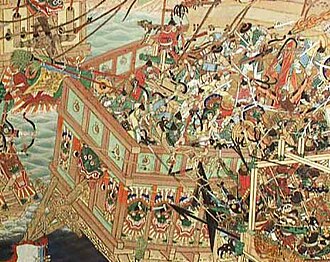
“I still have twelve ships.” — Admiral Yi Sun-sin, before the Battle of Myeongnyang, 1597
Few moments in Korean history carry the weight of the Battle of Myeongnyang. Fought on the 26th of October, 1597, in the narrow strait between Jindo Island and the Korean mainland, this engagement stands as one of the most remarkable naval victories in world history. Admiral Yi Sun-sin, commanding a desperate force of just 13 warships, turned the tides — quite literally — against a Japanese fleet of over 300 vessels. What followed was not merely a military triumph, but the salvation of Joseon Korea at its darkest hour.
Quick Facts: The Battle of Myeongnyang
| Date | 26 October 1597 |
|---|---|
| Location | Myeongnyang Strait, between Jindo Island and the Korean mainland |
| Joseon Commander | Admiral Yi Sun-sin |
| Joseon Ships | 13 warships |
| Japanese Fleet | Estimated 133–330+ warships |
| Outcome | Decisive Joseon victory |
| Conflict | Imjin War (Japanese invasions of Korea, 1592–1598) |
| Significance | Halted Japanese naval advance; protected Joseon’s western supply routes |
The Road to Crisis: How Korea Reached Its Darkest Hour
To understand the magnitude of Myeongnyang, one must understand the catastrophe that preceded it. Japan’s invasions of Korea — known in Korean as the Imjin Waeran — began in 1592 under the command of the Japanese warlord Toyotomi Hideyoshi. Japanese forces swept through the Korean peninsula with terrifying speed, capturing the capital Hanseong (modern-day Seoul) within weeks. The Joseon court fled northward, and the kingdom seemed on the verge of total collapse.
Admiral Yi Sun-sin had been Korea’s great naval bulwark during the first phase of the war. His innovative geobukseon, or turtle ships, and his mastery of Korean coastal waters had inflicted a series of devastating defeats on Japanese naval forces, denying them the sea supply lines they desperately needed to sustain their land armies. By 1593, a ceasefire had been negotiated, and Korea had a brief, fragile respite.
But the peace collapsed. In 1597, Hideyoshi launched a second invasion. This time, Yi Sun-sin himself had been stripped of his command — the victim of a Japanese disinformation campaign that manipulated the Joseon court into having him arrested and tortured. His replacement, Admiral Won Gyun, led the Korean fleet to near-total destruction at the catastrophic Battle of Chilcheollyang in August 1597. Of the entire Joseon navy, only 13 ships survived.
Yi Sun-sin was reinstated in desperation. He inherited a shattered fleet, broken crews, and a kingdom on its knees. The Japanese navy, now virtually unopposed, was preparing to sail around the Korean peninsula and cut off Chinese Ming dynasty reinforcements from reaching Joseon. If they succeeded, the war was effectively over.
Why Did Yi Sun-sin Choose the Myeongnyang Strait?
This is one of the most studied tactical questions in Korean military history. Facing an enemy fleet of over 100 warships — some estimates place the total Japanese force, including support vessels, at more than 300 — Yi Sun-sin could not hope to win through numbers or conventional engagement. Instead, he chose the battlefield with extraordinary care.
The Myeongnyang Strait, also known as Uldolmok, is a narrow channel of water running between the southwestern tip of the Korean peninsula and Jindo Island. It is famous — and feared — for its powerful tidal currents. The strait’s geography creates a natural bottleneck: the deep channel narrows dramatically, forcing tidal waters to rush through at remarkable speeds. These currents reverse direction roughly every six hours, creating conditions that any experienced sailor would treat with extreme caution.
Yi Sun-sin understood these waters intimately. He recognized that the strait’s narrowness would negate the Japanese numerical advantage. A fleet of 130 or 300 ships cannot fight effectively in a channel wide enough for only a handful of vessels to engage at once. The tidal current, flowing in one direction during the battle, would allow his 13 ships to hold a defensive line while the Japanese vessels struggled against the flow or were swept into confusion. When the tide turned, it would create chaos among the densely packed Japanese fleet.
“The narrow waters of Myeongnyang were not a trap set for the Japanese — they were the only ground on which Joseon could survive. Yi Sun-sin did not choose a battlefield; he chose the one place where 13 ships could matter.”
The Battle: 13 Ships Against a Fleet
On the morning of 26 October 1597, the Japanese fleet entered the Myeongnyang Strait in force. What happened next unfolded across several tense hours of combat in which Yi Sun-sin’s personal leadership proved as decisive as his tactical preparation.
As the Japanese vanguard advanced, Yi Sun-sin’s commanders hesitated, afraid to engage such overwhelming numbers. According to historical accounts, Yi Sun-sin himself sailed his flagship forward alone into the Japanese fleet, drawing fire and demonstrating to his officers that engagement was both possible and necessary. His personal courage galvanized his captains, and the remaining Korean ships followed.
The narrow channel worked exactly as Yi had calculated. Japanese warships crowded into the strait found themselves unable to maneuver or bring their superior numbers to bear. Korean cannon fire from the tightly positioned Joseon vessels raked the jammed Japanese formation. The leading Japanese commander, Kurushima Michifusa, was killed in the fighting — a significant blow to Japanese morale and coordination.
Then the tide turned. The powerful reversal of current in the Myeongnyang Strait struck the Japanese fleet at a critical moment. Ships were swept backward, colliding with those still pressing forward. The tight formation became a tangle. Japanese vessels capsized or rammed one another. The organized advance disintegrated into chaos.
By the time the battle ended, the Japanese had lost at least 31 warships destroyed and an unknown number damaged. Not a single Korean warship was lost. The disproportion of the result — 13 ships defeating a fleet of well over 100 — remains almost without parallel in naval history.
3 Reasons Why Myeongnyang Changed the Course of the Imjin War
- It secured Joseon’s western sea routes. The Japanese plan had been to sail their navy around the peninsula and link up with land forces advancing on the capital. Myeongnyang shattered that plan. The western sea lanes remained in Korean hands, allowing Chinese Ming reinforcements and supplies to continue reaching Joseon forces by sea.
- It broke Japanese naval confidence. After the catastrophic defeat, the Japanese navy never again attempted a major offensive operation in Korean waters. The naval stalemate that followed proved fatal to Japanese strategic ambitions, as their land armies could not be properly sustained without naval superiority.
- It preserved Yi Sun-sin’s fleet for future operations. Though 13 ships seem a slender force, they were the seed of Joseon’s rebuilt navy. In the following months, Yi Sun-sin gathered additional vessels and crews. By the time of the final decisive engagement at the Battle of Noryang in 1598, he commanded a substantial fleet once more. Myeongnyang bought the time and confidence needed for that recovery.
Yi Sun-sin: The Admiral Who Would Not Yield
The Battle of Myeongnyang is inseparable from the character of the man who fought it. Yi Sun-sin is today revered in South Korea as perhaps the nation’s greatest military hero, and the reverence is not difficult to understand. His career was marked not only by tactical brilliance but by an almost incomprehensible degree of personal resilience.
He had been imprisoned, tortured, and demoted to the rank of common soldier — and returned to command with no bitterness recorded in his actions, only a determination to do his duty. His famous Nanjung Ilgi, the war diary he kept throughout the conflict, reveals a man of deep moral seriousness who felt the weight of every life lost under his command.
Before Myeongnyang, when the court considered abandoning the remaining 13 ships as hopeless, Yi Sun-sin wrote his defiant response: he still had ships, and while he lived, the enemy would not dare to underestimate him. It was not bravado — it was a precise tactical assessment. And it proved correct.
Yi Sun-sin did not survive the war. He was killed at the Battle of Noryang in December 1598, reportedly by a stray bullet as the Japanese attempted their final evacuation from Korea. His last recorded words, according to tradition, asked that his death not be announced lest it discourage his men during the battle. The war ended with his death, Joseon battered but undefeated, Japan’s grand continental ambitions in ruins.
Myeongnyang in History and Memory
The Battle of Myeongnyang occupies a unique place in Korean national memory. It is studied in Korean schools, celebrated in museums, and has inspired novels, television dramas, and films — most notably the 2014 blockbuster The Admiral: Roaring Currents, which became the highest-grossing film in South Korean history at the time of its release, seen by over 17 million people.
The strait itself, the Uldolmok channel near Jindo, remains a place of pilgrimage for those interested in Korean history. The powerful tidal currents Yi Sun-sin turned into a weapon still rush through the channel today, a reminder of how geography and genius combined to change the fate of a nation.
Military historians have compared Myeongnyang to other famous battles of the outnumbered — Thermopylae, Agincourt — but the Korean battle has a distinction those engagements lack: it was a total tactical victory, not a heroic defeat. Thirteen ships went into the strait, thirteen ships came out. The Japanese fleet, whatever its precise size, did not pass.
Continue Exploring
Deepen your understanding of the Battle of Myeongnyang and the Imjin War with these resources: