“He opened territory in all four directions, taking land and never returning it.” — Traditional description of Gwanggaeto the Great, as recorded on his memorial stele
In the long sweep of Korean history, few figures loom as large as Gwanggaeto the Great. Born in 374 CE and ascending the throne of Goguryeo at just eighteen years of age, he went on to become the most expansionist ruler the Korean peninsula had ever seen. In a reign of barely two decades, he transformed Goguryeo from a powerful regional kingdom into a Northeast Asian empire whose shadow fell across modern-day Korea, Manchuria, and beyond. His story is one of military genius, political ambition, and an extraordinary legacy preserved in stone that has endured for over sixteen centuries.
Quick Facts: Gwanggaeto the Great
| Detail | Information |
|---|---|
| Born | 374 CE |
| Died | 412 CE |
| Reigned | 391–412 CE |
| Kingdom | Goguryeo |
| Posthumous Title | Gwanggaeto (廣開土, “Broad Expander of Territory”) |
| Memorial Stele | Erected 414 CE in Ji’an, modern Jilin Province, China |
| Dynasty | Goguryeo (37 BCE – 668 CE) |
A Kingdom on the Rise: Goguryeo Before Gwanggaeto
To understand Gwanggaeto’s achievement, it helps to understand the world he inherited. Goguryeo was one of the Three Kingdoms of Korea, a state founded, according to tradition, in 37 BCE in the northern regions of the Korean peninsula and extending into Manchuria. By the late fourth century, it had already survived centuries of conflict with Chinese dynasties, nomadic confederacies, and rival Korean kingdoms. It was a militarized society, organized around a warrior aristocracy and capable of fielding large, disciplined armies.
Yet Goguryeo had also suffered setbacks. In 371 CE — just three years before Gwanggaeto’s birth — the kingdom of Baekje dealt Goguryeo a devastating blow, killing King Gogukwon in battle and forcing a temporary retreat northward. The kingdom that Gwanggaeto inherited was one with wounds still healing, surrounded by rivals and threatened from multiple directions. That he not only stabilized Goguryeo but transformed it into the dominant power of Northeast Asia is a testament to exceptional leadership.
Why Did Gwanggaeto Launch Such Aggressive Expansion?
Historians have long debated the motivations behind Gwanggaeto’s relentless campaigns. The answer likely lies in a combination of factors: the need to avenge Goguryeo’s earlier defeats, the pressure of external threats from nomadic groups to the north, the economic logic of controlling trade routes and agricultural land, and — perhaps most importantly — the political culture of Goguryeo itself, where a king’s legitimacy was closely tied to military success.
Goguryeo’s warrior aristocracy expected results. A king who expanded territory, brought back tribute, and demonstrated supremacy over neighboring peoples was a king whose authority was secure. Gwanggaeto understood this calculus perfectly.
“In his reign of twenty-two years, Gwanggaeto campaigned in sixty-four fortresses and 1,400 villages.” — As recorded on the Gwanggaeto Stele, erected by his son Jangsu in 414 CE
Whatever his precise motivations, the scale of what he achieved is staggering. His campaigns took Goguryeo forces south against Baekje, west against the Later Yan dynasty, north and east against the Khitan and other nomadic groups, and even onto the Korean peninsula’s southern reaches in support of the kingdom of Silla against Japanese forces (referred to in sources as Wae) who had invaded from the sea.
5 Major Campaigns That Defined His Reign
1. Crushing Baekje and Avenging Past Defeats
Gwanggaeto’s campaigns against Baekje were among his most politically significant. In 396 CE, he personally led a massive military operation against Baekje, reportedly capturing fifty-eight fortresses and forcing the Baekje king to submit, surrender hostages, and pledge loyalty to Goguryeo. This dramatically reversed the humiliation of 371 CE and established Goguryeo’s dominance over the central Korean peninsula.
2. Repelling the Wae and Rescuing Silla
In 400 CE, Gwanggaeto sent an army of fifty thousand soldiers south to relieve the kingdom of Silla, which was under severe pressure from Wae forces — warriors from the Japanese islands. Goguryeo’s intervention was decisive: the Wae forces were driven back, and Silla became effectively a client state under Goguryeo’s protection. This episode is one of the most debated in early Korean and Japanese historiography, as it touches on sensitive questions of ancient relationships between the Korean peninsula and Japan.
3. Defeating the Later Yan
To Goguryeo’s west lay the Later Yan, a powerful state in the former territory of northeastern China. Gwanggaeto launched successful campaigns against the Later Yan, capturing significant territory and extending Goguryeo’s control over parts of Liaodong — a strategically vital region that had long been contested between Korean and Chinese powers.
4. Northern Campaigns Against the Khitan and Sushen
Gwanggaeto also pushed aggressively northward, subjugating groups including the Khitan and Sushen peoples. These campaigns secured Goguryeo’s northern frontiers and brought large new territories under the kingdom’s direct control, dramatically enlarging the state’s resource base and population.
5. Securing the Eastern Frontier
Eastward campaigns brought additional peoples and territories into Goguryeo’s orbit, consolidating the kingdom’s hold over the northeastern reaches of the Korean peninsula and adjacent Manchurian regions. By the end of his reign, Goguryeo’s territory had expanded to an extent that would never be surpassed.
The Gwanggaeto Stele: A Monument to Memory
Gwanggaeto died in 412 CE, likely in his late thirties — a relatively young age, though the sources do not record the cause of death. He was succeeded by his son, King Jangsu (the “Long-Living King”), who would reign for an extraordinary seventy-nine years and continue his father’s legacy.
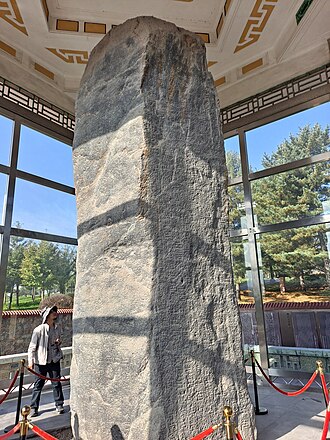
In 414 CE, just two years after Gwanggaeto’s death, Jangsu erected a massive memorial stele at the royal tomb site in what is now Ji’an, in modern Jilin Province, China. The stele stands approximately 6.39 meters tall and is covered with nearly 1,800 Chinese characters recording Goguryeo’s founding mythology, Gwanggaeto’s genealogy, and a detailed account of his military campaigns and conquests.
The Gwanggaeto Stele is one of the most important historical documents in Korean history — and one of the most contested. When the stele was rediscovered by the outside world in the late nineteenth century, Japanese scholars produced rubbings of its text and published interpretations that were later shown to have been altered. The controversy over certain passages — particularly those relating to Wae activity on the Korean peninsula — generated intense nationalist debates in Korea and Japan that have continued to the present day.
| Source | Date Compiled | Key Content | Language |
|---|---|---|---|
| Gwanggaeto Stele | 414 CE | Campaigns, conquests, tomb guardian records | Classical Chinese |
| Samguk Sagi | 1145 CE | Annals of Three Kingdoms, including Goguryeo | Classical Chinese |
| Samguk Yusa | c. 1280s CE | Legends, Buddhist history, Three Kingdoms lore | Classical Chinese |
Gwanggaeto’s Legacy in Korean Culture and National Identity
In modern Korea, Gwanggaeto the Great occupies an almost mythological status. His image has been used on currency, his name graces military destroyers in the Republic of Korea Navy, and his story has inspired numerous television dramas, films, and novels. He represents a period when a Korean state stood as the pre-eminent power in Northeast Asia — a memory that carries enormous emotional and political weight in a country that spent much of its modern history under foreign domination.
This cultural resonance is not without complications. Nationalist readings of Gwanggaeto’s reign sometimes exaggerate the extent of Goguryeo’s territory or project modern Korean identity onto an ancient kingdom that was, in many ways, quite different from any modern conception of Korea. Scholars both in Korea and internationally continue to debate the precise boundaries of Goguryeo’s conquests and the nature of the political relationships Gwanggaeto established with subjugated peoples.
Nevertheless, the core of the historical record — the stele erected by his own son, just two years after his death — leaves little doubt that Gwanggaeto presided over an extraordinary expansion of Goguryeo’s power. Whatever interpretive debates surround the details, the broad outline of his achievement is secure.
“Goguryeo’s territory under Gwanggaeto stretched from the Liao River in the west to the sea in the east, and from the Sungari River in the north to the Han River basin in the south.”