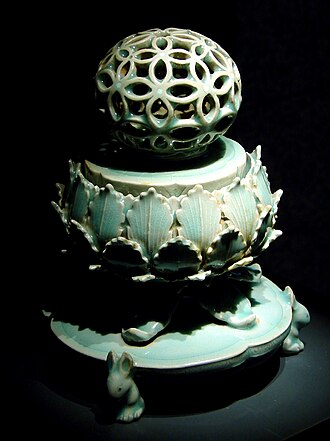
“The first is the celadon color of the Goryeo; the second is the carved decoration technique known as sanggam.” — A Chinese observer of the Goryeo period, remarking on the two greatest wonders of Korean craft.
Few objects in the history of East Asian art carry the quiet brilliance of a Goryeo celadon vessel. Lifted from the earth of kilns that blazed for centuries along the southwestern coast of the Korean peninsula, these pieces — with their otherworldly jade-green glaze and intricate inlaid designs — stand as one of the most celebrated achievements of Korean civilization. To hold a piece of Goryeo celadon is to hold the ambitions of an entire dynasty rendered in clay and fire.
Korean pottery and porcelain spans thousands of years, from the comb-pattern earthenware of the Neolithic period to the white porcelain of the Joseon dynasty and the bold export wares of later centuries. Yet it is the celadon of the Goryeo dynasty (918–1392) that has most captivated collectors, historians, and visitors to Korean museum collections around the world. Understanding this art form means understanding not just technique, but the culture, trade networks, and aesthetic philosophy of a dynasty at its height.
Quick Facts: Korean Celadon and Goryeo Pottery
| Feature | Detail |
|---|---|
| Dynasty | Goryeo (918–1392) |
| Signature style | Celadon with jade-green glaze (cheongja) |
| Key technique | Sanggam (inlaid slip decoration) |
| Main production region | Gangjin and Buan, South Jeolla Province |
| Influence | Derived from Chinese celadon; developed distinctly Korean character |
| Peak period | 12th–13th centuries |
| Major collections | National Museum of Korea, Seoul |
The Origins of Korean Celadon: How Did It All Begin?
Korean ceramics did not emerge in isolation. The peninsula had a long tradition of earthenware stretching back to the Neolithic period, when the Jeulmun culture produced distinctive comb-pattern pottery. Later, during the Three Kingdoms period (57 BCE–668 CE), stoneware production became increasingly sophisticated, with grey-bodied vessels fired at high temperatures in anagama-style climbing kilns. These early wares already demonstrated the Korean potter’s command of kiln technology and an eye for functional elegance.
The decisive turning point came during the early Goryeo period, when Korean potters began adapting the celadon-making traditions of China’s Yue kilns and later the renowned kilns of Yuezhou and Longquan. Chinese celadon had long been prized across East Asia for its smooth, pale green glaze — a color considered evocative of jade, the most precious of stones in Confucian and Buddhist thought alike. Korean craftsmen absorbed these techniques through trade and diplomatic exchange, then transformed them into something unmistakably their own.
By the mid-tenth century, kilns were operating in Korea capable of producing celadon that rivaled Chinese output. Over the following two centuries, Korean potters did not simply copy their continental neighbors — they refined the glaze, adjusted the firing conditions, and eventually introduced an entirely new decorative approach that would distinguish Korean ceramics forever.
The Sanggam Technique: Korea’s Defining Innovation
If the jade-green glaze is the soul of Goryeo celadon, then the sanggam technique is its heartbeat. Sanggam refers to the method of inlaying decoration into the surface of a vessel before glazing and firing. A potter would first carve a design into the leather-hard clay body — cranes in flight, scrolling clouds, chrysanthemums, willow trees — and then fill those incised lines with white or black slip (liquid clay). After scraping away the excess and allowing the piece to dry, a transparent celadon glaze was applied over the whole surface and the vessel was fired.
The result is a kind of pictorial magic: beneath the green glaze, the white and black inlaid motifs glow softly, as though seen through still water. No other ceramic tradition in East Asia developed the sanggam method to the same degree of sophistication as the Goryeo potters, and this remains one of the most celebrated Korean contributions to world art history.
“Goryeo celadon represents the moment when Korean craftsmen stopped imitating and started inventing — producing something the world had never seen before.”
Sanggam decoration flourished most brilliantly during the twelfth and thirteenth centuries, precisely when the Goryeo court was at its most culturally confident. The motifs chosen for inlaid decoration were never random. Cranes — symbols of longevity and transcendence — appeared frequently, soaring across the curved bellies of melon-shaped bottles. Willow trees and water birds evoked the contemplative ideal of Buddhist landscape painting. Chrysanthemums and peonies referenced the refined aesthetic of the aristocratic class that commissioned these pieces.
3 Reasons Why Goryeo Celadon Stands Apart in World Art
1. The Unmistakable Jade-Green Glaze
The color of Goryeo celadon is not a single shade but a spectrum — ranging from a cool, bluish grey-green to a warmer, more translucent emerald. This range was the result of subtle variations in kiln atmosphere, clay body composition, and glaze chemistry. Korean potters worked with iron-oxide glazes fired in a reduction atmosphere (low oxygen), which converted iron compounds in the glaze to produce the characteristic green. Contemporary Chinese observers were so struck by the quality of the best Goryeo pieces that they listed the celadon color as one of the greatest wonders they had encountered in Korea.
2. The Invention and Perfection of Sanggam Inlay
As described above, the sanggam technique was a Korean invention with no precise parallel in Chinese or Japanese ceramics of the same era. Its development required extraordinary skill at every stage — from carving to filling to glazing — and the best examples show a fluency of line and compositional grace that speaks to generations of practiced mastery. The technique proved so admired that later Korean potters of the Joseon dynasty adapted it for their own white and black-inlaid buncheong wares.
3. A Tradition That Mirrors Dynasty and Society
Goryeo celadon was not merely decorative — it was deeply embedded in the social and religious life of the dynasty. Celadon vessels were used in Buddhist rituals, displayed at court, given as diplomatic gifts, and buried with the aristocratic dead. The types of vessels produced — incense burners, ewers, cups, cosmetic boxes, roof tiles, and even celadon pillows — reflect the full range of Goryeo elite culture. Studying the ceramic record is, in many ways, studying the dynasty itself.
The Kiln Sites of Gangjin and Buan
The finest Goryeo celadon came overwhelmingly from kiln complexes in the southwestern coastal regions of the peninsula, particularly around Gangjin in South Jeolla Province and, to a lesser extent, Buan in North Jeolla Province. The Gangjin kilns, known collectively as the Sadang-ri kilns, have been excavated extensively and reveal a production history stretching from the early Goryeo period through several centuries of continuous operation.
These locations were not chosen arbitrarily. The southwestern coast offered access to high-quality kaolin clay, pine forests for kiln fuel, and coastal transport routes that allowed finished wares to be shipped efficiently to the Goryeo capital at Gaeseong (in present-day North Korea) and to international trading partners. The organization of celadon production at these sites appears to have involved both state patronage and private kiln operators, with the finest pieces destined for royal and aristocratic consumption.
Today, the Gangjin Celadon Museum and the surrounding kiln sites remain important heritage destinations in South Korea, attracting visitors who wish to understand the physical landscape from which this art emerged. Archaeological excavations have recovered thousands of kiln wasters (failed or discarded pieces) that tell the story of experimentation, quality control, and the relentless pursuit of perfection that defined Goryeo ceramic production at its peak.
From Goryeo to Joseon: How Korean Pottery Evolved
The fall of the Goryeo dynasty in 1392 and the establishment of the Joseon dynasty under the Yi family brought profound changes to Korean ceramic culture. The new dynasty was ideologically rooted in Neo-Confucianism rather than the Buddhism that had so deeply shaped Goryeo aesthetics. This philosophical shift was immediately visible in the ceramics that followed.
| Feature | Goryeo Celadon | Joseon White Porcelain (Baekja) |
|---|---|---|
| Glaze color | Jade green | Pure white |
| Decoration style | Inlaid (sanggam), carved, painted | Understated; cobalt blue painting (later period) |
| Dominant philosophy | Buddhist and aristocratic refinement | Neo-Confucian purity and restraint |
| Key vessel types | Ewers, incense burners, melon-shaped bottles | Moon jars, brush holders, ritual vessels |
| Production center | Gangjin, Buan | Gwangju, Gyeonggi Province (Bunwon kilns) |
| International influence | Admired by China and Japan | Deeply influenced Japanese ceramic aesthetics |
The transition was not abrupt. An intermediate ware called buncheong — grey-bodied, often decorated with white slip and stamped, brushed, or inlaid designs — bridged the aesthetic worlds of Goryeo and Joseon during the fifteenth century. Buncheong wares are celebrated today for their bold, sometimes playful decoration and a freedom of expression quite different from the courtly restraint of the finest celadon. They were also among the Korean ceramics most intensely admired by Japanese tea ceremony masters, many of whom prized buncheong bowls above almost any other vessel for the wabi aesthetic of rustic simplicity.
Joseon white porcelain, or baekja, represented the dynasty’s highest ceramic ideal. Pure white vessels — some so translucent they seem to glow from within — were produced at the government-run Bunwon kilns in Gwangju, Gyeonggi Province, under the direct supervision of royal officials. These pieces embodied the Confucian virtues of simplicity, clarity, and moral uprightness. The famous Joseon moon jar, a large spherical white vessel assembled from two separately thrown halves, has become one of the most iconic objects in Korean art history and continues to inspire contemporary Korean artists and designers.
Korean Pottery and Its Global Legacy
The story of Korean pottery is also, inescapably, a story of influence and exchange. Goryeo celadon was traded internationally during the dynasty’s peak, reaching China, Japan, and the wider maritime world of East Asia. During the Japanese invasions of Korea in the 1590s (the Imjin War), Japanese warlords specifically kidnapped Korean potters and transported them to Japan, where they established kiln traditions that transformed Japanese ceramic culture. The Arita porcelain tradition in Kyushu, which later became famous in Europe under the name Imari ware, traces its origins directly to the techniques brought by Korean potters forcibly relocated during this period.
In more recent centuries, Goryeo celadon has become a point of immense national pride in Korea, featured in museums, referenced in contemporary design, and studied by scholars worldwide. The National Museum of Korea in Seoul holds one of the finest collections of Korean ceramics in existence, and major international museums — from the British Museum to the Metropolitan Museum of Art — count Goryeo celadon among their most prized Asian art holdings.
Continue Exploring
Deepen your knowledge of Korean pottery and the Goryeo dynasty with these resources:
- Korean Pottery and Porcelain — Wikipedia
- Encyclopedia of Korean Culture (Academy of Korean Studies)
- National Museum of Korea — Official Site
- Celadon Pottery — Encyclopædia Britannica
- Korean Art — Asia Society
- Korean Cultural Heritage Administration
On Korea Through Time, also read: White Porcelain and the Joseon Aesthetic — coming soon.