“Where a dragon once roamed, a temple rose to touch the heavens — and for seven centuries, Hwangnyongsa stood as the spiritual heart of the Silla kingdom.”
In the ancient city of Gyeongju, now a quiet heritage town in southeastern South Korea, there lies a broad and windswept field scattered with stone foundations and the ghosts of lost grandeur. This is the site of Hwangnyongsa (황룡사), once the largest and most sacred Buddhist temple complex in the Silla kingdom. For nearly seven hundred years, it dominated the skyline of the capital, its nine-story wooden pagoda visible for miles in every direction. Today, only its earthen platforms and stone plinths remain — silent witnesses to a story of royal ambition, divine legend, and catastrophic loss.
Hwangnyongsa is not merely a ruin. It is one of the most significant archaeological and spiritual sites in Korean history, a place where mythology, statecraft, and religion converged to produce something truly extraordinary. Understanding Hwangnyongsa means understanding the soul of the Silla kingdom at its height.
Quick Facts: Hwangnyongsa at a Glance
| Fact | Detail |
|---|---|
| Name (Korean) | 황룡사 (Hwangnyongsa) |
| Translation | Temple of the Yellow Dragon |
| Location | Gyeongju, North Gyeongsang Province, South Korea |
| Construction Begun | 553 CE (reign of King Jinheung) |
| Nine-Story Pagoda Built | 645 CE (reign of Queen Seondeok) |
| Destroyed | 1238 CE (Mongol invasion) |
| UNESCO Recognition | Part of Gyeongju Historic Areas (World Heritage, 2000) |
| Modern Status | Archaeological site; excavations conducted 1976–1983 |
How Did Hwangnyongsa Begin? The Legend of the Dragon Palace
The founding story of Hwangnyongsa is one of the most captivating origin myths in Korean history. According to historical records, in 553 CE King Jinheung of Silla ordered the construction of a new palace on a broad plot of land in the capital. But as workers broke ground, something unexpected appeared: a yellow dragon emerged from the earth. Taking this as a divine omen, the king abandoned plans for a palace and instead ordered the construction of a Buddhist temple on the site. The temple was named Hwangnyongsa — the Temple of the Yellow Dragon — in honor of the miraculous sign.
This founding legend is not merely colorful folklore. In the context of Silla’s political and religious landscape, it carried enormous weight. The dragon in East Asian tradition is a symbol of royal authority, divine protection, and natural power. By associating the temple’s founding with a dragon omen, the Silla court was asserting that Hwangnyongsa enjoyed heavenly sanction — that it was not simply a place of worship, but a sacred covenant between the kingdom and the cosmos.
Construction of the temple complex took decades to complete. The main hall, dedicated to a massive gilt bronze statue of the Buddha, was not finished until 584 CE — more than thirty years after work began. The project consumed enormous resources and the labor of countless craftspeople, reflecting the supreme importance that Silla’s rulers placed on this site.
The Nine-Story Pagoda: A Tower of National Protection
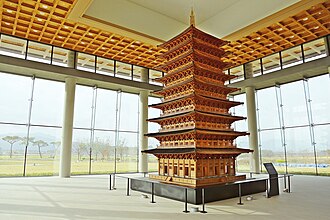
If Hwangnyongsa’s founding was defined by legend, its most famous structure was defined by political vision. In 645 CE, during the reign of Queen Seondeok — one of the few female monarchs in Korean history — a nine-story wooden pagoda was constructed within the temple complex. It was, by any measure, a monumental achievement of pre-modern engineering.
“Each of the pagoda’s nine stories was said to represent one of the nine neighboring nations that threatened Silla — a tower of prayers built to humble every enemy of the kingdom.”
The pagoda was reportedly designed with the involvement of a master craftsman named Abiji, who had trained in the kingdom of Baekje. Historical sources suggest the structure rose to a height of approximately 80 meters — roughly equivalent to a modern 25-story building — making it one of the tallest wooden structures ever built in East Asia. The sheer ambition of the project is staggering: in an era without modern machinery or engineering science, Silla’s builders created a timber tower that could withstand the winds, earthquakes, and storms of the Korean peninsula for over six centuries.
The pagoda was not conceived as mere architecture. Each of its nine stories was symbolically associated with one of the neighboring states or peoples that Silla considered potential threats or rivals. To ascend the pagoda in prayer was to symbolically place the kingdom’s enemies beneath Silla’s feet. It was devotion and deterrence combined — Buddhism and statecraft fused into wood and gilded finials.
The Heart of Silla Buddhism
For the better part of seven centuries, Hwangnyongsa functioned as the spiritual epicenter of the Silla kingdom. The temple complex was vast — archaeological excavations conducted between 1976 and 1983 revealed that the site covered approximately 72,000 square meters, making it one of the largest temple complexes ever built on the Korean peninsula.
At the center of the complex stood the main hall housing the Jangyuk Samjon — a colossal gilt bronze statue of the Shakyamuni Buddha, flanked by two bodhisattvas. Historical sources record that this statue was cast using an enormous quantity of bronze and gold. It was, in its time, considered one of the Three Treasures of Silla, alongside the nine-story pagoda and a famous ceremonial belt. These Three Treasures were understood not as mere religious objects, but as talismans of the entire kingdom’s survival and prosperity.
The great monk Jajang is closely associated with Hwangnyongsa. After studying Buddhism in Tang Dynasty China, Jajang returned to Silla and played a pivotal role in advocating for the construction of the nine-story pagoda. He argued that the pagoda’s protective spiritual power would unify the Korean peninsula under Silla’s rule and repel foreign invasions. His vision proved, in a sense, prophetic: Silla did eventually unify much of the peninsula in 668 CE, though this had far more to do with military alliance with Tang China than with pagoda construction.
Destruction: The Mongol Invasion of 1238
The story of Hwangnyongsa ends not with gradual decline, but with sudden, catastrophic violence. In 1238 CE, Mongol forces invaded the Korean peninsula, sweeping through the Goryeo kingdom and laying waste to countless towns, cities, and cultural sites. Gyeongju, by then no longer a capital but still a revered historic city, was among the places that suffered devastating destruction.
Hwangnyongsa was burned to the ground. The nine-story wooden pagoda — that extraordinary feat of engineering and faith that had stood for nearly six hundred years — was consumed by fire. The great gilt bronze statue was melted or looted. The complex that had taken generations to build was reduced to ash and stone foundations in what was likely a matter of hours or days.
The loss was felt deeply. Goryeo scholars recorded the destruction with grief, understanding that something irreplaceable had been taken from Korean civilization. The temple was never rebuilt. The Joseon dynasty that followed Goryeo actively discouraged Buddhism and would not have invested in reconstructing a Buddhist monument of such scale even had the resources been available.
What Archaeology Has Revealed
For centuries, Hwangnyongsa existed only in historical memory and fragmentary written records. Then, between 1976 and 1983, archaeologists conducted systematic excavations of the site, uncovering the full scale of what had been lost. The dig revealed the stone platform foundations of the main hall, the pagoda base, surrounding buildings, and a complex arrangement of gates and courtyards that together painted a vivid picture of the temple at its height.
Among the most remarkable discoveries were artifacts that had survived the Mongol destruction: roof tiles stamped with intricate patterns, fragments of Buddhist sculpture, and remnants of the bronze castings associated with the great statue. These objects now reside in the Gyeongju National Museum, offering visitors a tangible connection to the lost complex.
The pagoda’s central stone foundation pillar — a massive stone post that anchored the entire wooden superstructure — was also uncovered and remains in situ at the site today. Standing beside it, visitors can begin to imagine the scale of the tower that once rose above it.
Comparing the Three Treasures of Silla
| Treasure | Description | Current Status |
|---|---|---|
| Nine-Story Wooden Pagoda | Approx. 80-meter tower built in 645 CE; symbol of national protection | Destroyed by Mongols, 1238 CE |
| Jangyuk Samjon Buddha | Colossal gilt bronze Buddha statue in the main hall | Destroyed or looted, 1238 CE |
| Sacred Belt (Jangnyuk) | Ceremonial relic associated with divine protection of the kingdom | Lost; historical record only |
Hwangnyongsa Today: Heritage, Memory, and Reconstruction Debates
The site of Hwangnyongsa is today part of the Gyeongju Historic Areas, a UNESCO World Heritage Site designated in 2000. The open field preserves the archaeological remains, and interpretive signage helps visitors understand the layout of the lost complex. A nearby museum — the Hwangnyongsa History and Culture Museum — uses scale models and digital reconstructions to bring the temple back to life visually, giving visitors a sense of what once stood here.
Debates about whether to reconstruct the nine-story pagoda have recurred for decades in South Korea. Proponents argue that reconstruction would restore a profound piece of national heritage and create a major cultural landmark. Opponents — including many archaeologists and heritage specialists — caution that any reconstruction would be speculative, given how little physical evidence survives of the pagoda’s upper stories, and that a modern replica might actually detract from the authenticity and dignity of the existing archaeological site.
For now, the open field remains. And there is a quiet power in that emptiness — in standing where the dragon was said to have appeared, where a queen’s vision rose into the sky, and where fire and conquest brought it all down. Hwangnyongsa may be gone, but its story is very much alive.
Continue Exploring
- On this site: The Silla Kingdom: Rise of a Unified Korea
- On this site: Queen Seondeok: Silla’s Visionary Ruler
- On this site: Gyeongju Historic Areas: A City of Royal Tombs and Lost Temples
- Hwangnyongsa — Wikipedia
- Gyeongju Historic Areas — UNESCO World Heritage Centre
- Encyclopedia of Korean Culture — Academy of Korean Studies
- Gyeongju Tourism — Visit Korea Official Site
- National Museum of Korea