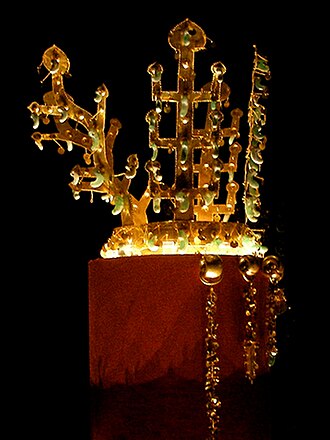
“No other artifact from ancient Korea speaks so powerfully of divine kingship, artistic brilliance, and a civilization at its peak as the golden crowns unearthed from the royal tombs of Silla.”
They emerged from the earth centuries after they were buried — thin sheets of hammered gold, shaped into towering tree-like forms, hung with jade comma-shaped ornaments and trembling gold spangles. The golden crowns of Silla are among the most extraordinary objects ever created on the Korean peninsula. Found inside the great burial mounds of Gyeongju, the ancient capital of the Silla Kingdom, these crowns have fascinated archaeologists, historians, and art lovers ever since their discovery in the twentieth century.
But what do these shimmering objects actually tell us? Who wore them, and why were they buried deep underground rather than passed down through generations? To answer these questions, we must travel back more than fifteen centuries to a kingdom that once ruled much of the Korean peninsula — the kingdom of Silla.
Quick Facts: The Golden Crowns of Silla
| Detail | Information |
|---|---|
| Kingdom | Silla (57 BCE – 935 CE) |
| Period of Manufacture | Approximately 5th–6th centuries CE |
| Primary Material | Pure hammered gold sheet |
| Key Decorative Elements | Upright tree and antler forms, jade gogok (comma-shaped pendants), gold spangles |
| Discovery Sites | Royal burial mounds (tumuli) in Gyeongju, North Gyeongsang Province |
| Notable Examples | Gold Crown from Geumgwanchong, Gold Crown from Cheonmachong, Gold Crown from Hwangnamdaechong |
| Current Location | National Museum of Korea (Seoul) and Gyeongju National Museum |
| National Treasure Status | Designated National Treasures of South Korea |
The Kingdom of Silla and Its Royal Capital
Silla was one of the Three Kingdoms of ancient Korea, traditionally said to have been founded in 57 BCE. For much of its history it was centered on the city of Gyeongju — known in ancient times as Seorabeol — nestled in the southeastern corner of the Korean peninsula. At its height, the Silla Kingdom was extraordinarily wealthy, maintaining active trade networks that connected Korea to China, Japan, and even the distant lands of Central Asia along the Silk Road.
That wealth and connectivity is written into every detail of the Silla crowns. The gold itself, worked with breathtaking skill into lace-like sheets of shimmering metal, speaks of a royal court that had both the resources and the craftsmen to produce objects of almost impossible delicacy. The jade gogok — curved, comma-shaped beads — that hang from the crown branches were considered deeply sacred across ancient Northeast Asia, symbolizing fertility, power, and spiritual authority.
Gyeongju today is often called the “museum without walls” because the entire city and its surrounding landscape are dotted with burial mounds, temple sites, stone pagodas, and stone-carved Buddhas. The great tumuli — grass-covered mounds rising from the flatlands — are where the crowns were found, buried with their royal owners for the journey into the afterlife.
What Do the Crowns Look Like? Anatomy of a Silla Crown
To understand why the Silla crowns are so remarkable, it helps to look carefully at what they are made of and how they are constructed. Each crown consists of several distinct elements that work together to create a towering, glittering whole.
The base of a typical Silla crown is a circular band of gold, wide enough to sit around the head of the wearer. Rising from this band are upright projections — usually three to five tall, tree-shaped forms that branch outward and upward, often resembling stylized trees or antlers. These upright pieces are cut from flat gold sheet and then decorated with punched or cut patterns that allow light to pass through them, giving the whole crown an impression of extraordinary lightness despite being made of metal.
Hanging from the branches of these upright forms, and from the band itself, are two types of pendant ornaments. The first are the jade gogok — the curved comma-shaped beads mentioned above, usually green or blue-green in colour, which sway gently when the crown moves. The second type of pendant is small, flat, circular gold spangles attached by fine gold wire, so that they tremble and catch the light with every slight movement of the wearer’s head. The overall visual effect, under torchlight or sunlight, must have been extraordinary: a crown that seemed almost alive with movement and reflected light.
Some crowns also include long, hanging ornaments called suhasik that fall on either side of the face, further adding to the sense of shimmering, living gold that surrounded the wearer.
“A Silla crown was not merely a symbol of rank — it was a performance of cosmic authority, designed to make the wearer appear surrounded by living light.”
Why Were the Crowns Buried? The Meaning of Silla Burial Practice
One of the most fascinating puzzles surrounding the Silla crowns is the question of why they were buried at all. Objects of such extraordinary craftsmanship and obvious value might have been expected to pass from ruler to ruler as sacred heirlooms. Instead, they were placed in the tomb alongside their royal owner and sealed beneath vast mounds of earth and stone.
The answer lies in the religious and cosmological beliefs of early Silla society. Before the full adoption of Buddhism — which became increasingly influential in Silla from the mid-sixth century onwards — the ruling elite of Silla followed shamanistic beliefs that placed enormous importance on providing the dead with everything they would need in the afterlife. The more powerful the individual in life, the richer and more elaborate the goods buried with them.
In this worldview, the crown was not simply a political symbol — it was a spiritual object that marked its wearer as a being who stood between the human world and the divine. The tree forms rising from the crown have been interpreted by many scholars as representations of the world tree or cosmic axis — the shamanic concept of a tree or pillar that connects the earth, the heavens, and the underworld. The antler forms carry similar associations with shamanic practice across a vast area of northern and central Asia.
This is why the crowns were buried rather than passed on: they belonged, in the most profound sense, to the individual who had worn them. To bury them was to ensure that their owner arrived in the afterlife fully equipped with the spiritual authority they had held in life.
3 Reasons the Silla Crowns Are Unique in World Heritage
- Unmatched technical mastery. The gold sheets from which the crowns are made are hammered to extraordinary thinness, yet cut and shaped with a precision that challenges modern craftspeople. The combination of structural strength with visual delicacy is a technical achievement that has rarely been matched in any goldworking tradition anywhere in the world.
- A window into pre-Buddhist Korean belief. Because the Silla crowns predate the full establishment of Buddhism as the dominant faith of the Korean ruling class, they offer one of the clearest surviving visual expressions of the shamanistic beliefs that shaped early Korean society. The tree forms, antler motifs, and jade pendants all speak of a spiritual worldview that is otherwise largely lost to history.
- Evidence of ancient international connection. The gogok jade beads found on Silla crowns share striking similarities with sacred curved beads found in ancient Japan (where they are called magatama), pointing to deep cultural connections across the ancient East Asian world. Meanwhile, some of the gold ornamental techniques used by Silla craftspeople show parallels with traditions found as far west as the steppes of Central Asia, suggesting that the Silk Road’s influence reached all the way to the eastern tip of the Korean peninsula.
The Major Crowns: A Closer Look at the Most Famous Examples
Several Silla crowns have been recovered from the burial mounds of Gyeongju, and each has its own story. The crown from Geumgwanchong — whose name literally means “Gold Crown Tomb” — is one of the best known. Discovered in 1921, it stands as one of the finest examples of Silla goldwork and is designated a National Treasure of South Korea. The tomb itself takes its name directly from this discovery, a testament to how completely the crown defined the site.
The crown from Cheonmachong — the “Heavenly Horse Tomb” — was recovered during excavations in 1973 and is equally remarkable. Cheonmachong is famous not only for its gold crown but for the painted birchbark artefact depicting a white horse in flight that gave the tomb its name. The crown found there is typical of the Silla style, with upright tree branches and hanging jade and gold pendants.
Hwangnamdaechong, the largest of all the Gyeongju tumuli, contained gold crowns in both of its twin burial chambers — indicating that it held a royal couple. The scale of the burial goods from Hwangnamdaechong speaks to the enormous wealth concentrated at the Silla court during the period of the Three Kingdoms.
Comparison: Silla Crowns and Royal Headwear Across Ancient Asia
| Feature | Silla Crown (Korea) | Baekje Crown (Korea) | Gaya Crown (Korea) |
|---|---|---|---|
| Primary material | Pure gold sheet | Gilt bronze or gold | Gold and gilt bronze |
| Key motifs | Trees, antlers, gogok jade, gold spangles | Flame and floral forms | Upright projections, simpler ornament |
| Burial context | Large earthen tumuli | Stone-lined tombs | Earthen and stone tombs |
| Known find sites | Gyeongju tumuli | Gongju, Buyeo region | Gimhae and surrounding areas |
| Spiritual symbolism | Shamanic cosmic tree / world axis | Buddhist and Chinese-influenced motifs | Status and ritual power |
Where Can You See the Crowns Today?
The golden crowns of Silla are preserved in two of Korea’s most important museums. Several crowns, including major examples from Geumgwanchong and other Gyeongju tumuli, are held by the National Museum of Korea in Seoul, where they are displayed as centerpieces of the ancient Korean collection. Others — particularly those excavated more recently or most closely associated with Gyeongju itself — are held at the Gyeongju National Museum, located in the heart of the ancient capital.
Visiting Gyeongju itself remains one of the most rewarding experiences for anyone interested in Korean history. The burial mounds of Daereungwon (the tumuli park in central Gyeongju) are open to visitors, and the interior of Cheonmachong has been reconstructed so that visitors can walk inside and see how a royal Silla burial was arranged. Gyeongju’s broader landscape of royal tombs, stone monuments, and ancient temple sites was recognized by UNESCO, and the broader Gyeongju Historic Areas are inscribed on the UNESCO World Heritage List.
Why Do the Silla Crowns Still Matter?
More than fifteen hundred years after they were made and buried, the golden crowns of Silla retain an extraordinary power over those who encounter them. Part of that power is purely visual — there is simply nothing quite like standing in front of a Silla crown in a museum gallery and seeing the gold catch the light, the jade pendants hanging still and green, and imagining the object swaying and trembling on the head of its wearer at some great ceremonial occasion in the ancient capital of Gyeongju.
But the crowns matter beyond their beauty. They are primary documents of a civilization — evidence of technical skills, spiritual beliefs, trading connections, and political structures that might otherwise be invisible to us. They are proof that the Korean peninsula, in the first millennium of the common era, was home to a court culture of extraordinary sophistication and creativity. And they are a reminder that much of what makes Korean cultural identity distinctive — the love of refined craft, the synthesis of spiritual meaning with aesthetic form, the deep connection between the living and the dead — has roots that reach back far beyond the more familiar periods of Korean history.
The crowns of Silla do not speak in words. But for those who know how to look, they speak volumes.
Continue Exploring
On This Site
- Gyeongju: Walking Through Korea’s Ancient Capital
- The Three Kingdoms of Korea: Silla, Baekje, and Goguryeo
- Inside the Royal Tombs: The Burial Mounds of Gyeongju