“A wise man can acquaint himself with them before the morning is over; a stupid man can learn them in the space of ten days.” — On Hangul, from the Hunminjeongeum Haerye (1446)
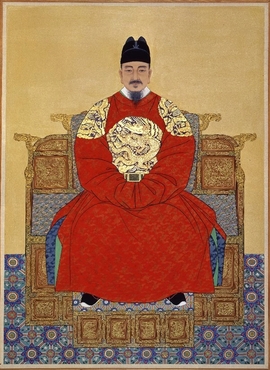
Few rulers in world history have left as permanent a mark on their nation’s identity as Sejong the Great. The fourth monarch of the Joseon Dynasty, Sejong reigned from 1418 to 1450 and oversaw one of the most remarkable periods of cultural, scientific, and intellectual achievement in Korean history. His greatest legacy — the Korean alphabet, Hangul — remains the writing system used by tens of millions of people today. Yet Hangul was only one thread in a much richer tapestry of accomplishment.
Quick Facts: Sejong the Great
| Fact | Detail |
|---|---|
| Born | 1397, Joseon Korea |
| Died | 1450 |
| Dynasty | Joseon |
| Reign | 1418 – 1450 |
| Position in dynasty | Fourth monarch of Joseon |
| Greatest achievement | Creation of Hangul (1443, promulgated 1446) |
| Honorific title | Sejong the Great (세종대왕) |
A Prince Chosen for His Mind
Sejong was not born to be king. As the third son of King Taejong, the throne was never his by automatic succession. Yet his father recognized in him an extraordinary intellect and depth of character that his older brothers lacked. Taejong moved to place Sejong on the throne in 1418, ensuring that Joseon would be guided by its most capable son. It was a decision that would define the dynasty’s golden age.
From the earliest years of his reign, Sejong demonstrated an appetite for learning and governance that set him apart. He surrounded himself with talented scholars, established institutional frameworks for research and policymaking, and approached the challenges of ruling a kingdom with a methodical, curious mind. He was deeply versed in Confucian philosophy, which shaped his vision of a just and benevolent monarchy — but he was equally drawn to practical questions of science, agriculture, medicine, and language.
The Hall of Worthies: Korea’s First Royal Research Institute
One of Sejong’s most consequential decisions was the establishment and expansion of the Jiphyeonjeon, known in English as the Hall of Worthies. This royal research institute gathered the brightest scholars in Joseon and tasked them with producing knowledge that would serve the kingdom and its people. The Hall became the intellectual engine of Sejong’s reign — a place where history was compiled, classical texts were analyzed, and new ideas were tested.
Under Sejong’s direction, the scholars of the Jiphyeonjeon produced works that touched nearly every domain of knowledge. Agricultural manuals were compiled to help Korean farmers adapt Chinese techniques to local conditions. Medical encyclopedias gathered native Korean remedies alongside imported knowledge. Astronomical instruments were designed and built. Calendrical systems were reformed. The Hall of Worthies was not merely an advisory body — it was an active force for the systematization and expansion of Korean knowledge.
“Sejong’s reign was defined not just by what he built, but by what he understood: that a kingdom’s greatest resource is the knowledge and capability of its people.”
Why Did Sejong Create Hangul?
This is perhaps the most important question one can ask about Sejong’s legacy, and the answer reveals everything about his governing philosophy. In 15th-century Korea, the written language used for official and scholarly purposes was Classical Chinese — a system entirely unrelated to spoken Korean. Literacy was effectively the privilege of the educated elite: aristocratic men who had spent years mastering thousands of Chinese characters. Ordinary Koreans, including women, farmers, and artisans, had no practical access to written communication.
Sejong found this situation deeply troubling. In the preface to the Hunminjeongeum — the 1446 document introducing Hangul to the kingdom — this concern is made explicit. The common people, unable to express themselves in writing, could not properly communicate with their government, could not read laws that governed them, and could not access accumulated knowledge. Sejong believed that a ruler’s duty extended to all subjects, not only the privileged few.
The alphabet he devised — working closely with scholars of the Hall of Worthies — was a masterpiece of linguistic engineering. Hangul’s consonant letters were designed to reflect the physical shape of the mouth and throat when producing each sound. Vowel letters were built on a philosophical framework derived from the relationships between heaven, earth, and humanity. The system could be learned in days rather than years, precisely because it was designed with the learner in mind. The opening quote of this article, from the Hunminjeongeum Haerye commentary, captures Sejong’s confidence in his creation’s accessibility.
Hangul was officially promulgated in 1446 under the name Hunminjeongeum, meaning “the correct sounds for the instruction of the people.” Though it faced resistance from conservative Confucian scholars who saw Classical Chinese as the only legitimate written form, Hangul survived and eventually became the foundation of Korean literacy. Today it is universally recognized as one of history’s most deliberately and thoughtfully constructed writing systems.
Science, Agriculture, and the Welfare of the People
Hangul was the most famous of Sejong’s contributions, but it was far from the only one. His reign saw an extraordinary flowering of scientific and practical achievement, all driven by the same underlying principle: that good governance required accurate knowledge of the natural world and genuine concern for the welfare of ordinary subjects.
In the realm of astronomy and timekeeping, Sejong oversaw the development of several important instruments. The cheugugi, a standardized rain gauge, was invented during his reign — one of the earliest such instruments recorded anywhere in the world. By deploying rain gauges across the kingdom, Sejong’s government could collect systematic data on rainfall and use it to inform agricultural planning and tax assessments, ensuring that farmers were not overtaxed during poor harvests. This was governance grounded in empirical observation rather than tradition alone.
Astronomical instruments including armillary spheres and sundials were constructed, and a reformed calendar more accurately calibrated to Korean geography replaced the Chinese calendar that had previously been used. Agricultural texts were compiled drawing on the practical knowledge of experienced Korean farmers, supplementing and adapting Chinese agricultural methods to Korean soils and climate. These were not abstract intellectual exercises — they were tools for feeding the kingdom.
Medical knowledge was similarly systematized. Large encyclopedias of medicine were produced during Sejong’s reign, gathering both classical learning and indigenous Korean herbal remedies. This project represented both a preservation effort and a democratization of knowledge: making medical information available in a more organized and accessible form.
3 Reasons Sejong’s Reign Defined Korean Civilization
- He gave Korea its own written voice. Hangul was not merely a practical tool — it was a declaration that the Korean language, and by extension Korean culture and identity, deserved a system of written expression of its own. This act of linguistic independence had profound consequences for Korean literature, governance, and national identity across the centuries that followed.
- He institutionalized the pursuit of knowledge. By establishing and empowering the Hall of Worthies, Sejong created a model for state-sponsored scholarship that produced lasting works in history, science, agriculture, medicine, and language. The intellectual culture he fostered outlasted his own reign and shaped Joseon’s subsequent centuries.
- He reoriented royal governance toward the common people. Sejong’s reign was marked by a consistent effort to extend the benefits of good governance beyond the aristocratic elite. Whether through accessible writing, practical agricultural guidance, or fair taxation informed by rainfall data, Sejong understood rulership as a responsibility to all subjects — a vision that resonated through Korean political culture for generations.
The Final Years and a Lasting Legacy
Sejong’s later years were shadowed by declining health. He suffered from diabetes and other ailments that increasingly limited his ability to govern directly. Yet even in these years his commitment to the intellectual projects of his reign did not waver. He died in 1450, having reigned for thirty-two years.
The title “the Great” — 대왕, Daewang — was not bestowed lightly in Korean history, and Sejong remains one of only a handful of Korean monarchs to bear it in common usage. His image appears on the 10,000 won banknote, the most widely circulated denomination of Korean currency. Gwanghwamun Square in central Seoul is dominated by a large bronze statue of the king. Hangul Day, observed on October 9th in South Korea, commemorates the promulgation of Hangul and stands as one of the nation’s official public holidays.
Across five and a half centuries, Sejong’s legacy has not faded — it has deepened. The alphabet he created is now recognized by linguists worldwide as a triumph of systematic design. The scientific spirit he encouraged shaped Korean intellectual culture in ways that persisted long after his death. And the principle that guided his greatest achievements — that knowledge should serve all people, not only the privileged — remains a touchstone of how Koreans understand their history and identity.
“A kingdom that cannot write its own language cannot fully know itself. Sejong understood this before almost anyone else in the world did.”