“We shall fight on the sea with fire and iron, and the enemy shall find no harbour in Korea.”
Few weapons in the history of warfare have captured the imagination quite like the geobukseon (거북선) — the Korean turtle ship. A revolutionary vessel of the late sixteenth century, the turtle ship was deployed by the Joseon Navy during one of the most dramatic conflicts ever to unfold on the Korean Peninsula: the Japanese invasions known as the Imjin War (임진왜란). Part warship, part symbol of national resilience, the turtle ship remains one of the most celebrated achievements in Korean military and technological history.
Quick Facts: The Turtle Ship at a Glance
| Fact | Detail |
|---|---|
| Korean Name | Geobukseon (거북선) |
| Era of Use | Late Joseon Dynasty, primarily 1592–1598 |
| Key Commander | Admiral Yi Sun-sin (이순신) |
| Primary Conflict | Imjin War (Japanese invasions of Korea) |
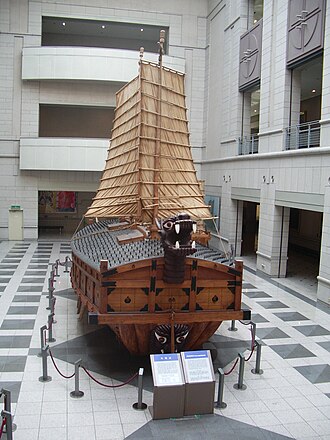
| Distinctive Feature | Covered, armored roof — possibly iron-plated |
| Propulsion | Oars and sail |
| Armament | Multiple cannon ports on all sides |
Origins: Where Did the Turtle Ship Come From?
The turtle ship did not emerge from nowhere. Korean naval engineering had a long tradition of building robust, cannon-equipped warships suited to the particular geography of the Korean coastline — a landscape of tidal shallows, rocky islands, and narrow straits that demanded maneuverable, flat-bottomed vessels. The panokseon, a broad-beamed warship that formed the backbone of the Joseon fleet, was already a formidable fighting platform. But the geobukseon represented something altogether different: a ship designed not merely to carry cannon, but to act as a weapon in its own right.
Historical records, including Yi Sun-sin’s own war diaries — the Nanjung Ilgi — confirm that the admiral was personally involved in the development and refinement of the turtle ship in the months immediately before the Japanese invasion of 1592. A diary entry from the first month of that year describes a trial firing of the vessel’s cannon, suggesting the ship was ready for combat just days before the first Japanese forces landed on Korean soil.
The name itself is straightforwardly descriptive. The ship’s silhouette, with its curved, covered upper deck, resembled a turtle’s shell — and like a turtle, the vessel was designed to be essentially impenetrable from above while remaining lethal from within.
Design and Construction: What Made the Turtle Ship So Formidable?
The turtle ship’s most striking feature was its covered deck — a roof of hexagonal wooden planks that shielded the rowers and fighting crew from enemy arrows, fire bombs, and boarding parties. Whether this roof was reinforced with iron plates remains one of the most debated questions in Korean military history. Some historical sources suggest iron spikes or plating were used; others are less specific. What is certain is that the roof made boarding the vessel extraordinarily difficult and dangerous, denying Japanese forces their preferred tactic of close-quarters combat.
Along the sides and front of the ship, multiple cannon ports allowed the turtle ship to deliver withering fire in almost every direction. A dragon-shaped figurehead at the bow could emit smoke — possibly from burning sulfur — to obscure the ship’s position and disorient the enemy. The vessel was rowed by oarsmen positioned below the covered deck, protecting them from above-deck combat, while officers and gunners operated the weapons from protected positions.
“The turtle ship was not simply a warship — it was a floating fortress, designed to break enemy formations and inspire fear before a single cannon was fired.”
The hull itself was based on the sturdy, flat-bottomed design common to Korean warships of the period, which made it well-suited to the shallow coastal waters where most of the Imjin War’s naval battles were fought. This gave the Joseon fleet a significant tactical advantage over the deeper-drafted Japanese vessels, which were less maneuverable in Korea’s complex coastal geography.
3 Battles That Proved the Turtle Ship’s Power
1. The Battle of Sacheon (May 1592)
The turtle ship’s combat debut came at the Battle of Sacheon in the fifth month of 1592. Leading a squadron against a Japanese fleet sheltering in Sacheon harbor, Yi Sun-sin deployed the turtle ship at the vanguard of the attack. The vessel’s covered deck proved immediately effective: Japanese archers found it impossible to inflict meaningful casualties, while Korean cannon tore through the lighter Japanese ships. The engagement was a decisive Korean victory and confirmed the tactical value of the new warship.
2. The Battle of Dangpo (June 1592)
Just weeks later, the turtle ship again led the Korean fleet into action at Dangpo. Japanese forces had anchored in the harbor, and Yi Sun-sin used the turtle ship to break through the enemy formation, disrupting their ability to coordinate a defense. Korean cannon fire devastated the Japanese fleet, with multiple enemy vessels sunk or captured. The turtle ship’s ability to operate in the midst of enemy ships without being boarded proved decisive.
3. The Battle of Hansan Island (August 1592)
Perhaps the most celebrated naval engagement of the entire Imjin War, the Battle of Hansan Island saw Admiral Yi Sun-sin employ his famous “crane wing” formation to encircle and destroy a large Japanese fleet. The turtle ship played a key role in drawing enemy vessels into the trap — sailing toward the Japanese fleet to provoke pursuit, then leading them into the waiting arms of the Korean formation. The result was the destruction of a significant portion of the Japanese naval force and a turning point in the war at sea.
The Turtle Ship vs. Japanese Warships: A Comparison
| Feature | Korean Turtle Ship (Geobukseon) | Japanese Atakebune (Large Warship) |
|---|---|---|
| Upper Deck | Fully covered, armored roof | Open or partially covered |
| Primary Tactic | Cannon bombardment, ram | Boarding and close combat |
| Hull Shape | Flat-bottomed, wide beam | Deeper draft, narrower |
| Coastal Maneuverability | Excellent in shallow waters | Limited in shallows |
| Crew Protection | High — rowers and gunners shielded | Low — open decks vulnerable |
| Boarding Vulnerability | Very low — spikes/covered roof | High — open to boarding |
Why Did the Turtle Ship Disappear After the Imjin War?
For all its battlefield success, the turtle ship did not become a permanent fixture of the Korean navy. After the conclusion of the Imjin War in 1598, the immediate threat of Japanese naval invasion receded, and the enormous cost and complexity of maintaining specialized warships of this type made large-scale production impractical in peacetime. The Joseon government, exhausted by years of devastating warfare, turned its attention to reconstruction rather than military innovation.
Records indicate that turtle ships continued to be built and maintained by provincial naval commands in the centuries following the Imjin War — serving as symbols of naval readiness as much as practical warships. By the nineteenth century, however, the vessel had effectively passed out of active service, overtaken by the changing nature of naval warfare and the eventual intrusion of Western gunboat technology into East Asian waters.
No original turtle ship survives today. What we know of its design comes from historical documents, including Yi Sun-sin’s diaries, official Joseon military records, and illustrated manuscripts. Several full-scale replicas have been constructed in South Korea, and models are displayed in museums across the country, allowing visitors to appreciate the vessel’s remarkable engineering.
Yi Sun-sin and the Turtle Ship: An Inseparable Legacy
It is impossible to discuss the turtle ship without discussing the man most associated with it: Admiral Yi Sun-sin (1545–1598). Yi is widely regarded as one of the greatest naval commanders in world history, a figure whose tactical genius and personal integrity have made him a towering presence in Korean national memory. Statues of Yi stand in prominent locations across South Korea, most famously in central Seoul’s Gwanghwamun Square.
Yi’s relationship with the turtle ship was one of designer, commander, and champion. He understood the vessel’s strengths — its invulnerability to boarding, its firepower, its psychological impact on enemy sailors — and deployed it accordingly, always at the tip of the spear rather than held in reserve. His campaigns during the Imjin War, in which the Korean navy won engagement after engagement against a numerically superior Japanese fleet, are studied to this day in military academies around the world.
Yi Sun-sin was killed at the Battle of Noryang in the final month of the war, reportedly saying as he lay dying that news of his death should be concealed lest it dishearten the fleet. He did not live to see the full fruit of the campaigns he had fought, but the turtle ship he championed had already helped secure Korea’s survival as a nation.
The Turtle Ship’s Place in Korean Cultural Memory
Today, the geobukseon is far more than a historical artifact. It has become a potent national symbol — an emblem of Korean ingenuity, resilience, and the capacity to resist overwhelming force through intelligence and determination. The ship appears on South Korean currency, in school textbooks, in blockbuster films, and in countless works of popular culture. It is referenced in discussions of Korean technological achievement and cited as an early example of the kind of innovation that has characterized Korea’s approach to challenges across centuries.
For visitors to South Korea, the turtle ship is a tangible connection to one of the most dramatic chapters in Korean history. Replicas can be seen at the Naval Academy Museum in Jinhae and at Tongyeong, the coastal city most closely associated with Yi Sun-sin’s campaigns. The waters off the southern coast of Korea, where the great naval battles of the Imjin War were fought, remain a place of historical pilgrimage for Koreans who understand what was at stake — and what was won — in those extraordinary years.
Continue Exploring
On Coreaverse
- Admiral Yi Sun-sin: The Man Who Saved Korea
- The Imjin War: Japan’s Invasion and Korea’s Resistance
- The Joseon Dynasty: Five Centuries of Korean Civilization