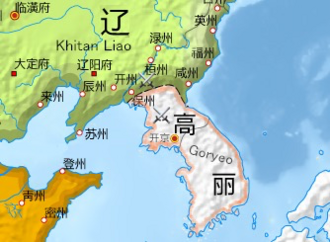
“We are a nation descended from Goguryeo. That is why we are called Goryeo.” — Seo Hui, diplomat and negotiator, addressing the Khitan general Xiao Sunning, 993 CE
Few chapters in Korean history match the drama, consequence, or sheer military determination of the Goryeo–Khitan War. Fought across three major invasions spanning from 993 to 1019 CE, the conflict pitted the relatively young Goryeo kingdom against one of the most formidable powers of the medieval world — the Khitan Liao dynasty of northern China. The outcome would define Korea’s borders, reinforce its sense of national identity, and send a message across Northeast Asia that Goryeo was a kingdom worth reckoning with.
To understand why this war mattered, we must first understand who the Khitans were, why they looked toward the Korean peninsula, and how Goryeo — against considerable odds — managed not only to survive but to emerge from the conflict politically stronger than before.
Quick Facts: The Goryeo–Khitan War at a Glance
| Detail | Information |
|---|---|
| Period | 993 – 1019 CE |
| Major Parties | Goryeo Kingdom vs. Khitan Liao Dynasty |
| Number of Major Invasions | Three (993, 1010, 1018–1019) |
| Key Goryeo Figures | Seo Hui (diplomat), Gang Jo (general), Gang Gam-chan (general) |
| Key Khitan Figures | Xiao Sunning, Emperor Shengzong, Xiao Baiya |
| Decisive Battle | Battle of Gwiju, 1019 CE |
| Outcome | Goryeo victory; expanded northern territories |
| Legacy | Construction of the Cheolli Jangseong (Thousand-Li Wall) |
Who Were the Khitans, and Why Did They Invade Korea?
The Khitans were a seminomadic people of Mongolian and Tungusic heritage who had established the powerful Liao dynasty across a vast swathe of northern China and Manchuria. By the late tenth century, the Liao state was one of the most powerful political entities in East Asia, controlling territories that brought it into direct contact with both Song China to the south and Goryeo Korea to the east.
From the Khitan perspective, Goryeo posed a strategic problem. The Korean kingdom maintained diplomatic and cultural ties with the Song dynasty — the Khitans’ primary rival — and controlled fertile territories along the Yalu River region that the Khitans wished either to dominate or neutralize. Furthermore, Goryeo had been extending its influence northward, settling and fortifying lands that the Khitans considered within their sphere of control.
The Jurchens, another northeastern people, occupied a buffer zone between Goryeo and the Liao frontier. As Khitan ambitions expanded, the strategic importance of the Korean peninsula grew correspondingly. For the Liao court, bringing Goryeo into a tributary relationship — or at minimum severing its alliance with Song China — became a key geopolitical objective.
The First Invasion (993): A War Won at the Negotiating Table
In 993 CE, a large Khitan force under general Xiao Sunning crossed into Goryeo’s northern territories. The military situation was alarming. Some members of the Goryeo court advocated surrender, even proposing to cede the northern territories to the Khitans in exchange for peace. It was a moment that could have fundamentally altered Korea’s geography and sovereignty.
Into this crisis stepped Seo Hui, a Goryeo diplomat of remarkable skill and nerve. Rather than accepting humiliation on the battlefield or at the negotiating table, Seo Hui requested a direct audience with Xiao Sunning and proceeded to argue Goryeo’s case with extraordinary confidence. He contended that Goryeo was the rightful successor state to Goguryeo — one of the ancient Three Kingdoms of Korea — and that the lands being disputed were therefore Goryeo’s by historical right. He further argued that Goryeo would be willing to enter into formal relations with the Liao dynasty, implicitly distancing itself from Song China, in exchange for Khitan recognition of Goryeo’s territorial claims.
Astonishingly, the argument worked. Xiao Sunning withdrew his forces, and the resulting agreement not only averted war but actually granted Goryeo the right to settle and develop the Gangdong Six Districts — a strategically important region east of the Yalu River. Goryeo had transformed a military crisis into a territorial gain through diplomacy alone.
“Seo Hui’s negotiation in 993 stands as one of the most remarkable diplomatic achievements in Korean history — a smaller power expanding its territory by outarguing a stronger invader.”
The Second Invasion (1010): Fire, Retreat, and Resilience
The relative peace that followed the first invasion did not last. In 1010, Liao Emperor Shengzong personally led a massive invasion force into Goryeo. The pretext was a recent political upheaval within Goryeo itself: General Gang Jo had staged a coup, killing King Mokjong. The Khitans used this internal instability as justification for military intervention, though their underlying strategic motivations remained unchanged.
This second invasion was far more destructive than the first. Khitan forces penetrated deep into Goryeo, eventually sacking and burning the capital, Gaegyeong (modern-day Kaesong). King Hyeonjong was forced to flee southward, and the court faced one of its gravest crises. However, Goryeo forces did not simply collapse. Fierce resistance slowed the Khitan advance, and the difficulties of maintaining a deep invasion — supply lines stretched thin, local resistance stiffening, and the looming threat of a long Korean winter — forced Emperor Shengzong to negotiate.
King Hyeonjong agreed in principle to travel to the Liao court and pay personal homage, a significant diplomatic concession. In exchange, Khitan forces withdrew. However, Hyeonjong never actually made the journey to the Liao court, a failure that the Khitans would cite as grounds for their third and most ambitious invasion.
3 Reasons the Third Invasion (1018–1019) Became a Turning Point
1. Goryeo Had Rebuilt and Prepared
In the years between the second and third invasions, Goryeo undertook serious military and strategic reforms. Fortifications were strengthened, troops were retrained, and the kingdom’s leadership recognized that a third Khitan assault was probable. When Khitan general Xiao Baiya crossed the border in late 1018 with a reported force of around 100,000 soldiers, he encountered a Goryeo that was far better prepared than in 1010.
2. Gang Gam-chan’s Strategic Brilliance
The defense of Goryeo during the third invasion was largely orchestrated by General Gang Gam-chan, one of the most celebrated military commanders in Korean history. Rather than meeting the Khitan army in open battle where their numerical strength might be decisive, Gang Gam-chan employed a strategy of attrition, harassment, and carefully chosen engagements. He understood the terrain, managed his supply lines, and waited for the right moment to strike decisively.
3. The Battle of Gwiju Shattered Khitan Power
The decisive engagement came in February 1019 at Gwiju (modern-day Kusong in North Korea). As the Khitan army, battered and exhausted from months of campaigning on hostile terrain, attempted to withdraw northward, Gang Gam-chan’s forces launched a devastating assault. Khitan casualties were catastrophic. Historical sources describe the retreating army as reduced to only a few thousand survivors from its original force. The Battle of Gwiju effectively ended the Khitan threat to Goryeo and stands as one of the most significant military victories in Korean history.
Comparison: Three Khitan Invasions of Goryeo
| Invasion | Year | Khitan Leader | Goryeo Response | Outcome |
|---|---|---|---|---|
| First | 993 CE | Xiao Sunning | Diplomatic negotiation by Seo Hui | Goryeo gains Gangdong Six Districts |
| Second | 1010 CE | Emperor Shengzong | Fierce resistance; capital sacked; king flees | Khitan withdrawal after diplomatic concession |
| Third | 1018–1019 CE | Xiao Baiya | Military strategy by Gang Gam-chan | Decisive Goryeo victory at Battle of Gwiju |
Why Did the Goryeo–Khitan War Matter for Korean History?
The significance of the Goryeo–Khitan War extends far beyond the military engagements themselves. Several lasting consequences shaped the trajectory of Korean civilization.
First and most immediately, Goryeo emerged from the conflict with its territorial integrity intact and, following the first invasion, even expanded. The Gangdong Six Districts, won through Seo Hui’s diplomacy, pushed Goryeo’s effective northern boundary further toward the Yalu River region — a boundary that would remain contested but largely respected for generations.
Second, the war demonstrated to neighboring powers — including Song China and later the Jurchen Jin dynasty — that Goryeo was a capable and resilient state. The kingdom’s ability to withstand three major invasions from one of Asia’s most powerful empires earned it a measure of respect in regional geopolitics.
Third, the experience of invasion prompted Goryeo to invest heavily in long-term defense infrastructure. The most significant of these projects was the Cheolli Jangseong, or Thousand-Li Wall, a massive fortification constructed along the northern frontier in the decades following the wars. This wall was intended to prevent future incursions from the north and represented one of the most ambitious construction projects in Korean history.
Fourth, and perhaps most intangibly, the wars fostered a stronger sense of collective Korean identity. The defense of the homeland against foreign invasion became a narrative of national pride, and figures like Seo Hui and Gang Gam-chan were celebrated as heroes whose actions had preserved the Korean people and their way of life. Gang Gam-chan, in particular, became a semi-legendary figure, his military genius remembered and honored across subsequent centuries.
The Heroes of the War: Seo Hui and Gang Gam-chan
Any account of the Goryeo–Khitan War must acknowledge the two men who, more than any others, determined its outcome.
Seo Hui (942–998) was a civil official and diplomat who understood that military confrontation with the Khitans in 993 could be avoided — and advantage gained — through argument rather than arms. His calm insistence on meeting the enemy general face to face, and his intellectually rigorous case for Goryeo’s legitimacy and territorial rights, required a particular kind of courage. Seo Hui’s success in those negotiations remains a foundational moment in Korean diplomatic history.
Gang Gam-chan (948–1031) was a different kind of hero — a military strategist whose patience and tactical genius proved decisive in 1019. Born into a scholarly family, Gang Gam-chan rose through the civil examination system before demonstrating his capabilities as a military commander. His management of the third invasion, culminating in the annihilating victory at Gwiju, secured his reputation as Goryeo’s greatest general. Shrines were built in his honor, and his legacy endured for centuries in Korean culture and memory.
Continue Exploring
Deepen your understanding of this pivotal era in Korean history with these resources: