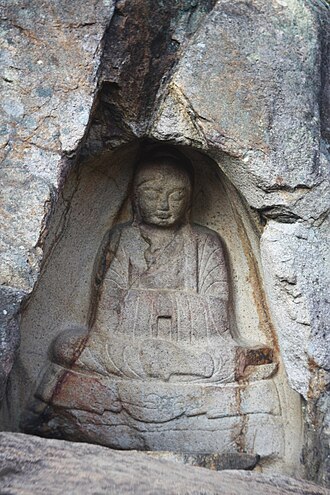
“She knew of things before they happened — the wisdom of a sovereign who shaped a kingdom by the strength of her mind alone.”
— Traditional account of Queen Seondeok, as recorded in the Samguk Sagi
In a world where female rulership was nearly unthinkable, a princess of the Silla kingdom ascended to its throne and governed one of the Three Kingdoms of Korea with both political skill and visionary cultural ambition. Queen Seondeok (선덕여왕), who reigned from 632 to 647 CE, stands as one of the most remarkable figures in all of Korean history — the first woman ever to rule a Korean kingdom in her own name. Her reign was defined by Buddhist patronage, diplomatic maneuvering, and enduring architectural achievements that still stand today.
Quick Facts: Queen Seondeok of Silla
| Korean Name | 선덕여왕 (Seondeok Yeowang) |
| Personal Name | Kim Deokman (김덕만) |
| Reign | 632 – 647 CE |
| Dynasty | Silla (신라) |
| Father | King Jinpyeong of Silla |
| Successor | Queen Jindeok of Silla |
| Religion | Buddhism |
| Era | Three Kingdoms Period |
Who Was Queen Seondeok, and How Did She Come to Rule?
Born as Princess Kim Deokman, Queen Seondeok was the eldest daughter of King Jinpyeong of Silla. The Silla kingdom, based in the southeastern Korean peninsula with its capital at Gyeongju, operated under a strict bone-rank system — a hereditary aristocratic hierarchy that determined social and political status by bloodline. Known as the golpum system, it placed the royal family at the apex of society.
King Jinpyeong had no male heirs, and Deokman, as a member of the seonggol (sacred bone) rank — the highest tier of the hierarchy — was regarded as a legitimate candidate for the throne. Upon her father’s death in 632, she was elevated to become the 27th ruler of Silla, making her the first female monarch in Korean recorded history. Her accession was not without controversy; neighboring kingdoms of Goguryeo and Baekje reportedly dismissed her as an unfit ruler on account of her gender, a perception that Queen Seondeok would spend her reign actively disproving.
A Reign Defined by Buddhism and Architecture
Perhaps the most lasting dimension of Queen Seondeok’s legacy is her fervent patronage of Buddhism, which was the dominant spiritual and cultural force in Silla society. Under her direction, some of the most important Buddhist structures in Korean history were commissioned and built.
The most iconic of these is Cheomseongdae (첨성대), an astronomical observatory constructed during her reign in the capital Gyeongju. Standing at approximately 9.17 meters tall and built from carefully arranged granite blocks, Cheomseongdae is believed to be the oldest surviving astronomical observatory in East Asia. Its cylindrical form, with a square base and an opening near the top, allowed court astronomers to observe the heavens and track celestial phenomena. Today, Cheomseongdae remains standing in Gyeongju and is designated as a National Treasure of Korea.
Queen Seondeok also oversaw the construction of Hwangnyongsa’s nine-story wooden pagoda, one of the grandest Buddhist structures of the ancient world. The pagoda, commissioned in 645 CE at the Hwangnyongsa temple complex in Gyeongju, was said to symbolize Silla’s desire to subdue nine neighboring countries, representing both spiritual aspiration and political ambition. Though the pagoda no longer stands — destroyed during the Mongol invasions of the 13th century — its scale and significance have been confirmed through archaeological excavations.
Another major structure attributed to her reign is Bunhwangsa, a Buddhist temple whose stone pagoda still partially stands in Gyeongju. Constructed in 634 CE, the Bunhwangsa pagoda is one of the oldest surviving stone structures of the Silla period and reflects the kingdom’s sophisticated integration of Buddhist iconography and architectural craft.
“The towers she built to touch the sky — one for the stars, one for the Buddha — still rise above the plains of Gyeongju, speaking across fourteen centuries.”
Diplomacy, Conflict, and Political Challenges
Queen Seondeok’s reign was far from peaceful. The Three Kingdoms period was an era of near-constant military competition between Silla, Goguryeo in the north, and Baekje to the west. Baekje in particular posed a persistent threat, launching repeated raids into Silla territory during her reign. The queen responded by strengthening alliances with the Tang Dynasty of China, a strategic relationship that would eventually prove decisive in the eventual unification of the peninsula under Silla in 668 CE — two decades after her death.
Queen Seondeok dispatched students and monks to Tang China to study Buddhism, statecraft, and culture, enriching Silla’s intellectual life and cementing diplomatic bonds. Among those sent was the monk Jajang, who returned from Tang China with sacred Buddhist relics and reportedly recommended the construction of the Hwangnyongsa nine-story pagoda as a means of protecting the kingdom through spiritual power.
Near the end of her reign, in 647 CE, a rebellion led by the aristocrat Bidam challenged her rule directly. Bidam raised the argument that a woman should not be permitted to govern, rallying a faction of discontented nobles. The rebellion was suppressed — though Queen Seondeok died during or shortly after the uprising, and it fell to her generals and successor to fully crush the revolt.
3 Reasons Queen Seondeok’s Legacy Endures
- She broke a historical ceiling. As the first female ruler of any Korean kingdom, Queen Seondeok demonstrated that the sacred bone rank could supersede gender in the determination of royal succession. Her reign paved the way for a second female ruler, Queen Jindeok, who followed her directly on the Silla throne.
- Her monuments outlasted her enemies. The structures commissioned during her reign — Cheomseongdae, Bunhwangsa, and the Hwangnyongsa pagoda — became defining symbols of Silla civilization. Cheomseongdae in particular has endured for over 1,300 years and remains one of the most visited historical sites in Korea.
- She shaped the Silla-Tang alliance. Her diplomatic relationship with Tang China was not simply a strategic calculation; it was a long-term cultural and political investment that helped position Silla as the dominant power on the Korean peninsula. The alliance she cultivated would ultimately deliver the unification of the Three Kingdoms under Silla rule.
Queen Seondeok in Historical Records and Popular Culture
The primary historical sources for Queen Seondeok’s life are the Samguk Sagi (Chronicles of the Three Kingdoms), compiled by scholar Kim Busik in 1145, and the Samguk Yusa (Memorabilia of the Three Kingdoms), written by the monk Iryeon in the late 13th century. Both texts include anecdotes that present her as exceptionally intelligent and perceptive — qualities the chroniclers framed as evidence of her fitness to rule despite being a woman.
One famous story recorded in these texts describes how Princess Deokman, before she became queen, predicted the behavior of peony flowers sent as a gift from the Tang emperor. Seeing that the painted image of the flowers had no butterflies, she concluded the flowers would have no fragrance — and she was right. The story, whether historically accurate or legendary, became emblematic of the wisdom attributed to her by later generations.
In modern South Korea, Queen Seondeok has enjoyed a significant cultural revival. A popular television drama series, Queen Seondeok, aired in 2009 and became one of the highest-rated dramas in Korean broadcasting history, introducing her story to millions of viewers and sparking renewed public interest in the Silla period.
Comparing the Three Great Structures of Her Reign
| Structure | Type | Date Built | Current Status |
|---|---|---|---|
| Cheomseongdae | Astronomical observatory | c. 632–647 CE | Intact; National Treasure |
| Bunhwangsa Pagoda | Buddhist stone pagoda | 634 CE | Partially standing; National Treasure |
| Hwangnyongsa Nine-Story Pagoda | Wooden Buddhist pagoda | 645 CE | Destroyed (13th century Mongol invasions) |
Death and Burial
Queen Seondeok died in 647 CE, the sixteenth year of her reign. According to the Samguk Yusa, she predicted her own death and requested to be buried on Doricheon — a reference to the Buddhist Trayastrimsha heaven — at the southern slope of Nangsan mountain near Gyeongju. It is recorded that monks later built Sacheonwangsa temple nearby, fulfilling what was interpreted as confirmation of her prophecy. Her tomb, a grass-covered royal burial mound in the hills near Gyeongju, can still be visited today.
She was succeeded by her cousin, Queen Jindeok, who became the second — and last — female ruler of Silla, reigning until 654 CE. Together, the two queens represent an extraordinary and historically unique period of female sovereignty in Korean history.
Continue Exploring
Deepen your understanding of Queen Seondeok, the Silla kingdom, and the Three Kingdoms period with these resources: