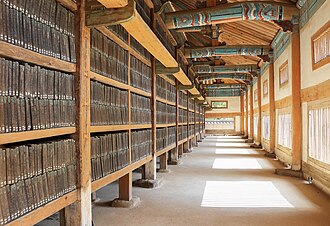
“The Tripitaka Koreana stands as one of the most extraordinary achievements in the history of human civilization — a monument to both faith and scholarship carved in wood.”
In the mountain forests of South Korea, tucked within the ancient halls of Haeinsa Temple, rests one of the most remarkable objects ever created by human hands. The Tripitaka Koreana — known in Korean as Palman Daejanggyeong (팔만대장경), meaning “Eighty-Thousand Tripitaka” — is the world’s most complete and accurate surviving collection of Buddhist scriptures, carved onto more than 81,000 wooden printing blocks. It has endured for nearly eight centuries, surviving invasions, fires, and the turbulent passage of time, and today stands as both a UNESCO Memory of the World Register entry and a National Treasure of South Korea.
For anyone seeking to understand Korean history, culture, and the profound depth of the Goryeo dynasty’s intellectual and spiritual life, the Tripitaka Koreana offers a window unlike any other. This is not merely a religious artifact — it is a testament to an entire civilization’s determination to preserve knowledge in the face of catastrophe.
Quick Facts: The Tripitaka Koreana at a Glance
| Detail | Information |
|---|---|
| Full Korean Name | Palman Daejanggyeong (팔만대장경) |
| Number of Woodblocks | Approximately 81,258 |
| Dynasty | Goryeo (고려) |
| Period of Creation | 1236–1251 CE |
| Current Location | Haeinsa Temple, South Gyeongsang Province |
| UNESCO Status | Memory of the World Register (2007); World Heritage Site (storehouse) |
| South Korean Status | National Treasure No. 32 |
| Total Characters Carved | Approximately 52 million |
The Goryeo Dynasty and the Age of Buddhist Faith
To understand the Tripitaka Koreana, one must first understand the world that produced it. The Goryeo dynasty (918–1392 CE), from which the modern name “Korea” derives, was a deeply Buddhist state. Buddhism was not merely a private spiritual practice during this era — it was woven into the very fabric of governance, culture, and national identity. Kings and aristocrats alike patronized temples, supported monks, and believed that the power of Buddhist teachings could protect the nation from harm.
It was precisely this belief — that the Buddha’s teachings, properly transcribed and preserved, could serve as a spiritual shield against enemies — that gave rise to one of the greatest publishing projects in premodern history. The Tripitaka Koreana was not created in a time of peace and leisure. It was carved during one of the most desperate periods in Korean history, when the very survival of the Goryeo state was in question.
Why Was the Tripitaka Koreana Created?
The story of the Tripitaka Koreana begins with destruction. In the early thirteenth century, the Mongol Empire under Genghis Khan and his successors launched a series of devastating invasions across Asia. Korea was not spared. Beginning in 1231, Mongol forces swept through the Korean peninsula, burning cities, slaughtering populations, and destroying cultural treasures.
Among the casualties of these early invasions was the First Tripitaka — an earlier set of Buddhist woodblocks that had been painstakingly created during the reign of King Hyeonjong (r. 1009–1031) after the Khitan invasions of the late tenth and early eleventh centuries. That first collection, completed around 1087, was believed to have helped repel the Khitan through its spiritual power. When Mongol forces burned it in 1232, the Goryeo court — which had retreated to the island of Ganghwa (Ganghwa Island) to escape the invasion — resolved to recreate the entire canon.
The logic was both spiritual and practical. Spiritually, a new and even more perfect set of scriptures might invoke the Buddha’s protection and help drive out the Mongols. Practically, the project gave the court a unifying national purpose during an extraordinarily difficult time. Work began in 1236 and continued for approximately sixteen years, concluding around 1251.
“Carved in crisis, preserved through centuries — the Tripitaka Koreana is a monument not just to Buddhist devotion, but to the stubborn resilience of Korean civilization.”
How Were the Woodblocks Made?
The creation of the Tripitaka Koreana was an undertaking of staggering scale and precision. Each of the roughly 81,258 wooden printing blocks measures approximately 24 centimeters in height and between 58 and 76 centimeters in length, with a thickness of around 2.6 to 4 centimeters. The wood used was primarily birch and wild cherry, sourced from coastal regions.
The preparation of the wood alone was an extensive process. The timber was cut and soaked in seawater for an extended period — reportedly as long as three years in some accounts — before being boiled in salt water and then dried in the shade. This treatment was designed to prevent warping and insect damage, and the remarkable preservation of the blocks over nearly eight centuries suggests it was extraordinarily effective.
Once prepared, the wooden planks were coated with a lacquer made from poison sumac resin to further protect them. The text was then carved by skilled craftsmen — scholars believe the carving was so consistent and precise that it appears almost as if a single master engraver produced the entire collection. Modern researchers have been astonished by the near-absence of errors: across approximately 52 million individual characters, the number of mistakes is extraordinarily small. The blocks were also reinforced at the corners with metal fittings to prevent damage and warping over time.
3 Reasons the Tripitaka Koreana Is Considered a World Masterpiece
-
Unmatched Accuracy and Completeness
The Tripitaka Koreana is widely regarded by scholars as the most accurate and complete version of the Buddhist Tripitaka — the three “baskets” of Buddhist teaching encompassing the Buddha’s discourses, monastic rules, and philosophical commentaries. Goryeo scholars consulted Chinese, Khitan, and Song dynasty versions of the canon and cross-referenced them meticulously to produce a corrected, authoritative text. Modern Buddhist scholars still refer to the Goryeo edition as the most reliable version of the Chinese-language Buddhist canon.
-
Extraordinary Preservation
After being moved to Haeinsa Temple in 1398, during the early Joseon dynasty, the woodblocks have remained there ever since — protected by the remarkable design of the Janggyeong Panjeon, the depositories built to house them. The storage halls are engineered with sophisticated natural ventilation systems that regulate temperature, humidity, and air circulation, preventing mold, insects, and warping. The halls themselves are a UNESCO World Heritage Site, recognized for their innovative architectural design. After more than 770 years, the vast majority of the woodblocks remain in usable condition.
-
A Living Cultural Heritage
Unlike many ancient artifacts that exist only as objects in museum cases, the Tripitaka Koreana has never entirely ceased to function. Prints have been made from the woodblocks at various points in history, and the texts they contain continue to be studied by Buddhist scholars around the world. The collection represents not a dead relic but a living intellectual and spiritual tradition that has influenced Buddhism across East Asia.
The Janggyeong Panjeon: An Architectural Marvel
One cannot discuss the Tripitaka Koreana without marveling at the structures built to protect it. The Janggyeong Panjeon — the storage halls at Haeinsa Temple in which the woodblocks are kept — were constructed in the fifteenth century and represent a triumph of premodern Korean architectural and environmental engineering.
The halls are oriented to maximize natural airflow, with windows of varying sizes positioned on opposite walls to create cross-ventilation that changes with the seasons. The floor is reportedly filled with charcoal, lime, salt, and clay, which together help regulate moisture levels. The surrounding landscape, including the slope of the hill and the placement of trees, was carefully considered to ensure proper air circulation around the buildings.
Perhaps most remarkably, this system has worked so well for over five centuries that modern scientists and preservation experts have found it difficult to improve upon. Proposals to install modern climate-control systems have generally been abandoned after studies showed that the traditional ventilation system actually outperformed contemporary alternatives in maintaining the stable conditions the woodblocks require.
The Janggyeong Panjeon was inscribed as a UNESCO World Heritage Site in 1995, with the Tripitaka Koreana itself added to the UNESCO Memory of the World Register in 2007.
Comparison: First Tripitaka vs. Tripitaka Koreana
| Feature | First Tripitaka (Chojo Daejanggyeong) | Tripitaka Koreana (Palman Daejanggyeong) |
|---|---|---|
| Creation Period | Approx. 1011–1087 CE | 1236–1251 CE |
| Historical Context | Response to Khitan invasions | Response to Mongol invasions |
| Fate of Original | Destroyed by Mongols in 1232 | Survives to this day |
| Scholarly Approach | Based primarily on Song Chinese sources | Cross-referenced Chinese, Khitan, and Song versions |
| Current Status | Lost | Preserved at Haeinsa Temple |
From Ganghwa Island to Haeinsa: A Journey Through History
When the Tripitaka Koreana was completed around 1251, it was housed on Ganghwa Island, where the Goryeo court had retreated from the Mongol advance. The woodblocks remained there for well over a century, through the eventual Mongol withdrawal, the restoration of royal authority to the mainland, and the turbulent final decades of the Goryeo dynasty.
It was not until 1398, in the early years of the newly established Joseon dynasty, that the woodblocks were transferred to their current home at Haeinsa Temple in the Gayasan mountains of South Gyeongsang Province. The reasons for this transfer are not entirely clear, but it is generally believed that the mountainous, relatively remote location was chosen partly for its security and partly because of Haeinsa’s status as one of Korea’s most important Buddhist temples.
The choice proved inspired. Over the following centuries, the Korean peninsula experienced wars, invasions, and dramatic political upheavals — including the devastating Japanese invasions of the 1590s and the horrors of the twentieth century’s conflicts. Through all of it, the woodblocks at Haeinsa survived largely intact. During the Korean War (1950–1953), a South Korean air force officer reportedly refused orders to bomb Haeinsa, even though North Korean troops were sheltering there, rather than risk destroying the irreplaceable cultural heritage housed within its walls.
The Tripitaka Koreana Today
Today, Haeinsa Temple is one of South Korea’s most visited cultural and religious sites, welcoming both Buddhist pilgrims and history enthusiasts from around the world. Visitors can view the exterior of the Janggyeong Panjeon depositories and glimpse the rows of ancient woodblocks through the latticed windows, though direct access to the blocks themselves is restricted to protect their preservation.
Efforts are ongoing to digitize the entire collection, making the texts accessible to scholars worldwide without risking damage to the originals. The National Institute of Korean History and various academic institutions have worked to create high-resolution digital archives of the woodblocks and the prints made from them.
For scholars of Buddhism, the Tripitaka Koreana remains an indispensable primary source. Its painstaking accuracy and the care with which Goryeo scholars cross-referenced competing versions of the Buddhist canon make it the gold standard for Chinese-language Buddhist textual studies.
Continue Exploring
On This Site
- The Goryeo Dynasty: Korea’s Golden Age of Buddhism and Culture
- Haeinsa Temple: A Sacred Mountain Monastery
- The Mongol Invasions and Korean Resistance