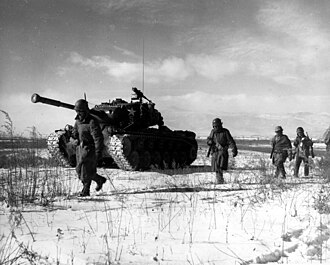
“Korea is a dagger pointed at the heart of Japan” — a geopolitical observation that underscored why the Korean peninsula became one of the most fiercely contested battlegrounds of the twentieth century.
The Korean War, fought between 1950 and 1953, was one of the defining conflicts of the Cold War era. It pitted the forces of the newly established Republic of Korea (South Korea) and a United Nations coalition against the Korean People’s Army of the Democratic People’s Republic of Korea (North Korea) and, later, Chinese forces. What began as a civil war rooted in the division of the peninsula quickly escalated into an international confrontation that would reshape East Asian geopolitics for generations.
For the Korean people, the war was nothing short of catastrophic. Families were torn apart, ancient cities reduced to rubble, and millions of lives lost. Yet the story of the Korean War is also one of resilience, international solidarity, and the enduring will of a people to determine their own destiny. Understanding this conflict is essential to understanding modern Korea — both North and South.
Quick Facts: The Korean War at a Glance
| Detail | Information |
|---|---|
| Conflict Name | Korean War (한국전쟁, Hanguk Jeonjaeng) |
| Duration | 25 June 1950 – 27 July 1953 |
| Location | Korean Peninsula |
| Primary Belligerents | North Korea & China (PVA) vs. South Korea & UN forces (led by USA) |
| Outcome | Armistice Agreement; no formal peace treaty signed |
| Division Line | Roughly the 38th parallel (Korean Demilitarized Zone) |
| UN Member Nations Involved | 21 nations contributed troops or support to the UN coalition |
| Also Known As | “The Forgotten War” (in the West); “Fatherland Liberation War” (in North Korea) |
How Did Korea Become Divided in the First Place?
To understand the Korean War, one must first understand the circumstances that led to the division of Korea. For centuries, Korea had existed as a single, unified civilization — a kingdom and later an empire with its own distinct language, culture, and traditions. That unity was violently disrupted in 1910, when Imperial Japan annexed the peninsula and subjected Koreans to thirty-five years of colonial rule.
When Japan surrendered to the Allied Powers in August 1945, ending the Second World War, the question of Korea’s future became urgent. As a temporary administrative measure, the United States and the Soviet Union agreed to divide the peninsula at the 38th parallel: Soviet forces would accept the Japanese surrender north of this line, while American forces would do so in the south. This division was intended to be provisional, but it hardened rapidly as the Cold War deepened.
By 1948, two separate governments had been established. In the south, Syngman Rhee became the first president of the Republic of Korea, backed by the United States. In the north, Kim Il-sung consolidated power as the leader of the Democratic People’s Republic of Korea, supported by the Soviet Union. Both governments claimed legitimacy over the entire peninsula, and tensions along the 38th parallel escalated through 1949 and into 1950, with numerous skirmishes recorded before the full-scale outbreak of war.
The Outbreak of War: June 25, 1950
In the early hours of June 25, 1950, North Korean forces launched a massive, coordinated invasion across the 38th parallel. The Korean People’s Army advanced rapidly southward, catching South Korean and American forces largely off guard. Within three days, Seoul — the capital of South Korea — had fallen to the invading forces.
The United Nations Security Council, meeting in emergency session, passed resolutions calling for a ceasefire and authorizing member states to assist South Korea. The United States, under President Harry S. Truman, committed ground, air, and naval forces almost immediately. General Douglas MacArthur was appointed commander of the UN forces. Fifteen other nations ultimately contributed combat troops to the coalition, while several more provided medical units and other forms of support.
By September 1950, UN and South Korean forces had been pushed back to a small defensive perimeter around the southeastern port city of Busan — the so-called Pusan Perimeter. The situation appeared dire. But on September 15, 1950, General MacArthur launched a daring amphibious assault at Incheon, far behind enemy lines. The landing was a stunning success. Within weeks, UN forces had recaptured Seoul and pushed the North Korean army back north of the 38th parallel.
“We shall land at Inchon, and I shall crush them.” — General Douglas MacArthur, on his plan to turn the tide of the Korean War through the Incheon Landing.
China Enters the War: A New Phase of Conflict
Emboldened by their success, UN forces pressed northward deep into North Korean territory, approaching the Yalu River — the border with China. This advance alarmed the newly established People’s Republic of China, which viewed a hostile, US-backed force on its border as an existential threat. In late October 1950, Chinese People’s Volunteer Army forces crossed the Yalu River in massive numbers, entering the conflict and shifting its entire character.
The Chinese intervention drove UN forces back southward in a brutal winter campaign. Seoul changed hands once again — falling to communist forces in January 1951, before being retaken by UN forces in March 1951. By mid-1951, the front had stabilized roughly along the 38th parallel, close to where the war had originally begun. It became grimly apparent to both sides that a decisive military victory would come at an unacceptably high cost.
From mid-1951 onward, the war settled into a grinding stalemate of trench warfare, limited offensives, and attritional battles over hills and ridgelines. Meanwhile, armistice negotiations began at Kaesong in July 1951, later moving to Panmunjom. These talks would drag on for two agonizing years, punctuated by continued fighting and tens of thousands of additional casualties.
4 Reasons the Korean War Still Matters Today
1. The Armistice, Not a Peace Treaty
On July 27, 1953, the Korean Armistice Agreement was signed by representatives of the United Nations Command, the Korean People’s Army, and the Chinese People’s Volunteer Army. Critically, the Republic of Korea did not sign the armistice. The agreement established a Military Demarcation Line close to the 38th parallel and created a Demilitarized Zone (DMZ) on either side. It was a ceasefire — not a formal peace treaty. Technically, the Korean War has never officially ended, a fact that continues to shadow inter-Korean relations and regional security to this day.
2. A Peninsula Permanently Divided
The war cemented the division of Korea into two radically different states. South Korea, known officially as the Republic of Korea, rebuilt itself from the ashes of war to become one of the world’s leading economies and democracies. North Korea, under the continued rule of the Kim dynasty, developed into one of the world’s most isolated and heavily militarized states. The human cost of this division — millions of separated families, a shared culture fractured — remains a profound wound.
3. The Cold War in Asia
The Korean War dramatically intensified the Cold War in Asia. It accelerated US military commitments in the region, contributed to the decision to rearm Japan, and deepened American involvement in other Asian conflicts. It also demonstrated that the Cold War could turn devastatingly hot, with superpower-backed forces clashing in direct, large-scale combat.
4. “The Forgotten War”
In the United States and much of the West, the Korean War has long been overshadowed by the Second World War that preceded it and the Vietnam War that followed. It is often called “the Forgotten War.” Yet for Korea, it was anything but forgotten. It shaped every aspect of how South Korea built its modern state and how North Korea justifies its political system. For Koreans on both sides of the DMZ, the war remains a living memory and a defining national trauma.
The Human Cost: Casualties and Destruction
The Korean War exacted an enormous human toll. Military casualties on all sides numbered in the hundreds of thousands. Civilian suffering was immense — the peninsula was subjected to intense aerial bombardment, particularly in the north, and ground combat swept repeatedly across populated areas. Millions of Koreans were displaced from their homes. The division of the peninsula separated families who would, in many cases, never see each other again.
The physical destruction of Korean cities, infrastructure, and cultural heritage was staggering. Ancient towns and historical sites that had survived centuries were reduced to rubble. The rebuilding of South Korea in the war’s aftermath — and the remarkable economic transformation that followed — is itself one of the most extraordinary stories in modern history, a journey from near-total devastation to a leading global economy within a single generation.
Korea’s War in Comparison: A Regional Context
| Aspect | Korean War (1950–1953) | Vietnam War (1955–1975) |
|---|---|---|
| Primary Division | 38th Parallel | 17th Parallel |
| UN Involvement | Yes — UN coalition authorised | No — US-led without UN mandate |
| Outcome | Armistice; peninsula remains divided | North Vietnam victory; reunification in 1975 |
| Duration of Active Combat | Approximately 3 years | Approximately 20 years |
| Chinese Intervention | Yes — PVA entered in 1950 | Limited — material and advisory support |
| Legacy Division | Ongoing — Korea remains divided | Resolved — Vietnam reunified |
The Korean War and National Memory
In South Korea, the war is commemorated as a foundational event in the nation’s modern history. June 25 is observed as a day of national remembrance. The War Memorial of Korea in Seoul stands as a powerful tribute to those who fought and died, housing thousands of artifacts and bearing the names of fallen soldiers. The war is taught as the crucible in which the modern South Korean nation was forged — a moment of near-destruction that gave way to extraordinary resilience and reconstruction.
In North Korea, the war is called the “Fatherland Liberation War” and is portrayed as a heroic struggle against American aggression — a narrative that underpins much of the state’s political ideology to this day. The different ways in which each Korea remembers the same war speaks volumes about how profoundly the conflict has shaped two divergent national identities from a once-shared heritage.
Internationally, the Korean War helped establish the principle that the United Nations could authorize collective military action in response to acts of aggression — a precedent with lasting implications for international law and global security.
Continue Exploring
On This Site
- How Korea Was Divided in 1945: The Story of the 38th Parallel
- The Miracle on the Han River: South Korea’s Postwar Transformation
- Visiting the DMZ: Where History Stands Still