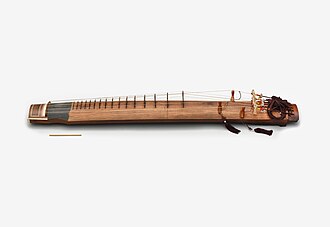
“Of all the instruments, the geomungo is the most noble” — a sentiment echoed by scholars and musicians across centuries of Korean history.
Few instruments in Korean history carry the weight of meaning that the geomungo does. This long, elegant zither — played with a small bamboo stick called a suldae — has been the instrument of choice for Korean scholars, aristocrats, and court musicians for well over a millennium. Its deep, resonant tones were considered the very sound of refined civilization, and its mastery was regarded as one of the highest attainments a cultured person could achieve.
The geomungo is classified as a zither, specifically a fretted zither, meaning it uses raised bridges and frets to shape its pitch. Strung with six strings and measuring roughly 150 centimeters in length, it produces a sound unlike any other instrument in the Korean classical tradition — rich, controlled, and contemplative. To play it well required not just technical skill but a kind of inner stillness that Korean scholars associated with moral cultivation.
Today, the geomungo is recognized as a National Intangible Cultural Heritage of South Korea, and it continues to be taught and performed both in traditional settings and in contemporary fusion music. Its story stretches back to the ancient kingdom of Goguryeo, winds through the royal courts of Goryeo and Joseon, and carries forward into modern Korean cultural life.
| Category | Details |
|---|---|
| Type | Fretted zither (plucked string instrument) |
| Origin | Goguryeo Kingdom (ancient Korea) |
| Strings | Six strings |
| Playing method | Struck and plucked with a bamboo stick (suldae) |
| Classification | National Intangible Cultural Heritage of South Korea |
| Korean script | 거문고 |
| Also known as | Hyŏnhakgŭm (玄鶴琴), “black crane zither” |
What Are the Origins of the Geomungo?
The origins of the geomungo are tied to one of Korea’s earliest and most powerful kingdoms: Goguryeo, which dominated the northern Korean peninsula and parts of Manchuria from roughly the 1st century BCE through 668 CE. According to traditional accounts preserved in Korean historical sources, the instrument was created by Wang San-ak, a court official and musician of Goguryeo.
The story goes that Wang San-ak received a Chinese seven-string zither known as the guqin — a deeply venerated instrument in Chinese classical culture — as a gift or diplomatic offering. Rather than simply imitating the Chinese instrument, Wang San-ak is said to have modified it significantly, adapting it to Korean musical sensibilities and creating an entirely new instrument in the process. He reportedly composed over one hundred pieces of music for this new instrument.
The name hyŏnhakgŭm (玄鶴琴), meaning “black crane zither,” is associated with a legend surrounding the instrument’s creation. According to the legend, when Wang San-ak first played his newly crafted instrument, a black crane descended from the heavens and danced to the music — a sign interpreted as divine approval of the instrument’s creation. The crane, a symbol of longevity, wisdom, and spiritual elevation in East Asian cultures, lent the instrument its early name. Over time, hyŏnhakgŭm was shortened and transformed into geomungo, with geomun being the native Korean rendering of the Chinese character for “black” (玄).
While it is difficult to verify these legendary accounts with archaeological precision, they reflect the cultural importance placed on the instrument from its earliest days. Wall paintings discovered in Goguryeo tombs — some of the most valuable visual records of ancient Korean life — depict musicians playing instruments that bear a recognizable resemblance to the geomungo, providing material evidence that zither-like instruments were indeed part of Goguryeo court and ceremonial culture.
Structure and Sound: How the Geomungo Works
Understanding the geomungo requires some appreciation of its physical construction, because the instrument’s design is inseparable from the sounds it produces and the techniques required to play it.
The body of the geomungo is a long, hollow wooden soundboard, traditionally made from paulownia wood (also called odong in Korean), which is prized for its acoustic resonance. The instrument’s six strings are made from twisted silk — a material that gives the geomungo its characteristically warm, somewhat muted tone, quite different from the brighter sound of metal or nylon strings used in other instruments.
Along the length of the instrument are sixteen raised frets, called gwe, made from paulownia wood and placed at intervals that define the instrument’s pitch range. Three of the six strings pass over these frets and are used to produce melodic lines. The remaining three strings — called the banyeol strings — are suspended over small moveable bridges called anjoк and are used primarily as drone or resonance strings, struck to provide rhythmic and harmonic support.
The player sits on the floor with the instrument laid across the lap and the left knee, in the traditional Korean floor-sitting posture. The right hand holds the suldae, a short stick made from bamboo, which is used to strike the strings with a controlled downward motion. The left hand simultaneously presses on the fret strings to adjust pitch and produce the instrument’s characteristic sliding tones and vibrato — techniques that require years of dedicated practice to master.
“The geomungo requires not just the hands but the entire spirit of the player — it is said that one cannot play it well without first quieting the mind.”
The resulting sound is deep, somewhat percussive on the attack, and then sustained and resonant. It occupies a lower register than many other Korean classical instruments, which is part of why it was associated with gravity, learning, and moral seriousness in the Confucian cultural framework that dominated Korean court and elite life, particularly during the Joseon dynasty.
3 Reasons the Geomungo Was Revered in Korean Court Culture
- Confucian associations with moral cultivation: In Joseon Korea (1392–1897), music was understood through a Confucian lens as a tool of self-cultivation and social harmony. The geomungo, with its grave tone and the intense concentration required to play it, was seen as particularly suited to the formation of virtuous character. It was standard among the yangban (aristocratic) class to learn the instrument as part of a classical education, alongside poetry, calligraphy, and painting.
- Role in court ritual and ceremony: The geomungo was a central instrument in jeongganbo-notated court music and was used in important ceremonial contexts, including royal banquets and Confucian ritual music performances. Its presence in official state music elevated its prestige far beyond that of a mere entertainment instrument.
- Association with legendary origins: The story of Wang San-ak and the descending black crane embedded the geomungo in a narrative of divine approval and cultural originality. Unlike instruments simply borrowed from China, the geomungo had its own founding myth, which reinforced Korean cultural pride in the instrument and encouraged its continued patronage by rulers and scholars alike.
The Geomungo vs. the Gayageum: Korea’s Two Great Zithers
The geomungo is often discussed alongside the gayageum, another Korean zither of great antiquity, and the two instruments are frequently compared. While both are zithers central to Korean classical music, they differ in character, technique, and cultural associations.
| Feature | Geomungo | Gayageum |
|---|---|---|
| Number of strings | 6 | 12 (traditional) |
| Playing method | Struck with bamboo stick (suldae) | Plucked with fingers |
| Frets | Yes (16 fixed frets) | No (moveable bridges only) |
| Tonal character | Deep, grave, percussive | Lighter, more lyrical |
| Origin kingdom | Goguryeo | Gaya (Kaya) |
| Cultural associations | Scholarly, masculine, Confucian | Broader appeal, lyrical, expressive |
Historically, the geomungo was considered the more “serious” and intellectually demanding of the two instruments, associated with the male scholarly elite. The gayageum, by contrast, was played more widely and was also associated with female court entertainers (gisaeng). Both instruments, however, are celebrated today as cornerstones of Korean classical music, and both are recognized as important elements of Korean intangible cultural heritage.
From Royal Courts to Modern Stages
The geomungo’s journey from the courts of Goguryeo to contemporary performance stages is a story of remarkable continuity and adaptation. Through the Unified Silla period (676–935 CE), the Goryeo dynasty (918–1392), and the long centuries of the Joseon dynasty (1392–1897), the instrument maintained its central place in Korean elite musical culture. It was notated in some of the earliest examples of Korean music notation, and pieces composed for it form a significant part of the surviving corpus of Korean classical music.
The late Joseon and early modern periods brought significant challenges. The social upheavals of the late 19th and early 20th centuries, including Japanese colonial rule (1910–1945), disrupted many traditional cultural institutions. The royal court music system that had patronized the geomungo for centuries was dismantled. However, dedicated musicians and cultural institutions worked to preserve the instrument’s repertoire and teaching traditions.
After Korean independence and the subsequent development of South Korea’s cultural heritage protection system, the geomungo was formally recognized as a National Intangible Cultural Heritage. This recognition provided institutional support for its transmission, with designated master musicians (boyuja) responsible for teaching and performing the tradition.
Today the geomungo occupies a dual role in Korean musical life. In the gugak (traditional Korean music) world, it remains an essential instrument in court music ensembles, chamber music, and solo performance. At the same time, younger generations of Korean musicians have embraced the geomungo in fusion and experimental contexts, combining it with jazz, electronic music, and other contemporary genres. This creative evolution ensures the instrument’s continued visibility even as its traditional repertoire is carefully preserved.
Continue Exploring
Deepen your understanding of Korean musical heritage and the cultural world from which the geomungo emerged:
- Geomungo — Wikipedia: A detailed overview of the instrument’s construction, history, and musical role.
- Encyclopedia of Korean Culture (AKS): Authoritative Korean-language and bilingual entries on traditional music and instruments.
- Gayageum — Wikipedia: Learn about the geomungo’s great counterpart in the Korean zither tradition.
- National Museum of Korea: Explore collections that include historical Korean musical instruments and Goguryeo artifacts.
- Goguryeo — Wikipedia: Background on the ancient kingdom where the geomungo was born.
- Asia Society: Resources on Korean performing arts and their place in broader Asian cultural history.