“He expanded the territory of Goguryeo to its greatest extent, earning a place as one of the most celebrated rulers in all of Korean history.”
Few figures in Korean history command as much reverence and fascination as Gwanggaeto the Great, the nineteenth monarch of the ancient kingdom of Goguryeo. Born in 374 CE and reigning until his death in 412 CE, he transformed a regional power into a dominant empire that stretched across vast swaths of Northeast Asia. His very name — Gwanggaeto — translates roughly to “Broad Expander of Territory,” a title that speaks directly to the defining achievement of his reign. Centuries after his death, he remains a symbol of Korean strength, ambition, and national pride.
To understand Gwanggaeto the Great is to understand a pivotal era in Korean history, a time when the Three Kingdoms of Korea — Goguryeo, Baekje, and Silla — competed fiercely for dominance, while external powers from the continent pressed inward from the north. Into this turbulent world, Gwanggaeto arrived as a warrior-king of extraordinary capability, reshaping the political map of the region through an almost unbroken series of military campaigns.
Quick Facts: Gwanggaeto the Great
| Birth Year | 374 CE |
|---|---|
| Death Year | 412 CE |
| Kingdom | Goguryeo |
| Reign | 391–412 CE |
| Reign Title | Yeongnak (永樂), meaning “Eternal Rejoicing” |
| Succession Number | 19th monarch of Goguryeo |
| Legacy Monument | Gwanggaeto Stele, erected 414 CE in modern-day Ji’an, China |
| Religion | Buddhism |
Who Was Gwanggaeto the Great?
Gwanggaeto was the son of King Gogukyang, the eighteenth ruler of Goguryeo, and he ascended to the throne in 391 CE at a remarkably young age. Goguryeo at the time was already one of the most powerful of the Three Kingdoms, occupying the northern Korean peninsula and extending into Manchuria. Yet it faced significant threats on multiple fronts — from rival Korean kingdoms to the south, from nomadic and proto-state powers to the north and west, and from the persistent ambitions of Chinese successor states following the fragmentation of the Han dynasty era.
Rather than adopting a defensive posture, Gwanggaeto chose relentless expansion. Over the course of his approximately twenty-two-year reign, he launched campaigns in nearly every direction, acquiring territory at a pace that historians still find remarkable. He adopted the era name Yeongnak, meaning “Eternal Rejoicing,” a title that proclaimed Goguryeo’s sovereign independence and positioned the kingdom as an empire in its own right — not a tributary state of any continental power.
Why Is Gwanggaeto the Great So Important to Korean History?
Gwanggaeto’s significance reaches beyond mere military accomplishment. His reign marked a decisive moment in the formation of Korean historical identity. He was among the first Korean rulers to assert full imperial sovereignty, using an independent reign title — a practice typically reserved for the emperors of China — and styling Goguryeo as the equal of any power on the continent.
His campaigns fundamentally altered the balance of power among the Three Kingdoms. He pushed Baekje southward, reducing that kingdom’s northern territory substantially. He intervened in the affairs of Silla, establishing Goguryeo as that kingdom’s protector and, in effect, its overlord. He battled confederacies and states across Manchuria and the Liaodong Peninsula. At the height of his reign, Goguryeo controlled a territory estimated to be one of the largest of any Korean state in history.
“Gwanggaeto did not merely win battles — he redrew the map of Northeast Asia, making Goguryeo the dominant power from the Korean peninsula to the Manchurian steppes.”
Beyond military and political achievements, Gwanggaeto is credited with promoting Buddhism within Goguryeo, continuing a tradition of royal patronage of the faith that helped define Korean cultural identity for centuries to come. He reportedly established nine Buddhist temples in Pyongyang, reflecting both personal devotion and the use of religion as an instrument of state-building and cultural cohesion.
The Gwanggaeto Stele: A Stone Record of Conquest
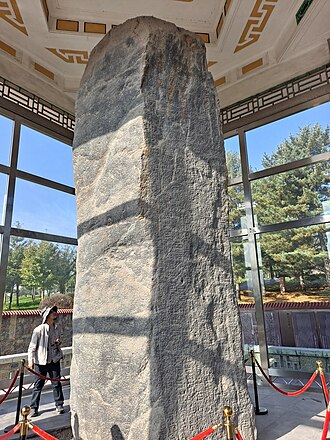
No discussion of Gwanggaeto the Great would be complete without reference to the extraordinary monument erected in his honor two years after his death. In 414 CE, his son and successor, King Jangsu, commissioned the construction of a massive stone stele near the royal tomb in what is today Ji’an, in Jilin Province, China — territory that was once the heartland of Goguryeo.
The stele stands approximately 6.39 meters tall and is inscribed with around 1,775 Chinese characters. Its text records the founding myth of Goguryeo, the lineage and accomplishments of Gwanggaeto, and the rules governing the care of the royal tomb. The inscription details military campaigns against Baekje, the rescue of Silla from Japanese (Wa) forces, battles with the Khitan and other northern peoples, and the expansion of Goguryeo’s borders across a huge geographic range.
The stele is one of the most important primary sources for early Korean history and has been the subject of intense scholarly attention — and at times, political controversy — particularly regarding certain passages that touch on the role of Japanese forces on the Korean peninsula during this era. Different nationalist interpretations in Korea, Japan, and China have at times read the same inscriptions in conflicting ways, making the stele not just a historical artifact but a living document in ongoing debates about regional history.
Military Campaigns: A Reign Defined by Expansion
The scope of Gwanggaeto’s military activity was extraordinary by any historical standard. The Gwanggaeto Stele records sixty-four walled towns and 1,400 villages captured during his reign — numbers that, even if somewhat formulaic, convey the relentless scale of his campaigns.
Among the most significant military events of his reign:
- Campaigns against Baekje (391–396 CE): Gwanggaeto launched a series of major offensives against Goguryeo’s southern rival, Baekje. He captured the Baekje capital’s surrounding fortresses and forced King Asin of Baekje to submit, taking hostages and extracting pledges of loyalty. This dramatically shifted the balance of power on the Korean peninsula.
- Intervention in Silla (400 CE): When the kingdom of Silla was threatened by a coalition of Japanese (Wa) forces and their allies, Gwanggaeto sent an army reportedly numbering 50,000 soldiers to repel the invaders. This campaign established Goguryeo’s dominance over Silla and extended Goguryeo’s influence deep into the southeastern Korean peninsula.
- Northern and western campaigns: Gwanggaeto conducted campaigns against the Khitan, the Later Yan state, and various other peoples and polities to the north and west. He captured the Liaodong Peninsula from Later Yan, a significant territorial gain that gave Goguryeo control over a strategically vital region linking Manchuria to the Chinese heartland.
- Campaigns against the Eastern Buyeo: In the final years of his reign, Gwanggaeto turned northeast, campaigning against the Eastern Buyeo and expanding Goguryeo’s reach in that direction as well.
Goguryeo vs. Its Rivals: A Snapshot of the Three Kingdoms Era
| Kingdom | Location | Relationship with Goguryeo Under Gwanggaeto | Outcome by 412 CE |
|---|---|---|---|
| Goguryeo | Northern Korea, Manchuria | Dominant power, imperial ambitions | Vast territorial expansion achieved |
| Baekje | Southwestern Korea | Primary rival; suffered major military defeats | Pushed southward, forced to submit |
| Silla | Southeastern Korea | Protected state; de facto Goguryeo tributary | Militarily dependent on Goguryeo |
| Gaya Confederacy | Southern Korea | Targeted during Silla campaigns | Weakened by Goguryeo intervention |
Legacy: Why Gwanggaeto Still Matters Today
Gwanggaeto the Great died in 412 CE at the age of just thirty-eight — young by any measure, yet he had already accomplished more than most rulers achieve in twice the lifespan. His son Jangsu, who would reign for an extraordinary seventy-nine years, continued many of his father’s policies and moved the Goguryeo capital to Pyongyang in 427 CE, a decision that further consolidated the kingdom’s southward ambitions.
In modern South Korea, Gwanggaeto the Great is celebrated as one of the greatest figures in Korean history. His image and name appear on military vessels, in school textbooks, in films and television dramas, and in public monuments. The Gwanggaeto Stele itself, though located in present-day China, remains a potent symbol of Korean historical pride and sovereignty.
His legacy also intersects with contemporary geopolitics. The precise extent of Goguryeo’s territory — and thus who can claim that kingdom’s heritage — has been a source of tension between South Korea, North Korea, and China. China’s controversial Northeast Project, a government-funded academic initiative in the early 2000s, argued that Goguryeo was a regional power within China’s historical sphere rather than a distinctly Korean state. Korean scholars and the Korean public responded with considerable passion, underscoring just how alive the memory of Gwanggaeto remains in the present day.
For those interested in Korean history, Gwanggaeto the Great stands as an indispensable figure — a ruler who defined an era, left a monumental physical record of his achievements, and whose shadow still falls across the politics and cultural identity of the region more than sixteen centuries after his death.