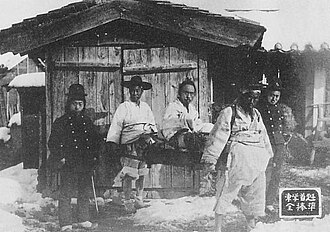
“We rise not to rebel against the state, but to save the people and secure the nation.”
— Proclamation attributed to Tonghak peasant leaders, 1894
In the spring of 1894, the Korean peninsula was shaken by one of the most dramatic popular uprisings in its long history. Tens of thousands of farmers, artisans, and followers of the Tonghak religious movement marched under the banner of justice, demanding an end to corruption, economic exploitation, and the creeping influence of foreign powers. The Tonghak Peasant Revolution — also romanized as the Donghak Peasant Revolution — was not simply a local rebellion. It triggered a chain of events that drew Qing China and Meiji Japan into open conflict on Korean soil, accelerating the collapse of the Joseon dynasty and reshaping the entire geopolitical order of East Asia.
To understand why so many ordinary Koreans took up arms in 1894, we must look at the world they inhabited: a kingdom groaning under the weight of corrupt officials, crushing taxes, and a rigid social hierarchy that offered the poor almost no recourse. The Tonghak movement gave that suffering a spiritual and political vocabulary — and ultimately, a sword.
Quick Facts: The Tonghak Peasant Revolution
| Date | 1894 (Joseon dynasty) |
| Location | Joseon Korea, primarily the Jeolla and Chungcheong provinces |
| Key Leader | Jeon Bongjun (전봉준), known as “Green Bean General” |
| Ideology | Tonghak religion, anti-corruption, anti-foreign intervention |
| Trigger | Abuses by local official Jo Byeong-gap in Gobu County |
| Outcome | Suppression by Joseon-Japanese forces; catalyst for First Sino-Japanese War |
| Legacy | Foundation of Korean democratic and nationalist consciousness |
The Roots of Tonghak: A New Religion for a Troubled Kingdom
The Tonghak movement — meaning “Eastern Learning” — was founded in 1860 by Choe Je-u as a direct response to the spread of Western religion and culture, which Koreans called Seohak (Western Learning). Choe Je-u drew on elements of Confucianism, Buddhism, and Shamanism to craft a distinctly Korean spiritual philosophy that emphasized the equality of all people and the innate divinity within each human being. Its radical egalitarianism made it immediately attractive to the poor and the marginalized.
The Joseon government viewed Tonghak with deep suspicion. Choe Je-u was executed in 1864, but his movement only grew in the following decades. His successor, Choe Si-hyeong, expanded the faith across the southern provinces, where economic hardship was most acute. By the early 1890s, Tonghak had tens of thousands of followers, and its adherents were growing increasingly bold in their demands for official recognition and an end to persecution.
In 1892 and 1893, large Tonghak assemblies petitioned the government in Jeonju and later in Boeun, calling for the posthumous rehabilitation of their founder and for relief from official oppression. These peaceful gatherings were dispersed, but they demonstrated the movement’s organizational strength and its capacity to mobilize large numbers of people. The stage was being set for something far more consequential.
Why Did the Peasants Revolt in 1894?
The immediate spark came from Gobu County in North Jeolla Province. The local magistrate, Jo Byeong-gap, had subjected farmers to a series of outrageous abuses: forcing them to contribute unpaid labor to build a new reservoir, then charging them fees to use the water it held. He levied illegal taxes, embezzled public grain, and sold government positions to the highest bidder. His cruelties were a concentrated example of the systemic corruption that plagued late Joseon governance.
When farmers led by Jeon Bongjun submitted a formal complaint to the government and received no response, they took direct action. In January 1894, they stormed the Gobu government office, seized the magistrate’s stores of grain, and destroyed the hated reservoir gates. The rebellion had begun.
“Jeon Bongjun stood barely five feet tall, earning him the nickname ‘Green Bean General’ — yet his small frame commanded an army that shook an empire.”
The government’s initial response was to send an investigator — who promptly arrested the protesting farmers rather than the corrupt official. This spectacular injustice turned a local grievance into a province-wide revolt. Jeon Bongjun reorganized his forces, and by May 1894 the Tonghak army had captured Jeonju, the provincial capital of Jeolla. This was the revolution’s high-water mark.
3 Key Turning Points That Defined the Revolution
1. The Jeonju Agreement and the Jipgang Reform Bureau
After capturing Jeonju, Jeon Bongjun negotiated a ceasefire with the Joseon government. The resulting Jeonju Agreement of June 1894 saw the peasant forces agree to disband in exchange for genuine reforms. Tonghak leaders established local governance councils called Jipgang (執綱所) across the southern provinces, implementing measures that prefigured many modern democratic principles: reducing corvée labor, redistributing land confiscated by corrupt officials, and abolishing aspects of the rigid social hierarchy. For a brief period, the peasants had won — at least on paper.
2. The Entry of Chinese and Japanese Forces
The Joseon court, panicked by the initial rebel successes, had made a fateful request to Qing China for military assistance under the terms of a bilateral treaty. China sent troops — and Japan, citing the same treaty, immediately dispatched its own forces. By the time the Jeonju Agreement was signed, both foreign armies were on Korean soil. Neither showed any intention of leaving. The standoff between China and Japan over Korea rapidly escalated into the First Sino-Japanese War, which broke out in July 1894. Korea had become the arena for a contest that would determine the regional order of East Asia.
3. The Second Rising and the Battle of Ugeumchi
When it became clear that Japanese forces were not withdrawing — and indeed were directing the Joseon government’s affairs from behind the scenes — Jeon Bongjun launched a second, more explicitly anti-Japanese uprising in the autumn of 1894. Tonghak armies from the north and south converged, numbering in the tens of thousands. They met Japanese and pro-government Korean troops at the Battle of Ugeumchi (Gongju) in November 1894. Armed primarily with traditional weapons and bamboo spears, the peasant forces faced modern Japanese rifles and artillery. The battle was a catastrophe. Thousands of Tonghak fighters were killed over several days of fighting, and the revolution was effectively broken.
The Aftermath: Defeat, Death, and a Lasting Legacy
Jeon Bongjun was captured in December 1894 and executed in Seoul in March 1895. The suppression that followed the revolution’s defeat was brutal: government and Japanese forces killed tens of thousands of Tonghak followers across the southern provinces. Many more fled into hiding or abandoned their faith publicly to escape persecution.
Yet the revolution’s ideas did not die with its leaders. The Tonghak movement itself survived, eventually evolving into the Cheondogyo religion in the early twentieth century. The spirit of popular resistance that Jeon Bongjun embodied resurfaced in the March First Independence Movement of 1919, when Cheondogyo leaders were among the primary organizers of the nationwide protest against Japanese colonial rule.
Historians today recognize the Tonghak Peasant Revolution as a foundational moment in the development of Korean democratic consciousness. The rebels’ demands — accountability of officials to the people, abolition of social privilege, protection from foreign domination — were decades ahead of their time. In South Korea, March 11 is observed as Donghak Revolution Memorial Day, honoring those who gave their lives in the uprising.
How Does the Tonghak Revolution Compare to Other 19th-Century Peasant Uprisings?
| Feature | Tonghak Revolution (Korea, 1894) | Taiping Rebellion (China, 1850–64) | Sepoy Mutiny (India, 1857) |
|---|---|---|---|
| Primary Cause | Corruption, taxation, foreign encroachment | Economic inequality, religious millenarianism | Colonial policy, religious grievances |
| Religious Element | Tonghak (indigenous Korean faith) | Syncretic Christian-influenced movement | Hindu and Muslim traditions |
| International Impact | Triggered First Sino-Japanese War | Reshaped Qing dynasty governance | Led to direct British Crown rule of India |
| Long-term Legacy | Foundation of Korean democratic nationalism | Weakened Qing; contributed to its eventual fall | Accelerated Indian independence movement |
Why Does the Tonghak Revolution Still Matter Today?
The Tonghak Peasant Revolution occupies a unique place in Korean historical memory. It was simultaneously a social revolution, a religious movement, and an early expression of anti-imperialist nationalism. At a time when the Joseon elite were debating reform from above, the Tonghak rebels demanded transformation from below — insisting that the people themselves had the right to determine their conditions of life.
The revolution also serves as a reminder of the high costs paid by ordinary Koreans during the turbulent last decades of the Joseon dynasty. The tens of thousands who died at Ugeumchi and in the subsequent repression were farmers and craftspeople who had simply demanded what most humans throughout history have wanted: honest government, fair taxation, and the right to live without fear.
In modern South Korea, the legacy of the Tonghak Revolution is actively commemorated. The city of Jeonju — where the rebels achieved their greatest military victory — houses museums and memorials dedicated to the uprising. Scholars debate its significance, but few question that the ideals articulated by Jeon Bongjun and his followers echo through Korean history all the way to the democratic movements of the twentieth century.
Continue Exploring
On Coreaverse
- Cheondogyo: How the Tonghak Faith Survived into the Modern Age
- The Decline of the Joseon Dynasty: Corruption, Reform, and Collapse
- The March First Movement: Korea’s Cry for Independence in 1919