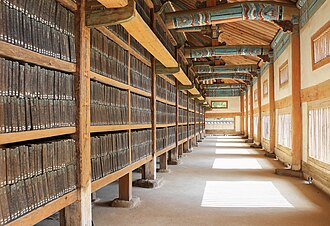
“The Tripitaka Koreana stands as one of the greatest achievements of human civilization — a monument to faith, scholarship, and extraordinary craftsmanship.”
Tucked within the ancient halls of Haeinsa Temple on the slopes of Gayasan Mountain in South Korea, an extraordinary collection of wooden printing blocks has rested in silence for nearly eight centuries. The Tripitaka Koreana — known in Korean as Palman Daejanggyeong, meaning the “Eighty-Thousand Tripitaka” — is the world’s most complete and accurate version of the Buddhist Tripitaka, the vast body of canonical Buddhist scripture. Carved onto more than 81,000 woodblocks during the Goryeo dynasty, it represents not just a religious undertaking, but one of the most ambitious intellectual and material achievements in Korean history.
For anyone seeking to understand the depth of Korea’s Buddhist heritage, the spiritual determination of the Goryeo people, and the remarkable ingenuity of medieval Korean craftspeople, the story of the Tripitaka Koreana is essential reading.
Quick Facts: The Tripitaka Koreana at a Glance
| Feature | Detail |
|---|---|
| Korean Name | Palman Daejanggyeong (팔만대장경) |
| Dynasty | Goryeo (고려) |
| Period of Carving | 1237–1248 CE |
| Number of Woodblocks | Approximately 81,258 |
| Number of Characters | Approximately 52 million |
| Current Location | Haeinsa Temple, Hapcheon, South Gyeongsang Province |
| UNESCO Status | Memory of the World (1997); Haeinsa repository — World Heritage Site (1995) |
| National Treasure | South Korea National Treasure No. 32 |
What Is the Tripitaka and Why Did Goryeo Create It?
The word “Tripitaka” comes from Sanskrit and means “Three Baskets,” referring to the three major collections of Buddhist scripture: the Vinaya (monastic rules), the Sutra (Buddha’s teachings), and the Abhidharma (philosophical analysis). Compiling and preserving the complete Tripitaka was considered an act of immense religious merit — and a declaration of a kingdom’s civilization and devotion.
The Goryeo dynasty (918–1392) was deeply Buddhist. Royal patronage of temples, monks, and scripture was woven into the fabric of governance. However, the immediate motivation behind the creation of what we now call the Tripitaka Koreana was not purely devotional — it was born from crisis.
In the 13th century, the Mongol invasions devastated the Korean peninsula. The Mongols under the successors of Genghis Khan launched repeated incursions into Goryeo, burning cities, displacing populations, and destroying cultural treasures. A first set of Tripitaka woodblocks, carved in the early 11th century during the Khitan invasions, had already been lost to fire. Facing the Mongol threat, the Goryeo court — then operating from its refuge on Ganghwa Island off the west coast — commissioned the creation of an entirely new set of woodblocks. The undertaking was both a prayer for divine protection and a defiant act of cultural preservation.
Work began in 1237 and was completed in 1248, a span of just over a decade that saw tens of thousands of craftspeople, scholars, and monks laboring in extraordinary coordination.
The Making of 81,000 Woodblocks: A Feat of Medieval Engineering
The sheer scale of the project is staggering even by modern standards. Each of the approximately 81,258 woodblocks measures roughly 70 centimeters in length, 24 centimeters in width, and about 2.6 to 4 centimeters in thickness. Both sides of each block are carved, resulting in over 160,000 carved faces in total — bearing approximately 52 million individual Chinese characters.
The production process was meticulous and technically sophisticated. The wood used was primarily birch, sourced primarily from coastal islands. After being cut, the timber was soaked in seawater for an extended period and then boiled in salt water, a treatment that helped prevent warping and insect damage. The planks were then dried slowly in the shade before being planed smooth. Only after this lengthy preparation process — which could take years — were the surfaces ready for carving.
Scholars and monks were responsible for the textual accuracy. The Goryeo editors carefully compared multiple Chinese and Korean versions of the Buddhist canon to produce the most authoritative text possible. The result was a canon renowned across East Asia for its exceptional accuracy — Chinese and Japanese monks reportedly came to Goryeo specifically to consult the text.
“Each of the 81,258 woodblocks is a testament to human patience. With approximately 52 million carved characters, not a single block was considered complete until it met exacting standards of precision and scholarship.”
After carving, each block was lacquered and its edges reinforced with copper fittings to prevent splitting. The care taken at every stage of production explains why, nearly 800 years later, the woodblocks remain in remarkable condition — still capable, in theory, of producing printed pages.
Haeinsa Temple: The Perfect Sanctuary
The woodblocks were eventually moved to Haeinsa Temple, founded in 802 CE on Gayasan Mountain in what is now South Gyeongsang Province. The storage halls built to house the collection — known as Janggyeong Panjeon — are themselves a marvel of premodern Korean architecture and environmental engineering.
The Janggyeong Panjeon complex consists of two main buildings, Sudarajang and Beopbojeon, along with two smaller structures. What makes these halls extraordinary is their passive climate control system. The builders oriented the buildings and sized their ventilation windows with careful attention to air circulation, ensuring that moisture levels within the storehouses remain naturally regulated throughout the year. The floors are made of a mixture of charcoal, salt, lime, and sand — materials that help absorb excess moisture and regulate humidity.
Modern engineers and climate scientists who have studied the Janggyeong Panjeon have expressed astonishment at its effectiveness. Despite Korea’s hot summers and cold winters, the interior conditions remain remarkably stable — protecting the woodblocks from the very deterioration that has destroyed similar collections elsewhere in Asia. This architectural achievement led UNESCO to inscribe Haeinsa’s Janggyeong Panjeon on the World Heritage List in 1995.
Three Reasons the Tripitaka Koreana Remains Significant Today
- It is the most complete and accurate version of the Buddhist canon in existence. Scholars of Buddhism worldwide consult the Tripitaka Koreana as a reference standard. Its careful editorial work, cross-referencing multiple traditions, gives it an authority unmatched by other versions of the canon. For serious students of Buddhist thought and textual history, it remains an indispensable primary source.
- It is a landmark of printing technology history. The woodblock printing tradition that produced the Tripitaka Koreana represents one of humanity’s great contributions to the transmission of knowledge. The scale and precision of the Goryeo project — predating Gutenberg’s movable type press by roughly two centuries — demonstrates the sophistication of East Asian printing technology. UNESCO recognized this by inscribing the Tripitaka Koreana on the Memory of the World Register in 1997.
- It embodies the resilience of Korean civilization. Created in the shadow of Mongol invasion and national trauma, the Tripitaka Koreana was an act of cultural defiance as much as religious devotion. That it survives — intact, accessible, and still studied — speaks to the enduring strength of Korean heritage and the extraordinary care taken by generations of monks and custodians at Haeinsa.
Comparing the Tripitaka Koreana to Other Major Buddhist Canons
| Canon | Origin | Period | Medium | Current Status |
|---|---|---|---|---|
| Tripitaka Koreana | Goryeo Korea | 1237–1248 CE | Woodblock printing | Intact; Haeinsa Temple, Korea |
| Khitan Canon (first Goryeo edition) | Goryeo Korea | Early 11th century | Woodblock printing | Destroyed by fire (Mongol invasions) |
| Yongle Canon | Ming Dynasty China | 1410–1440 CE | Manuscript / woodblock | Partially preserved |
| Pali Canon (Theravada) | Sri Lanka / Southeast Asia | 1st century BCE onward | Palm leaf manuscripts; later print | Preserved in multiple editions |
A Living Heritage: The Tripitaka Koreana Today
Haeinsa Temple continues to be an active Buddhist monastery, home to hundreds of monks. The Janggyeong Panjeon storage halls, which hold the woodblocks, are open to visitors — though access to the woodblocks themselves is restricted to protect them from humidity and handling. The sight of the storage halls, their wooden lattice windows casting geometric shadows across rows upon rows of ancient blocks, is one of the most moving experiences Korean heritage has to offer.
In recent decades, digital preservation efforts have been undertaken to ensure that the content of the Tripitaka Koreana is not vulnerable to any future physical catastrophe. High-resolution digitization projects have made the full text searchable and accessible to scholars worldwide — a modern continuation of the Goryeo monks’ original mission to preserve and transmit the Buddhist teaching.
Every year, thousands of pilgrims, scholars, and tourists make the journey to Haeinsa to witness this remarkable artifact firsthand. For Korean Buddhists, it remains a living symbol of their tradition’s depth and resilience. For historians, it is a window into the intellectual and material culture of the Goryeo dynasty at its most ambitious. And for anyone who cares about the history of human knowledge, it is simply one of the most extraordinary objects ever created.
The story of the Tripitaka Koreana is, at its heart, a story about what people do when they believe something is worth saving. Eight centuries after frightened craftsmen pressed their tools against birch wood on Ganghwa Island, their work endures — silent, patient, and intact.
Continue Exploring
On This Site
- Haeinsa Temple: Goryeo’s Spiritual Mountain Fortress
- The Goryeo Dynasty: Buddhism, Celadon, and Mongol Invasion
- Korea’s Great Buddhist Heritage Sites