“We have won an armistice on a single battleground — not peace in the world.”
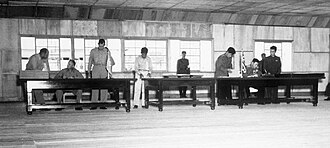
On a sweltering morning in late July 1953, military officers representing opposing sides of one of the twentieth century’s bloodiest conflicts sat down at Panmunjom, a small village straddling the border between North and South Korea, and signed a document that would define the Korean Peninsula for generations. The Korean Armistice Agreement did not end the Korean War — technically, it merely halted the fighting. But for millions of Koreans, soldiers, and civilians alike, it marked the moment when the guns fell silent after three years, one month, and two days of devastating conflict.
Understanding the armistice means understanding the war it paused, the negotiations that produced it, and the frozen conflict it created — a conflict whose consequences are still felt every single day on the Korean Peninsula.
Quick Facts: The Korean Armistice Agreement
| Detail | Information |
|---|---|
| Date Signed | July 27, 1953 |
| Location | Panmunjom, Korea |
| Signatories | UN Command, Korean People’s Army, Chinese People’s Volunteer Army |
| Duration of Korean War | June 25, 1950 – July 27, 1953 (active fighting) |
| Buffer Zone Created | Korean Demilitarized Zone (DMZ), approximately 4 km wide |
| Approximate Length of DMZ | ~250 km across the peninsula |
| South Korea’s Position | Did not sign; President Rhee Syngman opposed the agreement |
| Peace Treaty Status | No formal peace treaty has ever been signed |
The War That Made the Armistice Necessary
To understand the armistice, one must first understand how profoundly the Korean War reshaped the peninsula. When North Korean forces crossed the 38th parallel on June 25, 1950, they triggered a conflict that would draw in the United States and a coalition of United Nations member states on behalf of South Korea, and later the People’s Republic of China on behalf of the North. The fighting swept across the peninsula in dramatic swings — North Korean forces pushed deep into the South in the summer of 1950, only to be rolled back by a bold UN counteroffensive that autumn. Then Chinese intervention in late 1950 reversed the tide again, sending UN forces retreating southward in bitter winter conditions.
By mid-1951, the front lines had stabilized roughly near the 38th parallel, the original dividing line between North and South Korea. Both sides had suffered enormous casualties. Hundreds of thousands of soldiers had died. Millions of Korean civilians had been displaced, killed, or separated from their families. Cities across the peninsula lay in ruins. Yet despite this stalemate on the ground, the political will to negotiate a ceasefire was slow to develop. Armistice talks began at Kaesong in July 1951 and later moved to Panmunjom, but they dragged on for two grinding years while soldiers continued to die in battles over hills and ridgelines that would ultimately change hands in the final agreement by only marginal distances.
Why Did Negotiations Take Two Years?
The single most contentious issue delaying an armistice was not territory, not the location of the ceasefire line, but the fate of prisoners of war. The United Nations Command insisted on the principle of voluntary repatriation — that prisoners should not be forcibly returned to a country they did not wish to go back to. This was partly humanitarian in motivation and partly a significant ideological point: if thousands of North Korean and Chinese prisoners refused repatriation, it would be a powerful propaganda victory for the Western-aligned cause, demonstrating that soldiers were willing to defect rather than return home.
The Chinese and North Korean negotiators, by contrast, insisted on the return of all prisoners. To accept voluntary repatriation would be to acknowledge that their own men might prefer life under capitalism — an unacceptable admission. This deadlock over prisoners consumed the better part of two years of negotiations, even as men died in trench warfare that moved the front lines only negligibly. The impasse was eventually broken through a complex arrangement involving a neutral nations supervisory commission to oversee the prisoner exchange, allowing prisoners to choose their destination under the oversight of neutral parties.
“The armistice negotiations at Panmunjom were among the most protracted and frustrating diplomatic encounters of the Cold War era — two years of talking while men continued dying a few miles away.”
The death of Soviet leader Joseph Stalin in March 1953 is widely considered a turning point that helped break the diplomatic logjam. With Stalin gone, the Chinese and North Koreans found more flexibility in the Soviet position, and the new Eisenhower administration in Washington signaled willingness to consider using nuclear weapons if a settlement was not reached — a threat that concentrated minds on all sides. By the summer of 1953, the pieces were finally in place for a settlement.
What the Armistice Actually Said
The Korean Armistice Agreement was a detailed military document rather than a political treaty. Its core provisions established a Military Demarcation Line roughly corresponding to the front lines as they existed at the moment of signing. On either side of this line, a buffer zone approximately two kilometers wide was established — together forming the Korean Demilitarized Zone (DMZ), running approximately 250 kilometers across the peninsula. Despite its name, the DMZ became one of the most heavily fortified strips of land on Earth, bristling with mines, barriers, guard posts, and troops on both sides.
The agreement also established mechanisms for prisoner exchange, a military armistice commission to oversee compliance, and a neutral nations supervisory commission. It called for a political conference to be held within three months to resolve the broader questions of Korean unification and the withdrawal of foreign forces — a conference that was eventually held in Geneva in 1954 but produced no resolution.
Critically, the armistice was signed by military commanders: General William K. Harrison Jr. on behalf of the UN Command, and General Nam Il on behalf of the Korean People’s Army and the Chinese People’s Volunteer Army. South Korean President Rhee Syngman refused to sign. Rhee had long opposed any settlement that left Korea divided, and he dramatically attempted to derail the negotiations in June 1953 by unilaterally releasing tens of thousands of North Korean anti-communist prisoners — an act that outraged the negotiating parties on both sides but ultimately did not prevent the armistice from being concluded.
The Creation of the DMZ and Panmunjom
Of all the physical consequences of the armistice, none has been more enduring than the Demilitarized Zone. Cutting across mountains, rivers, and the ruins of communities that once bridged north and south, the DMZ froze the landscape in a kind of enforced abandonment. Over the decades, this unexpected consequence produced an extraordinary ecological reserve — a ribbon of wilderness where wildlife flourishes precisely because humans have been kept out. Rare birds, Asiatic black bears, and even the endangered Amur leopard cat have been observed within its boundaries.
Within the DMZ lies the Joint Security Area at Panmunjom, the site where the armistice was signed and where, for decades, the only face-to-face contact between North and South Korean military personnel took place. The distinctive blue buildings of the JSA, straddling the Military Demarcation Line, became one of the most recognizable and symbolically charged locations in Cold War geography. It was at Panmunjom that occasional diplomatic contacts, prisoner exchanges, and tense confrontations unfolded across the decades of armistice.
Armistice vs. Peace Treaty: A Comparison
| Feature | Armistice Agreement (1953) | Peace Treaty (Never Signed) |
|---|---|---|
| Legal Status | Military ceasefire document | Would formally end the war |
| Signatories | Military commanders only | Would require governments |
| Territorial Settlement | Ceasefire line, not a recognized border | Would define permanent borders |
| Political Questions | Deferred to future conference | Would address unification, sovereignty |
| Duration | Technically temporary | Would be permanent settlement |
| Current Status | Still in force | Does not exist |
Why the Armistice Still Matters Today
More than seven decades after it was signed, the Korean Armistice Agreement remains one of history’s most consequential unresolved documents. The Korean War has never formally ended. The two Koreas remain technically at war, separated by the DMZ, their relationship oscillating between periods of dialogue and dangerous tension. North Korea has on multiple occasions declared the armistice void or suspended, though these declarations have not been recognized by the other parties.
The armistice created the conditions for South Korea’s postwar development — the relative stability it provided, however uneasy, allowed the Republic of Korea to rebuild and eventually achieve the extraordinary economic transformation known as the Miracle on the Han River. It also locked in the division of the peninsula and the separation of millions of Korean families, a wound that has never healed. An estimated tens of thousands of separated families spent decades unable to see or even communicate with relatives on the other side of the DMZ. Occasional reunion programs, beginning in the late twentieth century, have allowed some families to meet — but the numbers are small relative to the scale of separation.
The geopolitical architecture established by the armistice — a US military presence in South Korea, the alliance structures that grew around it, the isolation of North Korea — has shaped not just Korean history but the entire strategic landscape of East Asia. Every subsequent crisis on the peninsula, every nuclear test in the North, every diplomatic initiative between Seoul and Pyongyang, takes place within a framework whose foundation was laid at a table in Panmunjom on July 27, 1953.
That document, dense with military terminology and procedural detail, was in many ways a beginning as much as an ending — the beginning of a divided Korean existence that persists to this day, a reminder that some of history’s most consequential moments are not the grand declarations of victory or defeat, but the quiet, terrible compromises that leave questions unanswered for generations.