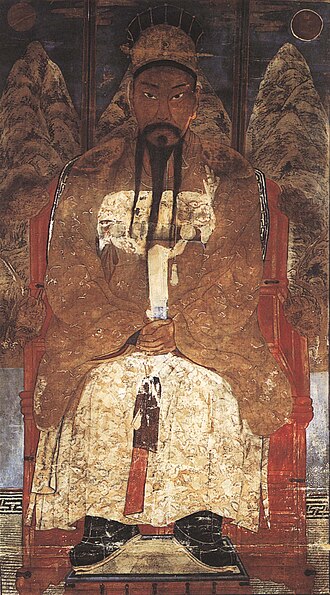
“In the beginning, Hwanung descended from heaven to the peak of Baekdu Mountain, and from his union with a bear-woman, Dangun was born — the ancestor of all Korean people.”
Few origin stories in the world are as enduring, as symbolically rich, or as politically charged as the legend of Dangun Wanggeom, the mythic founder of Gojoseon — Korea’s first kingdom. For thousands of years, this tale of divine descent, transformation, and civilizational founding has served as the spiritual and cultural bedrock of Korean identity. Whether understood as sacred history, national myth, or poetic metaphor, the story of Dangun continues to shape how Korean people understand who they are and where they come from.
Quick Facts: Dangun at a Glance
| Fact | Detail |
|---|---|
| Also Written As | Tan’gun, Dangun Wanggeom |
| Role in Legend | Founder of Gojoseon, Korea’s first kingdom |
| Traditional Founding Date | 2333 BCE |
| Father (in myth) | Hwanung, son of the Heavenly King Hwanin |
| Mother (in myth) | Ungnyeo, a bear transformed into a woman |
| Sacred Site | Baekdu Mountain (Baekdusan) |
| Earliest Written Source | Samguk Yusa (13th century CE), compiled by the monk Iryeon |
| National Founding Day | Gaecheonjeol, celebrated on October 3rd in South Korea |
The Legend of Dangun: A Story in Three Acts
The myth of Dangun has been passed down in several versions, but the most authoritative written account appears in the Samguk Yusa, a 13th-century compilation of Korean legends and history written by the Buddhist monk Iryeon. The story unfolds in three distinct movements, each carrying layers of cosmological and social meaning.
The Descent from Heaven. In the beginning, Hwanin — the Lord of Heaven — had a son named Hwanung who longed to live among humans in the world below. Hwanin, seeing that his son wished to benefit humanity, permitted him to descend to earth. Hwanung came down with three thousand followers to the peak of Baekdu Mountain, near a sacred sandalwood tree called Sindansu. He established a divine city there, calling it Sinsi, the City of God. He brought with him three heavenly ministers governing wind, rain, and clouds, and he set about ruling over three hundred and sixty human affairs — including agriculture, medicine, and moral law. This portion of the myth establishes the idea that Korean civilisation was not merely human in origin but divinely ordained and organised.
The Transformation of the Bear. At the foot of the sacred mountain lived a bear and a tiger, both of whom deeply wished to become human. They prayed to Hwanung for transformation. Moved by their sincerity, Hwanung gave them a bundle of sacred mugwort and twenty cloves of garlic, instructing them to eat only these foods and to avoid sunlight for one hundred days. The tiger, unable to endure the hardship, fled the cave. The bear persevered, and after twenty-one days was transformed into a woman — Ungnyeo, meaning Bear Woman. Ungnyeo longed for a child but had no husband. She prayed beneath the sandalwood tree, and Hwanung, taking temporary human form, married her. She became pregnant and gave birth to a son: Dangun Wanggeom.
The Founding of Gojoseon. Dangun grew up and, in the fiftieth year of the reign of the legendary Chinese Emperor Yao — traditionally dated to 2333 BCE — he established his capital, first at Pyongyang and later at Asadal on Baekdu Mountain. He named his kingdom Joseon, later referred to by historians as Gojoseon (Old Joseon) to distinguish it from the later Joseon dynasty. According to legend, Dangun ruled for an extraordinarily long time — over one thousand years — before eventually withdrawing to Asadal, where he became a mountain god.
“The bear endured where the tiger could not. In this choice, the legend encodes a timeless lesson: civilisation is built not by ferocity, but by patience, discipline, and devotion.”
Why Does the Dangun Myth Still Matter Today?
For many readers encountering this story for the first time, a reasonable question arises: why does a legend from the 13th-century written record — describing events supposedly set in 2333 BCE — continue to occupy such a central place in modern Korean culture and national identity? The answer is complex, and it touches on religion, nationalism, colonialism, and the deep human need for origin stories.
First, the myth provides Koreans with a sense of deep historical continuity. By placing the founding of the Korean nation thousands of years before the Common Era, the legend situates Korea as one of humanity’s oldest civilisations — a claim that carries enormous cultural pride. The traditional founding year of 2333 BCE is the basis for the Dangun calendar, a traditional Korean reckoning of years that counts forward from that date. In this system, the year 2024 CE corresponds to the year 4357 in the Dangun calendar.
Second, the concept of Hongik Ingan — broadly translated as “to broadly benefit the human world” or “living and acting for the benefit of all mankind” — is attributed to Hwanung as the governing philosophy he brought from heaven. This phrase became a foundational concept in Korean statecraft and education, and it remains the stated educational ideal in South Korea’s national curriculum to this day.
Third, the myth gained enormous renewed importance during and after the period of Japanese colonial rule (1910–1945). During colonisation, Japanese authorities actively suppressed Korean cultural and historical memory. In response, the Dangun legend became a rallying point for Korean nationalists and independence activists who wished to assert that Korea had its own ancient, dignified civilisation independent of and predating Chinese or Japanese influence. The religion of Cheondogyo and later the syncretic faith of Daejongism both drew heavily on Dangun mythology as expressions of Korean spiritual and cultural sovereignty.
3 Reasons the Dangun Myth Is Uniquely Korean
- The Animal Transformation Motif. While transformation myths exist in many cultures, the specific detail of a bear becoming human through patience and spiritual practice — rather than through magic or divine whim — is distinctive. It frames human civilisation as something earned through discipline, not given freely. The contrast between the patient bear and the impatient tiger reinforces a moral hierarchy that prizes endurance and steadfastness.
- The Synthesis of Heaven and Earth. Dangun is neither fully divine nor fully human. He is the son of a heavenly being and an earth-born woman. This synthesis mirrors a uniquely Korean cosmological sensibility that sees heaven, earth, and humanity not as separate realms but as fundamentally interconnected — a worldview sometimes called Cheonjiин (Heaven, Earth, Human). This tripartite harmony appears repeatedly throughout Korean philosophy, art, and architecture.
- The Mountain as Sacred Centre. Baekdu Mountain — a volcanic peak on the border of modern North Korea and China — is not merely a setting in the Dangun myth. It functions as the axis mundi, the cosmic centre of the Korean world. This sanctification of a specific geographic location bound the myth to the actual land, making it inseparable from Korean territorial and cultural identity. Baekdu Mountain remains a deeply charged symbol in both Korean states today.
Dangun in History: Myth, Memory, and Archaeology
Historians and archaeologists approach Dangun very differently from religious practitioners or nationalists. From a scholarly standpoint, Gojoseon is considered a real early Korean polity that existed in the northern Korean peninsula and Manchuria, but the dates associated with Dangun — 2333 BCE — far predate any archaeological evidence for a complex state in the region. The archaeological record suggests that Gojoseon as a recognisable political entity emerged considerably later, with some scholars placing its formation in the first millennium BCE.
The earliest written references to Dangun appear in the Samguk Yusa (1281 CE) and the Jewang Ungi (1287 CE), both compiled in the 13th century CE — thousands of years after the events they describe. This does not necessarily render the tradition historically worthless; oral traditions can preserve genuine historical memory across millennia. However, it does mean that separating mythic elaboration from historical core is extraordinarily difficult.
In North Korea, the regime of Kim Il-sung took the remarkable step in 1993 of claiming that archaeologists had discovered the tomb of Dangun near Pyongyang. The North Korean government asserted that skeletal remains found at the site were those of Dangun himself, and they subsequently reconstructed the tomb on a grand scale as a national monument. International archaeologists have greeted this claim with deep scepticism, viewing it as a politically motivated attempt to legitimise the North Korean state by anchoring it to Korea’s most ancient mythic ancestor.
Gaecheonjeol: Celebrating the Opening of Heaven
In South Korea, the founding of Gojoseon by Dangun is commemorated annually on October 3rd as Gaecheonjeol — the National Foundation Day, whose name literally translates as “the day heaven opened.” It is one of South Korea’s five national public holidays. On this day, ceremonies are held at Chamseongdan, an ancient altar at the summit of Manisan on Ganghwa Island, a site traditionally associated with Dangun himself. The altar is believed to have been built by Dangun, and it remains one of the most sacred sites in Korean folk and religious tradition.
The holiday is not merely symbolic. It is a living expression of the belief — held by many Koreans across many generations — that their nation was born from a covenant between heaven and earth, and that the values Hwanung brought from the sky — care for humanity, moral governance, and civilised order — remain the proper foundations of Korean society.
Continue Exploring
- Dangun — Wikipedia: Full entry on the legendary founder of Gojoseon
- Encyclopedia of Korean Culture (AKS) — Authoritative Korean cultural and historical reference
- Tangun — Encyclopaedia Britannica: Overview of the Dangun legend
- UNESCO World Heritage — Explore Korea’s heritage sites connected to its ancient past
- Asia Society — Korean History and Culture: Educational resources on Korean civilisation
- Visit Korea — Explore Manisan and Ganghwa Island’s sacred Dangun sites