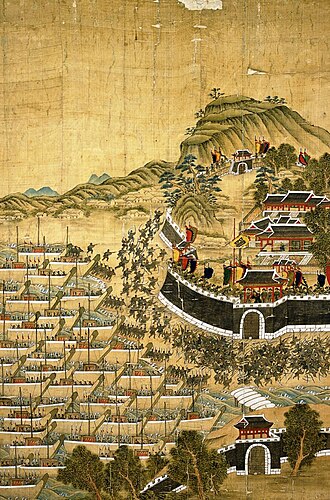
“The enemy came like a tide, and the land was consumed in fire — yet Korea endured.”
Few events in Korean history were as catastrophic — or as ultimately defining — as the Imjin War (임진왜란, Imjin Waeran). Stretching from 1592 to 1598, this series of Japanese invasions tore through the Korean peninsula, devastating cities, displacing millions, and drawing in the might of Ming Dynasty China. The war is named after the imjin year in the traditional Korean calendar cycle, the year the first invasion began. It reshaped the balance of power across East Asia and left wounds on the Korean peninsula that took generations to heal.
For English-speaking readers exploring Korean history, the Imjin War offers a profound lens through which to understand Korean resilience, the complexity of early modern East Asian geopolitics, and the stories of remarkable individuals — soldiers, admirals, monks, and farmers — who rose to defend their homeland.
Quick Facts: The Imjin War at a Glance
| Fact | Detail |
|---|---|
| Dates | 1592–1598 |
| Korean Name | 임진왜란 (Imjin Waeran) |
| Aggressor | Japan under Toyotomi Hideyoshi |
| Defenders | Joseon Korea, Ming Dynasty China |
| First Invasion | 1592–1593 (called Imjin Waeran) |
| Second Invasion | 1597–1598 (called Jeongyu Jaeran) |
| Key Naval Hero | Admiral Yi Sun-sin |
| Outcome | Japanese withdrawal following Hideyoshi’s death in 1598 |
Why Did Japan Invade Korea in 1592?
The architect of the invasion was Toyotomi Hideyoshi, the powerful warlord who had unified Japan after decades of civil war. His stated ambition was nothing less than the conquest of Ming China, and Korea — geographically positioned as the natural land bridge between Japan and the Asian continent — was to be his corridor. When the Joseon court refused to grant Japanese forces passage, Hideyoshi launched a full-scale invasion.
In the spring of 1592, a Japanese force estimated at over 150,000 soldiers crossed the Korea Strait and landed at Busan. The Joseon military, long at peace and underprepared for such a massive assault, was rapidly overwhelmed. Within weeks, the capital Hanyang (modern Seoul) had fallen. King Seonjo fled northward toward the Chinese border, a humiliating retreat that stunned the Korean populace and shook faith in the Joseon court.
Japanese forces swept northward with alarming speed. Well-armed with firearms acquired through contact with Portuguese traders in the decades prior, Japanese infantry units outpaced the military technology available to most Joseon forces. The early weeks of the war were defined by a series of rapid Korean defeats on land.
Admiral Yi Sun-sin and the Turtle Ships
Yet the war’s story was far from one-sided. On the seas, the Joseon navy — under the command of Admiral Yi Sun-sin — achieved a remarkable series of victories that fundamentally disrupted Japanese supply lines and strategic plans.
Yi Sun-sin is today celebrated as one of the greatest naval commanders in world history. Operating with inferior numbers, he employed superior tactics, detailed intelligence gathering, and innovative warship design to defeat Japanese naval forces repeatedly. Among the vessels associated with his fleet was the geobukseon, or turtle ship — an armored warship whose distinctive covered deck made it exceptionally difficult to board and whose powerful cannons allowed it to engage enemy fleets at range.
“I have twelve ships remaining. I do not believe the enemy will dare to look down upon me.”
Yi’s victories at battles including Hansan Island in 1592 prevented Japan from establishing reliable naval supply routes along Korea’s western coast. Without secure supply lines, the Japanese land advance began to stall. Control of the sea proved to be as decisive as any battle fought on land.
The Role of Ming China and the Righteous Army
As Japanese forces advanced toward the Yalu River border with China, the Ming Dynasty recognized the existential threat and dispatched an army to assist Joseon. The arrival of Ming forces in 1593 stabilized the front, and a combination of Chinese military pressure and determined Korean resistance forced the Japanese to retreat southward. Negotiations for peace followed, though they ultimately collapsed, leading to the second invasion in 1597.
Alongside the formal military response, ordinary Koreans mounted a remarkable grassroots resistance. Known as the uibyeong, or Righteous Army, these were volunteer militia units formed by Confucian scholars, Buddhist monks, farmers, and local leaders who refused to accept occupation. Fighting in guerrilla engagements across the peninsula, the Righteous Army harassed Japanese supply lines, ambushed garrisons, and kept resistance alive even when formal military structures had collapsed.
Buddhist monk-soldiers, defying the Confucian-dominated Joseon court’s long suppression of Buddhism, took up arms in significant numbers. Figures such as the monk Hyujeong organized monastic fighters who contributed meaningfully to the war effort, a fact that somewhat improved the standing of Korean Buddhism in the aftermath of the conflict.
3 Ways the Imjin War Changed Korea Forever
1. Demographic and Agricultural Catastrophe
The human cost of the Imjin War was staggering. Years of campaigning, famine, and displacement decimated the Korean population. Agricultural land was burned or abandoned across wide swaths of the peninsula. The fiscal and administrative capacity of the Joseon state was severely weakened, and it would take decades for the population and economy to recover to pre-war levels. Many skilled Korean artisans — particularly potters whose craft was highly prized in Japan — were forcibly taken to Japan, a loss that impacted Korean material culture for a generation.
2. The Reshaping of East Asian Power
The war exhausted not only Korea but also Japan and China. The enormous expense of the Ming military campaign in Korea contributed to financial pressures that weakened the dynasty over the following decades. In Japan, Hideyoshi’s death in 1598 triggered a succession crisis that would culminate in the Battle of Sekigahara in 1600 and the rise of the Tokugawa shogunate. The Imjin War, in other words, was a catalyst that helped reshape the entire political order of East Asia in the early seventeenth century.
3. A Lasting Cultural Memory
Perhaps most enduringly, the Imjin War became embedded in Korean cultural identity as a defining moment of suffering and survival. Admiral Yi Sun-sin became a national hero of the highest order — his statue stands today in central Seoul. The war produced a rich body of literature, painting, and oral tradition. Shrines and commemorations for those who died in resistance dot the Korean landscape. The experience of invasion, resistance, and survival continues to resonate in Korean historical consciousness.
Comparison: The Two Invasions
| Feature | First Invasion (1592–1593) | Second Invasion (1597–1598) |
|---|---|---|
| Korean Name | Imjin Waeran (임진왜란) | Jeongyu Jaeran (정유재란) |
| Japanese Force Size | Estimated 150,000+ | Estimated 140,000+ |
| Initial Japanese Success | Rapid advance; capital fell within weeks | Slower; met stronger resistance |
| Naval Situation | Yi Sun-sin dominant from early stages | Yi briefly removed; reinstated after defeat at Battle of Chilchonryang |
| End of Invasion | Negotiations following Ming intervention | Japanese withdrawal after Hideyoshi’s death (1598) |
| Final Battle | Pyongyang recaptured by Ming-Korean forces | Battle of Noryang; Yi Sun-sin killed in final engagement |
The Death of Yi Sun-sin: A Bittersweet Victory
The war’s final act came at the Battle of Noryang in the winter of 1598. Following Hideyoshi’s death that autumn, Japanese forces began withdrawing from the Korean peninsula. A combined Korean-Ming naval force intercepted the retreating Japanese fleet in the straits of Noryang. The battle was a decisive allied victory — but it cost Korea its greatest hero. Admiral Yi Sun-sin was struck by a bullet during the fighting and died. His reported last words were a request to conceal his death so that it would not discourage his men, a story that has become one of the most celebrated moments in Korean historical memory.
Yi’s death at the moment of final victory gave the end of the Imjin War a bittersweet, almost mythic quality that has only deepened his legendary status across the centuries since.
Legacy: Why the Imjin War Still Matters
The Imjin War occupies a place in Korean historical consciousness comparable to the role that events like the Norman Conquest or the Hundred Years’ War play in European memory. It was a rupture — a before and after — that tested the Joseon state and Korean society to their absolute limits. Out of that crucible came not only suffering but stories of extraordinary courage: the naval genius of Yi Sun-sin, the grassroots defiance of the Righteous Army, the sacrifice of monks who took up arms for their country, and the quiet endurance of farmers and families who rebuilt their lives from ashes.
For historians, the war also serves as a vital case study in early modern East Asian international relations, the limits of tribute-system diplomacy, and the way in which the introduction of firearms technology reshaped military balance across the region.
Visiting Korea today, traces of the Imjin War are everywhere — in the fortresses that line the southern coast, in the shrines to local heroes, in the name of streets and the faces on banknotes. It is history that has never fully receded into the past.
Continue Exploring
On This Site
- Admiral Yi Sun-sin: Life, Legacy, and the Turtle Ships
- The Joseon Dynasty: Korea’s Last Royal House
- Korea’s Mountain Fortresses: Heritage of Defense