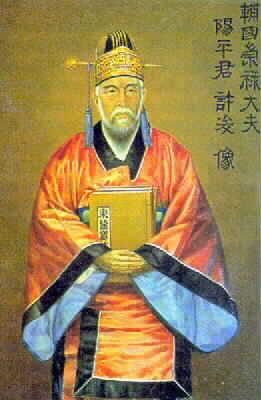
“Medicine must be accessible to all people, not only those who can afford foreign remedies.”
In the long history of Korean civilization, few figures have left a mark as enduring as Heo Jun (허준), the royal physician of the Joseon dynasty who dedicated his life to making medicine available to every Korean, regardless of social standing. Born in the 1530s and dying in 1615, Heo Jun lived through one of the most turbulent periods in Korean history — including the devastating Japanese invasions known as the Imjin War — and yet managed to produce a medical masterpiece that would be consulted by healers across East Asia for generations.
His great work, the Dongui Bogam (동의보감, Principles and Practice of Eastern Medicine), completed in 1613, is not merely a medical text. It is a cultural monument: a systematic effort to document the full body of Korean and Chinese medical knowledge, written in a form that local practitioners and even ordinary people could use. In 2009, UNESCO recognized the Dongui Bogam by inscribing it on the Memory of the World Register, confirming its place as one of humanity’s shared intellectual treasures.
Quick Facts: Heo Jun and the Dongui Bogam
| Detail | Information |
|---|---|
| Full Name | Heo Jun (허준); also romanized as Hŏ Chun |
| Born | 1530s, Joseon Korea (present-day Seoul area) |
| Died | 1615 |
| Occupation | Royal court physician (内醫院, Royal Medical Office) |
| Clan | Yangcheon Heo clan |
| Major Work | Dongui Bogam (동의보감), completed 1613 |
| UNESCO Recognition | Memory of the World Register, 2009 |
| Historical Period | Joseon dynasty; served during the Imjin War (1592–1598) |
Who Was Heo Jun? A Physician Born Between Two Worlds
Heo Jun came from the Yangcheon Heo clan, a lineage with aristocratic roots in Joseon society. He rose through the ranks of the Joseon medical establishment to serve as a physician in the Royal Medical Office (內醫院), the institution responsible for the health of the royal family and the court. His talent and dedication brought him into close proximity with King Seonjo, one of Joseon’s most significant monarchs, under whose patronage the great medical project was eventually commissioned.
Life in Joseon Korea during Heo Jun’s time was defined by rigid social hierarchies, but medicine was one of the rare fields where skilled practitioners of relatively humble or irregular birth could achieve distinction. Heo Jun navigated this world with evident skill, earning the trust of the court while never losing sight of the needs of common people — a tension that would shape the philosophy embedded in his masterwork.
The Imjin War, Japan’s invasions of Korea beginning in 1592, shattered the stability of the Joseon state. Disease ravaged soldiers and civilians alike, and the disruption of trade routes cut Korea off from Chinese medical supplies and texts. It was precisely this crisis that underscored the urgent need for a comprehensive Korean medical encyclopedia — one based on locally available herbs and treatments that did not depend on expensive imports from China.
Why Did Heo Jun Write the Dongui Bogam?
The origins of the Dongui Bogam project lie in a royal command. King Seonjo ordered Heo Jun to compile a definitive Korean medical encyclopedia, recognizing that Korea needed a systematic record of its own medical traditions. The king’s directive was clear: document indigenous Korean herbal remedies alongside the classical Chinese medical canon, and write the work in a way that could be understood and used throughout the peninsula.
What made this commission revolutionary was its explicit democratizing ambition. Korea possessed abundant medicinal plants and herbs, but much of the knowledge about them was fragmented, passed down informally among local healers, or buried in Chinese-language texts accessible only to educated elites. Heo Jun’s task was to gather, verify, and organize this knowledge — and critically, to provide Korean vernacular names for medicinal ingredients alongside their Chinese classical names. This meant that a local herbalist or rural healer who could not read classical Chinese could still identify and use the remedies described.
“The Dongui Bogam was not written for scholars alone — it was written for the people of Korea, in a language and format they could use.”
Heo Jun worked on the project for many years, experiencing interruptions caused by the Imjin War itself. The compilation was completed in 1613, near the end of his life, and first printed in 1613. The work runs to 25 volumes, organized into sections covering internal medicine, external medicine, miscellaneous disorders, and pharmacology — a structure that reflects both the Chinese medical tradition and Heo Jun’s own systematic genius.
3 Reasons the Dongui Bogam Changed Korean History
1. It Systematized Korean Medical Knowledge
Before the Dongui Bogam, medical knowledge in Korea was scattered across dozens of texts, many of them Chinese, and much practical knowledge existed only in oral tradition. Heo Jun brought all of this together into a single, organized reference work. The 25 volumes covered the full range of medical conditions recognized in East Asian medicine, from diagnosis to treatment, from acupuncture to herbal pharmacology. For the first time, Korean practitioners had a comprehensive, authoritative guide written with the Korean context in mind.
2. It Privileged Local Korean Remedies
One of the most significant decisions Heo Jun made was to systematically document Korean vernacular names for medicinal plants and substances alongside their classical Chinese equivalents. This was far more than a linguistic convenience — it represented an assertion that Korean medicine, rooted in the Korean landscape and Korean healing traditions, was a legitimate and sophisticated tradition in its own right. The very title, Dongui Bogam — “Principles and Practice of Eastern Medicine” — reflected this confidence in a distinctly Korean medical identity.
3. Its Influence Extended Across East Asia
The Dongui Bogam was not only influential within Korea. After its initial publication, the work was reprinted multiple times and circulated widely in China and Japan, where it was recognized as a major contribution to East Asian medical literature. Its influence persisted for centuries, and it remained a foundational reference text in traditional Korean medicine well into the modern era. UNESCO’s 2009 inscription on the Memory of the World Register acknowledged this lasting international significance.
Heo Jun’s Legacy: From Royal Court to Cultural Icon
Heo Jun died in 1615, just two years after completing his masterwork. His legacy, however, proved extraordinarily durable. In modern Korea, he is remembered not merely as a historical physician but as a symbol of dedication to the public good — a man who used his privileged position at the royal court to serve ordinary Koreans.
That reputation was powerfully reinforced in popular culture. A celebrated South Korean television drama, Heo Jun, broadcast in 1999–2000, introduced his life story to millions of viewers and sparked widespread renewed interest in traditional Korean medicine. The drama’s enormous popularity reflected a deeper cultural pride in Korea’s indigenous medical traditions — traditions that Heo Jun had done more than anyone else to preserve and systematize.
In the realm of traditional Korean medicine (한의학, hanuihak), the Dongui Bogam continues to be studied and referenced. It stands as the foundational text of a medical tradition that remains a living part of Korean healthcare, practiced alongside Western medicine throughout the country today.
Comparison: Heo Jun’s Dongui Bogam and Other East Asian Medical Classics
| Work | Origin | Period | Scope | Distinctive Feature |
|---|---|---|---|---|
| Dongui Bogam | Korea (Joseon) | Completed 1613 | 25 volumes; internal, external, pharmacology | Korean vernacular herb names; indigenous focus |
| Bencao Gangmu (Compendium of Materia Medica) | China (Ming dynasty) | Completed 1578 | 52 volumes; comprehensive Chinese pharmacology | Largest pre-modern Chinese pharmacological text |
| Huangdi Neijing (Yellow Emperor’s Classic) | China | Compiled circa 2nd century BCE–1st century CE | Foundational theory of Chinese medicine | Theoretical basis for all East Asian medicine |
This comparison illustrates both the debt that Heo Jun’s work owed to the Chinese medical tradition and the ways in which the Dongui Bogam represented a distinctly Korean contribution — systematizing local knowledge in a form accessible to Korean practitioners rather than simply transmitting Chinese learning.
Visiting the Legacy: Where to Encounter Heo Jun’s World Today
For those interested in experiencing Heo Jun’s legacy firsthand, Korea offers several meaningful connections to his life and work. The Joseon-era medical tradition is documented in collections at the National Museum of Korea in Seoul, which holds historical medical instruments and texts. The tradition of traditional Korean medicine is explored at specialist museums and clinics throughout the country.
The neighborhood of Yangcheon in Seoul, associated with Heo Jun’s clan, maintains local heritage connections to the physician. Scholars and enthusiasts of traditional Korean medicine can also access digital and physical editions of the Dongui Bogam through major Korean libraries and the Academy of Korean Studies, which maintains extensive resources on Joseon intellectual history.
UNESCO’s Memory of the World Register entry for the Dongui Bogam can be explored through the UNESCO website, providing an international perspective on why this work is considered part of humanity’s shared documentary heritage.
Continue Exploring
- Hŏ Chun — Wikipedia: Comprehensive overview of Heo Jun’s life and medical career
- Encyclopedia of Korean Culture (AKS): Scholarly articles on Joseon medicine and the Dongui Bogam
- Dongui Bogam — Wikipedia: Detailed entry on the structure, history, and influence of Heo Jun’s masterwork
- Tongŭi pogam — Britannica: Britannica’s account of the Dongui Bogam and its historical context
- UNESCO World Heritage: Explore Korea’s entries on the UNESCO Memory of the World Register
- National Museum of Korea: Collections related to Joseon-era culture, science, and medicine