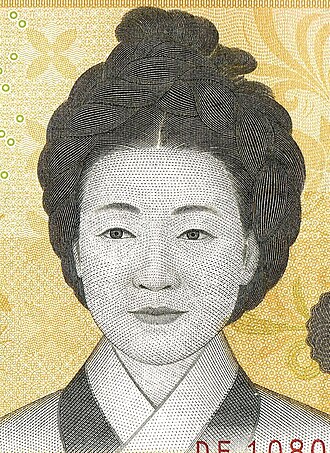
“She was not merely a virtuous mother — she was a painter, a poet, and a calligrapher whose brush moved with the force of genuine genius.”
In a society where Confucian ideals placed women firmly within the domestic sphere, Shin Saimdang defied expectation at every turn. Born in 1504 in Gangneung, on the eastern coast of the Korean peninsula, she became one of the most celebrated artists, calligraphers, and poets of the Joseon Dynasty. Her life was a remarkable intersection of intellectual brilliance and cultural achievement — and her legacy has only grown in the centuries since her death in 1551.
Today, Shin Saimdang’s face graces the 50,000 won banknote, making her the first woman to appear on a South Korean currency note. It is a fitting honor for a woman whose work bridged the personal and the profound, the domestic and the artistic, in ways that continue to resonate with audiences across the world.
Quick Facts: Shin Saimdang at a Glance
| Detail | Information |
|---|---|
| Born | 1504, Gangneung, Joseon Korea |
| Died | 1551 |
| Clan | Pyongsan Shin clan |
| Known For | Painting, calligraphy, poetry |
| Era | Joseon Dynasty (16th century) |
| Notable Son | Yi I (Yulgok), renowned Confucian scholar |
| Modern Legacy | Featured on the 50,000 won banknote |
A Childhood Shaped by Learning and Landscape
Shin Saimdang was born into the Pyongsan Shin clan, a family that valued learning and supported her intellectual development from an early age. Growing up in Gangneung — a city nestled between the Taebaek Mountains and the East Sea — she was immersed in the natural world that would later define much of her artistic output. The landscapes of the Gangneung region, with their dramatic coastlines, vivid insects, birds, and flowering plants, appear again and again in her paintings.
From childhood, Shin Saimdang demonstrated an extraordinary aptitude for the arts. She studied painting and calligraphy with a dedication that was unusual for women of her time and social position. Her early works showed a precocious talent: she reportedly began copying the works of master painters as a young girl, developing a style that was simultaneously technically refined and deeply personal.
Her father recognized her gifts and actively encouraged her education — a fact that set her apart from many of her female contemporaries, whose access to learning was far more restricted. This parental support gave Shin Saimdang a foundation of confidence and craft that would sustain her throughout her life.
Why Is Shin Saimdang Considered Korea’s Greatest Female Artist?
The question is worth pausing on, because Shin Saimdang’s reputation rests not on a single masterwork but on the extraordinary breadth and consistency of her artistic achievement. She excelled across multiple disciplines — painting, calligraphy, and poetry — at a time when mastery of even one of these arts was considered a remarkable accomplishment.
Her paintings of insects, grapes, orchids, and birds are particularly celebrated. Working in a style rooted in the Korean and Chinese literati painting traditions, she brought an intimacy and observational precision to her subjects that set her work apart. Her depictions of grasshoppers, butterflies, and watermelons are executed with a naturalistic tenderness, capturing not just the appearance of her subjects but something of their vitality.
“Her brush did not simply record the natural world — it celebrated it, finding in a cluster of grapes or the wing of a dragonfly the same spiritual resonance that scholars sought in classical texts.”
In calligraphy, Shin Saimdang was equally accomplished. She mastered multiple scripts and was praised by contemporaries for the elegance and strength of her brushwork. Her calligraphic style reflected her deep engagement with the Confucian literary tradition, even as her life quietly challenged some of its more restrictive prescriptions for women.
As a poet, she wrote verses that expressed longing, love for nature, and the emotional textures of daily life. Her poetry, written in classical Chinese — the prestige literary language of the Joseon educated class — demonstrates a command of form and imagery that earned her recognition among the male literary scholars of her era.
3 Reasons Shin Saimdang’s Legacy Has Endured for Five Centuries
1. The Quality and Range of Her Surviving Works
Unlike many women artists of the premodern world whose works were lost, attributed to others, or simply never preserved, a substantial body of work attributed to Shin Saimdang has survived. Her paintings of insects and plants in particular have been treasured by collectors and institutions for generations. This survival is itself a testament to the esteem in which her contemporaries and successors held her work. The existence of these tangible artistic objects has allowed scholars and the public alike to encounter her genius directly, rather than through the filter of historical description alone.
2. Her Role as the Mother of Yi I (Yulgok)
Shin Saimdang was the mother of Yi I, known by his pen name Yulgok, one of the most important Confucian philosophers in Korean history. Yi I’s own prominence brought renewed attention to his mother’s life and work, and she became celebrated not only as an artist but as the exemplary Confucian mother who had shaped a great mind. This dual identity — brilliant artist and devoted mother — allowed her legacy to navigate the complex gender expectations of Joseon society. She was admired on terms that the culture found legible, even as the actual substance of her achievement was extraordinary by any measure. Yi I himself also appears on Korean currency, on the 5,000 won note, making the mother-son pair a unique presence in Korea’s everyday life.
3. Her Symbolic Power in Modern Korea
The decision to place Shin Saimdang on the 50,000 won banknote — introduced in 2009 — was a deliberate act of cultural recognition. She became the first woman to appear on South Korean currency, a moment that sparked widespread public conversation about the role of women in Korean history and cultural memory. Her face on the banknote ensured that her name and image entered the consciousness of every South Korean in a way that no museum exhibition or academic paper could achieve. In an era of growing interest in women’s history and gender equality, Shin Saimdang became a focal point for broader national conversations.
Life Within the Joseon Social Order
To understand Shin Saimdang fully, it is essential to appreciate the world she inhabited. The Joseon Dynasty was a deeply Confucian society in which women’s lives were governed by strict codes of conduct. The ideal woman was expected to be obedient to her father before marriage, to her husband after marriage, and to her son in widowhood. Public life, scholarship, and artistic expression were largely reserved for men of the educated elite class known as the yangban.
Shin Saimdang navigated this world with remarkable skill. She married Yi Won-su, a government official, and bore several children, fulfilling the social expectations placed upon women of her class. Yet she continued to paint, write, and practice calligraphy throughout her married life, maintaining an artistic identity that was recognized and respected even within the constraints of her era.
Her relationship with her family in Gangneung was also notable. She is said to have maintained close ties with her natal family throughout her life, spending considerable time in Gangneung even after marriage — an arrangement that was somewhat unusual for the period and that speaks to the particular circumstances and values of her family.
Shin Saimdang and the Art of Her Time: A Comparison
| Aspect | Shin Saimdang | Typical Male Literati Artist of Joseon |
|---|---|---|
| Access to Education | Supported by family; largely self-directed | Formal education through state institutions and private academies |
| Subject Matter | Insects, plants, grapes, birds; intimate natural world | Landscapes, mountains, Confucian allegories |
| Public Recognition (in lifetime) | Praised but within domestic sphere | Recognized in public literary and artistic circles |
| Posthumous Fame | Grew substantially; now iconic national figure | Varied; many figures largely forgotten |
| Calligraphic Tradition | Multiple scripts; praised for elegance | Central to public career and identity |
The Gangneung Connection: Place as Identity
Gangneung, the city of Shin Saimdang’s birth and childhood, remains deeply connected to her memory. The Ojukheon — a historic house in Gangneung that was the birthplace of both Shin Saimdang and her son Yi I — is now a major cultural heritage site. Visitors to Ojukheon can explore the rooms where Korea’s most celebrated female artist spent her formative years, surrounded by the bamboo groves that give the house its name.
The Ojukheon site includes a museum dedicated to Shin Saimdang and Yi I, where visitors can view reproductions of her paintings and learn about her life in historical context. The house itself is one of the oldest wooden residential structures surviving in Korea, lending an architectural dimension to the experience of her legacy.
For visitors to Korea’s east coast, Gangneung offers a rare opportunity to walk in the footsteps of one of the country’s most extraordinary historical figures — in a landscape that clearly shaped her artistic sensibility and her understanding of the natural world.
A Legacy Written in Ink and Currency
Shin Saimdang died in 1551, at a time when she had already earned recognition as an artist of exceptional ability. In the centuries that followed, her reputation only deepened. She was invoked as a model of Confucian womanhood — devoted mother, faithful wife — but also celebrated as a creative genius whose work transcended the social categories that defined her world.
The tension between these two identities — the idealized Confucian woman and the genuine artistic innovator — is precisely what makes Shin Saimdang so compelling a historical figure. She did not choose between artistry and domesticity; she inhabited both fully, at a cost and with a grace that we can only partially reconstruct from the evidence she left behind.
Her paintings of grapes and grasshoppers, her calligraphic scrolls, her poems in classical Chinese — these are not curiosities or footnotes to Joseon history. They are primary documents of a remarkable human intelligence engaging with the world on its own terms. And her face on the 50,000 won note is a daily reminder that Korean history has always included women whose contributions deserve to be seen, named, and honored.
Continue Exploring
On This Site
- The Joseon Dynasty: An Introduction to Korea’s Last Royal Era
- Yi I (Yulgok): The Confucian Scholar Who Shaped Korean Thought
- Ojukheon House: Walking Through History in Gangneung