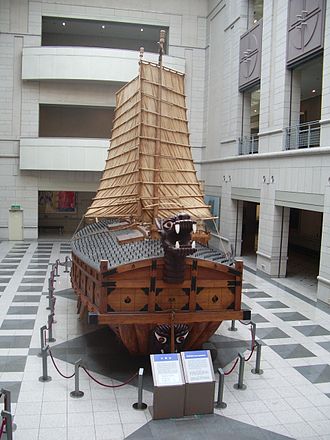
“The enemy will not easily dare to attack us directly.” — A sentiment embodied by the turtle ship, Korea’s iron-clad wonder of the 16th century.
Few weapons in history have captured the imagination quite like the geobukseon — the turtle ship of Joseon Korea. Deployed during one of the most dramatic military campaigns in East Asian history, this extraordinary vessel became a symbol of Korean ingenuity, resilience, and the genius of Admiral Yi Sun-sin. At a time when Japan’s forces seemed unstoppable, the turtle ship helped turn the tide of the Imjin War and cement a place in history that resonates to this day.
Quick Facts: The Turtle Ship at a Glance
| Fact | Detail |
|---|---|
| Korean Name | 거북선 (Geobukseon) |
| Era of Use | Joseon Dynasty, primarily 1592–1598 |
| Key Commander | Admiral Yi Sun-sin |
| Conflict | Imjin War (Japanese invasions of Korea) |
| Type | Armored warship (oar and sail powered) |
| Notable Feature | Covered deck with iron spikes; multiple cannon ports |
The World That Built the Turtle Ship
To understand the turtle ship, one must first understand the crisis that demanded it. In 1592, Japan’s warlord Toyotomi Hideyoshi launched a massive invasion of the Korean peninsula, sending hundreds of thousands of troops across the Korea Strait. The Joseon court, long at peace, was ill-prepared for such an onslaught. Japanese forces swept northward with alarming speed, capturing the capital Hanyang (present-day Seoul) within weeks.
At sea, however, the story was different. Korea’s southern naval commander, Yi Sun-sin, had spent the months before the invasion preparing his fleet and refining a new kind of warship — one that would prove devastatingly effective against Japanese naval tactics. The result was the turtle ship, an armored vessel unlike anything the region had seen.
The design drew on earlier Korean naval traditions. Records suggest that a precursor to the turtle ship existed as early as the reign of King Taejong in the early 15th century, though the vessel Yi Sun-sin developed and deployed was a more sophisticated evolution of this concept. By the time Japanese fleets arrived in Korean waters, Yi’s shipwrights had constructed a weapon that would shock and confound the invaders.
What Made the Turtle Ship So Formidable?
The turtle ship’s name came from its distinctive shape. The vessel featured a covered, rounded upper deck that resembled the shell of a turtle — a design that was as practical as it was striking. This armored roof protected the oarsmen and soldiers within from arrows, fire, and the boarding tactics that Japanese naval fighters favored. According to historical accounts, the cover was studded with iron spikes to prevent enemy soldiers from leaping aboard and taking control of the vessel.
The ship was propelled by both oars and sails, giving it considerable maneuverability in the coastal and island-studded waters of southern Korea. It was equipped with multiple cannon ports on its sides, bow, and stern, allowing it to deliver devastating firepower in multiple directions simultaneously. The exact number of cannons varied, but the ship was designed to be an offensive, close-range weapon that could ram into enemy formations and fire at point-blank range.
One of the most debated features of the turtle ship is the dragon-headed prow. Historical records describe a carved dragon’s head at the bow that could emit smoke — possibly from burning materials placed inside — to obscure the ship’s movements and intimidate enemies. Whether this was a regular battlefield tactic or an occasional device remains a subject of scholarly discussion, but the psychological impact of such imagery should not be underestimated in the context of 16th-century warfare.
“The turtle ship was not merely a weapon — it was a statement. A declaration that Korea’s defenders would meet aggression with innovation, and courage with craft.”
3 Battles That Proved the Turtle Ship’s Worth
1. The Battle of Sacheon (May 1592)
The turtle ship made its combat debut at the Battle of Sacheon in May 1592. Yi Sun-sin led his fleet, including at least one turtle ship, against a Japanese naval force in the harbor. The armored vessel charged into the Japanese fleet, absorbing arrows and projectiles that would have devastated an unprotected ship. Yi’s forces won a decisive victory, and the turtle ship emerged from its baptism of fire as a proven weapon of war. Yi himself was wounded by a bullet during the engagement but continued to direct the battle.
2. The Battle of Dangpo (June 1592)
Less than a month after Sacheon, Yi engaged Japanese forces again at Dangpo. The turtle ship once more played a leading role, using its cannon fire to devastating effect against Japanese vessels. Korean forces destroyed numerous enemy ships and killed thousands of Japanese sailors and soldiers. The pattern of Korean naval dominance was becoming clear: on land, Japan held the advantage; at sea, Yi Sun-sin and his fleet, anchored by the turtle ship, were nearly invincible.
3. The Battle of Hansan Island (August 1592)
Often considered the greatest naval engagement of the Imjin War, the Battle of Hansan Island saw Yi Sun-sin deploy his famous crane-wing formation to encircle and destroy a large Japanese fleet. The turtle ship led the initial charge to draw the Japanese forces out into open water, where Korean cannon fire proved overwhelming. The engagement was a catastrophic defeat for Japan’s naval forces and effectively ended any serious threat of a Japanese naval offensive for the remainder of the first invasion. Some historians compare the strategic significance of Hansan Island to that of the Battle of Midway or Trafalgar — a naval turning point that reshaped the entire campaign.
How Did the Turtle Ship Compare to Other Warships of Its Era?
| Feature | Turtle Ship (Korea) | Japanese Atakebune | European Galleon (16th c.) |
|---|---|---|---|
| Armored Deck | Yes (iron spikes) | Partial | No |
| Primary Tactic | Ram and cannon fire | Boarding and archery | Broadside cannon |
| Propulsion | Oar and sail | Oar and sail | Sail |
| Anti-boarding Design | Yes (covered deck) | No | No |
This comparison underscores just how revolutionary the turtle ship’s design was. Japanese naval tactics in the 1590s relied heavily on bringing ships alongside enemy vessels and sending soldiers over the side to fight hand-to-hand. The turtle ship’s covered, spiked deck made this approach suicidal. Japanese soldiers who tried to board found themselves impaled, while Korean cannon fire tore through their exposed hulls from close range.
Why Is Admiral Yi Sun-sin Inseparable From the Turtle Ship’s Legacy?
It is impossible to discuss the turtle ship without discussing the man who made it famous. Yi Sun-sin is widely regarded as one of the greatest admirals in world history, and his association with the turtle ship is central to his legend. Yet it is worth noting that Yi commanded a larger fleet in which the turtle ship was one element — a powerful vanguard and shock weapon, but not the only instrument of his victories.
Yi’s genius lay in his tactical creativity, his insistence on preparation, and his ability to exploit the geographical realities of Korea’s southern coastline. He understood that the narrow channels, shifting tides, and rocky islands of that region favored a defender who knew the terrain. The turtle ship, compact and maneuverable, was perfectly suited to this environment.
Yi Sun-sin was killed at the Battle of Noryang in December 1598, the final major engagement of the Imjin War. As Japanese forces retreated, a combined Korean and Ming Chinese fleet pursued them, and Yi was struck by a bullet. His reported last words urged those around him to conceal his death until the battle was won. He died in victory, and his legacy became inseparable from Korea’s sense of national survival and dignity.
Today, a towering statue of Yi Sun-sin stands in Gwanghwamun Square in central Seoul, and his image appears on the Korean 100-won coin. The turtle ship itself has become one of the most recognizable symbols of Korean history, reproduced in museums, textbooks, and popular culture across the country and beyond.
Mysteries and Debates That Endure
Despite the turtle ship’s fame, historians continue to debate several key questions about its construction and capabilities. No original turtle ship survives — all existing replicas are reconstructions based on historical records, many of which are incomplete or contradictory. The exact dimensions of the vessel, the precise nature of its armor (some records suggest iron plating over the deck, though others describe a wooden cover with iron spikes), and the number of cannons it carried remain subjects of ongoing scholarly discussion.
The question of whether the turtle ship should be considered the world’s first ironclad warship is particularly contentious. Some Korean historians and enthusiasts make this claim, pointing to descriptions of iron plating on the deck. Western historians generally reserve the title of first ironclad for vessels like the USS Monitor and CSS Virginia of the American Civil War era (1862), arguing that true ironclad status requires iron hull plating, not merely an armored deck. The debate reflects broader questions about how we define technological firsts and how we situate non-Western innovations within global history.
What is beyond dispute is that the turtle ship was an extraordinary achievement of 16th-century naval engineering — a vessel designed with a clear tactical purpose, refined through practice, and deployed with remarkable effectiveness at a moment of national crisis.
Continue Exploring
Deepen your understanding of the turtle ship, Admiral Yi Sun-sin, and the Imjin War with these resources:
- Turtle Ship — Wikipedia: A comprehensive overview of the vessel’s history, design, and battles.
- Admiral Yi Sun-sin — Wikipedia: The life and campaigns of Korea’s greatest naval commander.
- Encyclopedia of Korean Culture (AKS): Scholarly articles on Joseon-era military history and naval technology.
- Turtle Ship — Britannica: A concise, authoritative introduction to the geobukseon.
- National Museum of Korea: Explore artifacts and exhibits related to the Joseon Dynasty and the Imjin War.
- Asia Society: Resources on Korean history and its place in the broader story of East Asia.